Oni
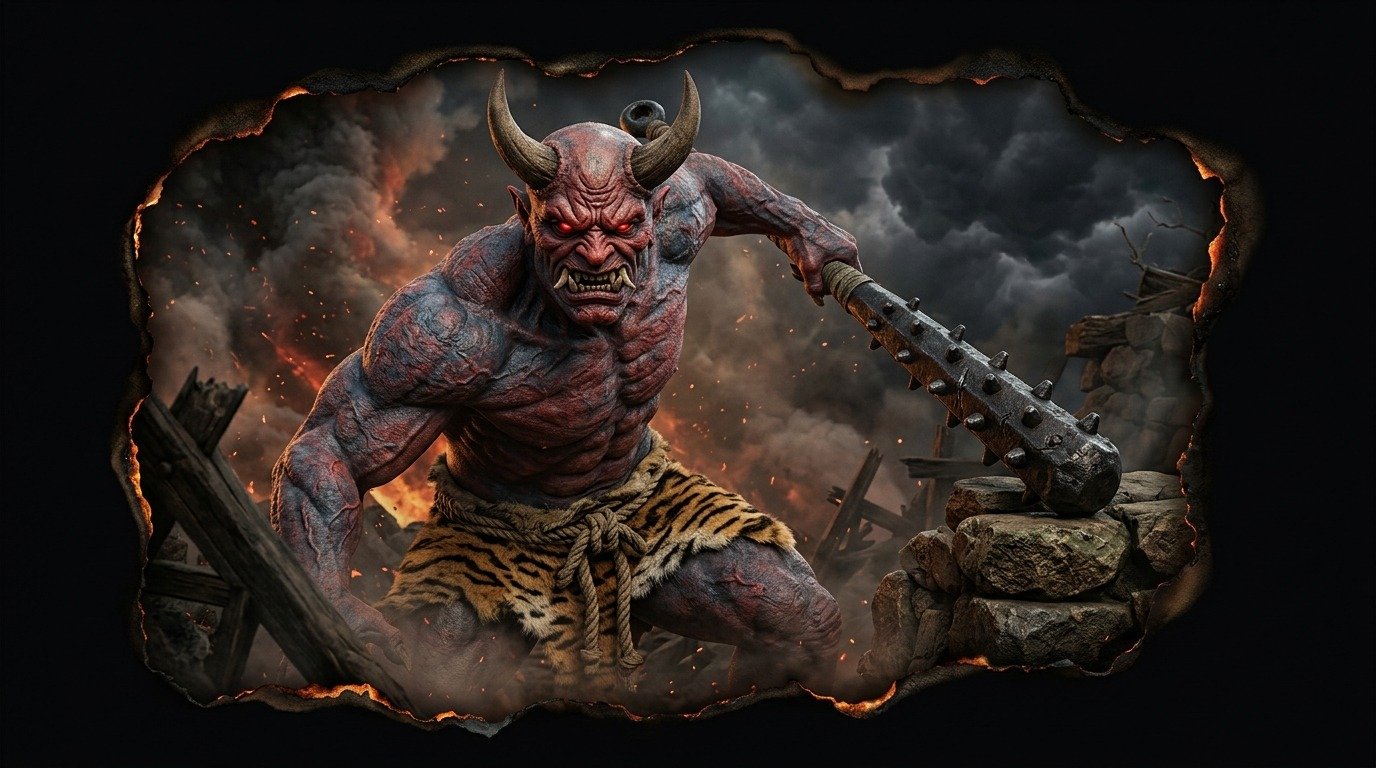
Oni: The Giant of Transgressions and Materialized Wrath
Origin and Legend
The etymology of the word *Oni* (鬼) traces back to the classical Chinese term for designating the spirits of the dead or invisible entities (*on* or *oku*, denoting concealment or the invisible). In early Japan, before the adoption of Chinese writing, the word referred to untamed spirits of nature, the forces of chaos, epidemic diseases, and natural disasters that ravaged agricultural communities with no apparent cause. With the introduction of Buddhist cosmology in the 6th century, especially through the concept of Buddhist hells (*Jigoku*), the form of the Oni materialized and acquired its canonical physiognomy. They became the torturers and guardians of the underworld, under the orders of Enma-ō (the king of the judgment of the dead). In this synthesis, the Oni adopted the physical traits of Sanskrit *rakshasas*: giants of colossal proportions, with red, blue, or ash-green skin, bulging eyes, sharp fangs protruding from their mouths, and keratinous horns on their foreheads, wearing only tiger-skin loincloths and carrying a spiked iron club called a *kanabō*.
Historical and Regional Evolution
The classical iconographic configuration of the Oni was consolidated through the system of *Onmyōdō* (esoteric astrology and geomancy). According to this discipline, the northeast direction is known as the "Demon Gate" (*Kimon*), a highly unstable quadrant through which the energies of chaos penetrate the physical plane. In the Chinese zodiac wheel, this direction is represented by the transition between the Ox (*Ushi*) and the Tiger (*Tora*). Hence, the Oni possesses the horns of the ox and tiger-skin clothing, a perfect geomantic codification of spatial instability. In the Heian period, Oni were seen as tangible threats that raided the streets of the capital, Heian-kyō, during twilight. Famous legends such as that of Shuten-dōji, the king of the Oni who dwelt on Mount Ōe, describe these creatures as anthropophagous bandits of immense mystical power who kidnapped nobles to devour them. The eradication of Shuten-dōji by the warrior Minamoto no Yorimitsu (Raikō) using a sacred sword and mystical poison symbolizes the victory of state order and Buddhism over the marginal and barbaric forces of the frontiers unsubjugated by the Emperor. With the passage of the centuries, the figure of the Oni was integrated into popular seasonal exorcism rituals, such as *Setsubun* (the beginning of spring), where roasted soybeans are thrown to drive away demons to the cry of *"Oni wa soto! Fuku wa uchi!"* ("Demons out! Fortune in!").
Esoteric or Symbolic Meaning
In deep esoteric and psychological analysis, the Oni is the crystallization of the most destructive unconscious impulses of the human psyche: uncontrolled anger, insatiable greed, poisonous jealousy, and sadistic violence. Unlike illusory or subtle entities, the Oni is dense matter, pure physical force without intellectual refinement. It is karmic punishment made flesh; the personification of self-generated suffering caused by the individual's moral transgressions. Likewise, there is the process of "becoming an Oni" in life (*Oni-ka*). In the dramaturgy of Noh theater (especially in the *Hannya* mask), it is illustrated how the extreme jealousy or hatred of a scorned woman can transmute her physical and spiritual physiognomy, causing her to sprout horns and transforming her into a demon thirsty for vengeance. The Oni teaches that hell is not just a post-mortem destination, but an ontological state constructed through the systematic repetition of destructive acts.
Manifestation and Protocols of Exorcism and Containment
The outbreak of Oni energy in domestic or communal spaces manifests through epidemic outbreaks of irrational anger, collective physical violence, deformities in livestock births, and an atmospheric heaviness in the northeast corners of properties. To counteract and repel these gigantic entities, the following traditional methods are employed: * **Purification by Soybeans (*Mame-maki*):** Roasted soybeans possess, according to *Onmyōdō*, the energetic signature of the Metal element in its purest and most concentrated state, which cuts and destroys the distorted wood upon which the Oni's wrath feeds. * **Use of Apotropaic Plants:** Placing holly branches with dried sardine heads (*Hiiragi Iwashi*) on door thresholds. The thorns of the holly blind the Oni's eyes, while the stench of the decomposing sardine disturbs its acute sense of smell, preventing its entry. * **Use of Oni-gawara:** In the architecture of temples and noble residences, terminal roof tiles carved with the face of an angry Oni are placed. Much like the Western gargoyle, this "evil against evil" acts as a spiritual lightning rod, deflecting harmful external influences by confronting them with an image of equal or greater ferocity. ---
Comments
Share information, an experience, or a source to help enrich this entry. They are automatically reviewed before being published.
Loading comments...