Nekomata
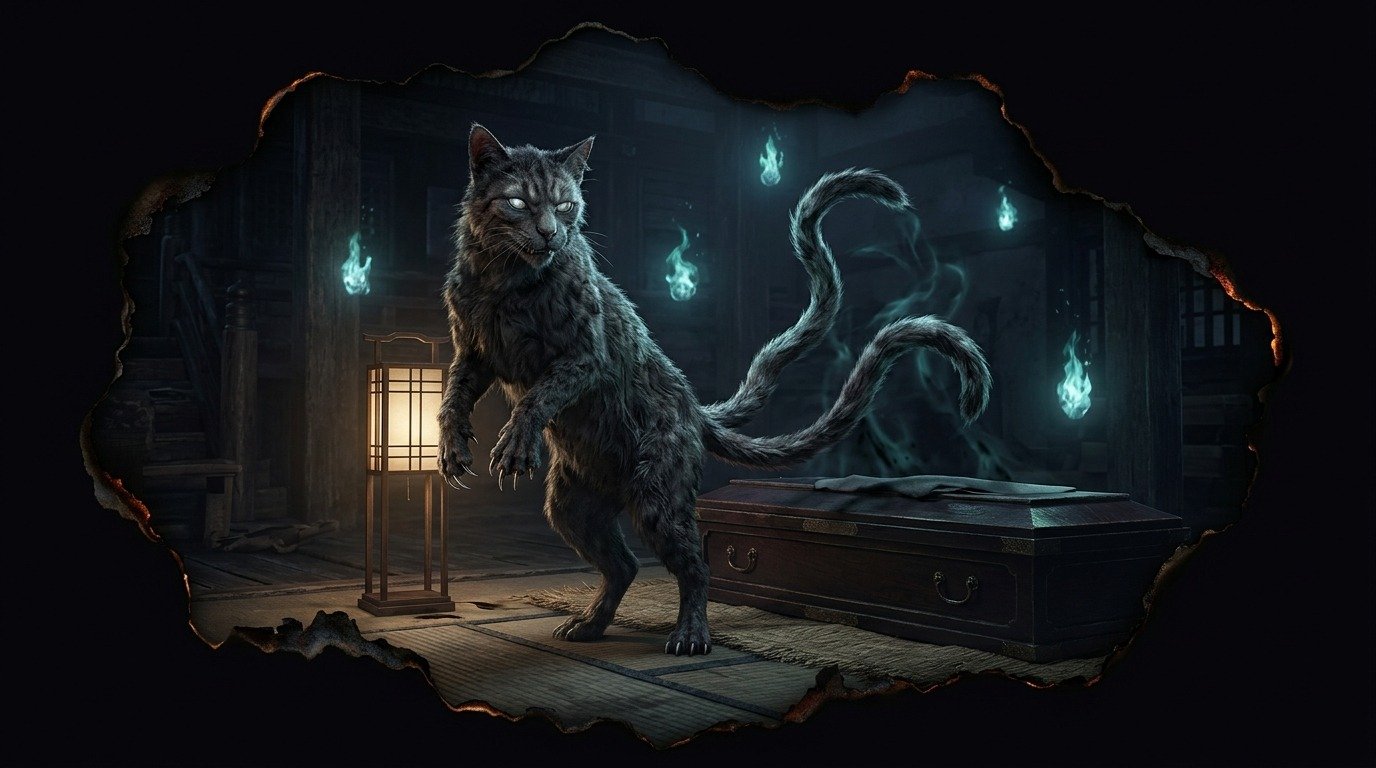
Nekomata: The Bifurcation of the Feline and the Shadow
Genesis of the Forked Tail
The Nekomata (猫股 or 猫又) represents one of the darkest and most complex stages of the transmutation of domestic animals in Japanese folklore. Unlike other animal spirits, the myth of the Nekomata is divided into two lineages clearly differentiated by their ecology and history: the wild beasts of the mountains and the domestic felines that undergo a metamorphosis due to extreme longevity. The central belief holds that when a domestic cat exceeds forty or fifty years of age (or reaches an unusual weight of one *kan*, approximately 3.75 kg (8.27 lbs)), its tail begins to split vertically from the tip to the base, dividing into two identical and mobile tails. This physical process externalizes the splitting of its soul: the animal has ceased to belong to the sphere of ordinary nature and has entered the realm of the *yōkai*. From that moment on, it walks on its hind legs, learns the language of men, and acquires advanced necromantic abilities.
Variants: From Mountain Beasts to Household Demons
The first documented mention of the creature does not belong to domestic folklore, but to the historical chronicles of the aristocracy. In the *Meigetsuki* (The Record of the Full Moon), written by the courtier Fujiwara no Teika in the early thirteenth century (Kamakura period), it describes with dread how a Nekomata descended from the mountains of Yamato Province and killed several people in a single night. These "mountain Nekomata" (*senzan no nekomata*) were described as wild beasts the size of leopards, with gleaming eyes and iron claws, that devoured straggling travelers. Conversely, the urban or domestic Nekomata, popularized in the Edo period through works such as the *Tosa Obake Zōshi*, is a conspiratorial entity. It hides in the shadows of the home, consumes the oil of lamps (*andon*)—which in ancient times was extracted from fish, explaining the feline's natural attraction—and uses its two tails as whips to manipulate the flow of fire and stagnant spiritual energy. Its resentment toward its former owners usually translates into acts of domestic sabotage or direct violence.
Esotericism of the Threshold of Death and Necromancy
From an esoteric perspective, the Nekomata is the absolute lord of the threshold of physical death. The bifurcation of its tail represents the duality of the plane of the living and that of the dead. In Japanese sympathetic magic, the Nekomata is feared for its ability to reanimate fresh corpses. By jumping over a coffin or waving its forked tails over a lifeless body, it infuses a fraction of its own dark *ki* into the corpse, controlling it like a puppet to perform malevolent tasks or attack the living. This link with necromancy and spiritual fire (*kitsunebi* or *onibi*) places the Nekomata in a higher category than that of a simple transformed animal (*bakeneko*). While the *bakeneko* seeks to imitate human life to integrate or play pranks, the Nekomata operates with a cold and calculated malice, seeking the subversion of the natural order and control over ancestors who have not been properly buried.
Safeguard Measures and Omens
To neutralize the influence of a potential Nekomata within a residential or ritual environment, Japanese tradition prescribes several practical and mystical defenses: 1. **Preventive amputation (historical)**: During the Edo period, the custom of docking the tails of kittens became popular to prevent them from splitting over the years and giving rise to the creature. Although cruel, this reveals the social panic that the entity inspired. 2. **Detection by behavior**: If an old cat shows an unusual interest in the oil of ancestral altars (*Butsudan*), or if it is heard emitting meows with human voice inflections, it must be closely monitored. Leaving it alone with corpses before funeral rites (*otsuya*) must be avoided. 3. **Use of consecrated salt (*Morishio*)**: Placing cones of purified sea salt in the corners of the deceased's room blocks the entry of the Nekomata and its ability to manipulate the souls of the recently departed.
Comments
Share information, an experience, or a source to help enrich this entry. They are automatically reviewed before being published.
Loading comments...