Kitsune
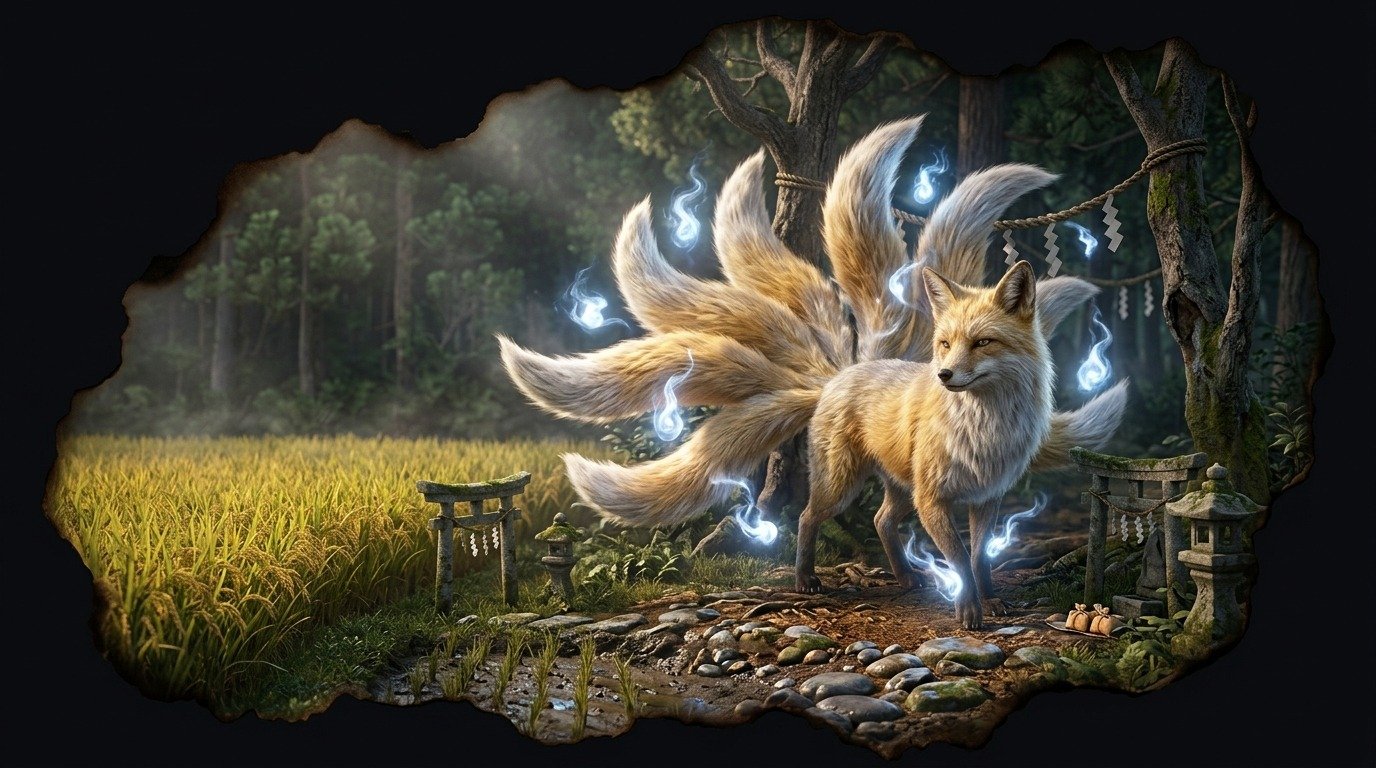
Kitsune: The Messenger of the Fields and the Weaver of Illusions
Origin and Legend
The figure of the Kitsune (the mythical Japanese fox) is a complex tapestry of indigenous zoolatry, Shinto animism, and continental influences imported from China and Korea starting in the 6th century CE. In classical Chinese texts, such as the *Shan Hai Jing* (Classic of Mountains and Seas), the existence of the nine-tailed fox (*Huli jing*) is already documented—a creature of omen that could be both auspicious and destructive. Upon taking root in the Japanese archipelago, this creature merged with local agricultural deities, becoming the primary emissary of Inari Okami, the divinity of rice, fertility, and worldly success. Shinto folklore divides these beings into two fundamental categories: the *Zenko* (benevolent or celestial foxes), directly associated with the service of Inari, devoid of malice and bringers of blessings; and the *Yako* or *Nogitsune* (field or wild foxes), free spirits prone to mischief, deceit, and even malevolence toward humans. The accumulation of power and wisdom in a Kitsune manifests physically in the multiplication of its tails; each century of life adds an appendage until reaching the limit of nine (*Kyūbi no Kitsune*), at which point its fur turns golden or silver-white, and it acquires omniscient clairvoyance.
Historical and Regional Evolution
Throughout the Heian (794–1185) and Kamakura (1185–1333) periods, the Kitsune transitioned from being a numinous herald to an entity feared for its capacity for spiritual possession, a pathological and mystical phenomenon known as *Kitsunetsuki*. Historical records document exorcisms practiced by esoteric Buddhist monks (*Shugendō*) and masters of *Onmyōdō* (the Way of Yin and Yang) to rid young women of the influence of these spirits, who supposedly entered the body through the fingernails or the chest. During the Edo period (1603–1867), with urbanization and the flourishing of popular literature and Kabuki theater, the perception of the Kitsune diversified. Legends of fox-wives (*Kitsune Nyōbō*) emerged, where a fox assumes the form of a virtuous woman to marry a human out of love, fleeing only when her true nature is discovered by a dog or a physical oversight (such as revealing her tail while sleeping). In parallel, in the agricultural regions of Tohoku and Kyushu, there persisted a fear of *Kitsune-mochi* (fox-owning families), lineages accused of employing familiar spirits to enrich themselves at the expense of their neighbors, which generated severe social ostracism and marriage bans that lasted well into the 20th century.
Esoteric or Symbolic Meaning
From the perspective of archetypal psychology and Shinto esotericism, the Kitsune embodies the absolute fluidity of form and the illusion of the phenomenal world (*Maya*). It represents the threshold between the wild and the civilized, the sacred and the profane. The fox seals the alliance between the deep forest and the cultivated field; it is the custodian of the earth's vital energy that allows germination, but which demands a tribute of respect and offerings (such as *aburaage*, or fried tofu, considered its favorite food). On the initiatory plane, the metamorphosis of the Kitsune symbolizes the transmutation of lower matter into subtle spirit. Its sacred fires, the *Kitsunebi* (fox-fires), are not physical combustion, but the externalization of its concentrated *reiki* (spiritual energy). The Kitsune teaches that reality is not a monolithic block, but a fabric of perceptions that the adept can shape if they master the art of the mind and the will.
Manifestation, Warnings, and Protection Protocols
The presence of a Kitsune in its human form is usually betrayed by subtle anomalies: the inability to pronounce certain complex words, an instinctive and uncontrollable fear of canids, the reflection of a zoological form in water or in polished bronze mirrors, and an androgynous or hypnotic beauty that disturbs the judgment of the observer. To counteract the influence of a *Kitsunetsuki* or to protect a space from the illusions of a *Nogitsune*, traditional exorcists resorted to the following protocols: * **Pacification Offerings:** Installing a small altar (*Kamidana*) consecrated to Inari, flanked by two stone or ceramic foxes carrying the key to the granary in their mouths, appeases the disturbing energies of the place. * **Protection Amulets (*Ofuda*):** Employing calligraphed talismans from Shinto shrines of high solar vibration, such as Fushimi Inari-Taisha, placed on the beams of the home. * **The Use of the Dog:** Keeping domestic canids of noble lineage (such as the Akita or Shiba Inu) within the boundaries of the settlement, as their barking instantly breaks the veil of illusion of any Kitsune and forces its retreat in its original form.
The Kumiho and the Tenko
The origin of this myth feeds on the local folklore of pre-Buddhist Japan, enriched by the influence of Chinese myths about the *Huli Jing* (the nine-tailed fox spirit) and Korean tales of the *Kumiho* (a notably more carnivorous and perverse variant). Unlike the Western fox, an exclusive symbol of petty cunning, the Japanese Kitsune embodies the sacred duality of nature: it can be a benevolent guardian, a mystical master, or a ruthless trickster capable of ruining entire empires through deceit. Upon reaching a millennium of existence, the Kitsune ascends to the rank of *Tenko* (Heavenly Fox), acquiring omniscience and immortality. The *Zenko* are pure white in color, protect temples, and bring abundance to devotees of Inari; the *Yako* or *Nogitsune*, with common fur, delight in deceiving arrogant Buddhist monks, seducing unsuspecting travelers, and possessing human beings to feed on their vital force.
The Mastery of Illusion
At an esoteric and psychological level, the Kitsune represents the force of *Maya* (cosmic illusion) and the power of transformation (*Henge*). They master the art of *Genjutsu* (illusion techniques so perfect that they deceive all physical senses). A Kitsune can transform dry leaves into shiny gold, dilapidated huts into sumptuous palaces, and itself into a woman of dazzling beauty, a wise old man, or a young monk. This ability to shapeshift symbolizes the fluidity of the soul and the falsehood of the appearances of the material plane. The Kitsune exposes human hypocrisy: its deceptions rarely fall upon just and humble people; on the contrary, they select as victims the greedy, the lustful, and the arrogant, using their own impure desires as the rope with which they are to hang themselves.
The Kitsunetsuki: Symptoms and Exorcism
Considered for centuries as a real illness in Japan (and even cataloged in Japanese clinical psychiatry until the early 20th century as a culture-bound psychosis), Kitsunetsuki occurs when a *nogitsune* enters the body of a victim, usually through the fingernails or the chest. * **Symptomatology:** The possessed person shows a radical change in personality; their eyes narrow slightly, they develop an obsessive preference for fried tofu (*aburaage*), they show an unusual cunning for deceit, they speak languages they did not know, and their voice acquires a high-pitched, hissing tone resembling a yip. In addition, a moving lump usually manifests under the victim's skin, shifting autonomously. * **Traditional Exorcism:** To free a victim of Kitsunetsuki, the protocol requires the intervention of Shinto priests of the Yoshida Shinto lineage or monks of esoteric Buddhist sects (such as Shingon or Nichiren Buddhism). The ritual involves the burning of sandalwood incense and the recitation of protective sutras combined with the use of sacred salt. The exorcist must interrogate the fox to discover its name and the reason for its grievance. Once the spirit reveals its complaint (which often involves the destruction of a local shrine or the mistreatment of one of its animal descendants), it is offered compensation in the form of food offerings at an Inari temple in exchange for leaving the body of the possessed, warning it that, if it does not comply, it will be consumed by the sacred fire of ascetic rituals (*Shugendō*).
Comments
Share information, an experience, or a source to help enrich this entry. They are automatically reviewed before being published.
Loading comments...