Inari
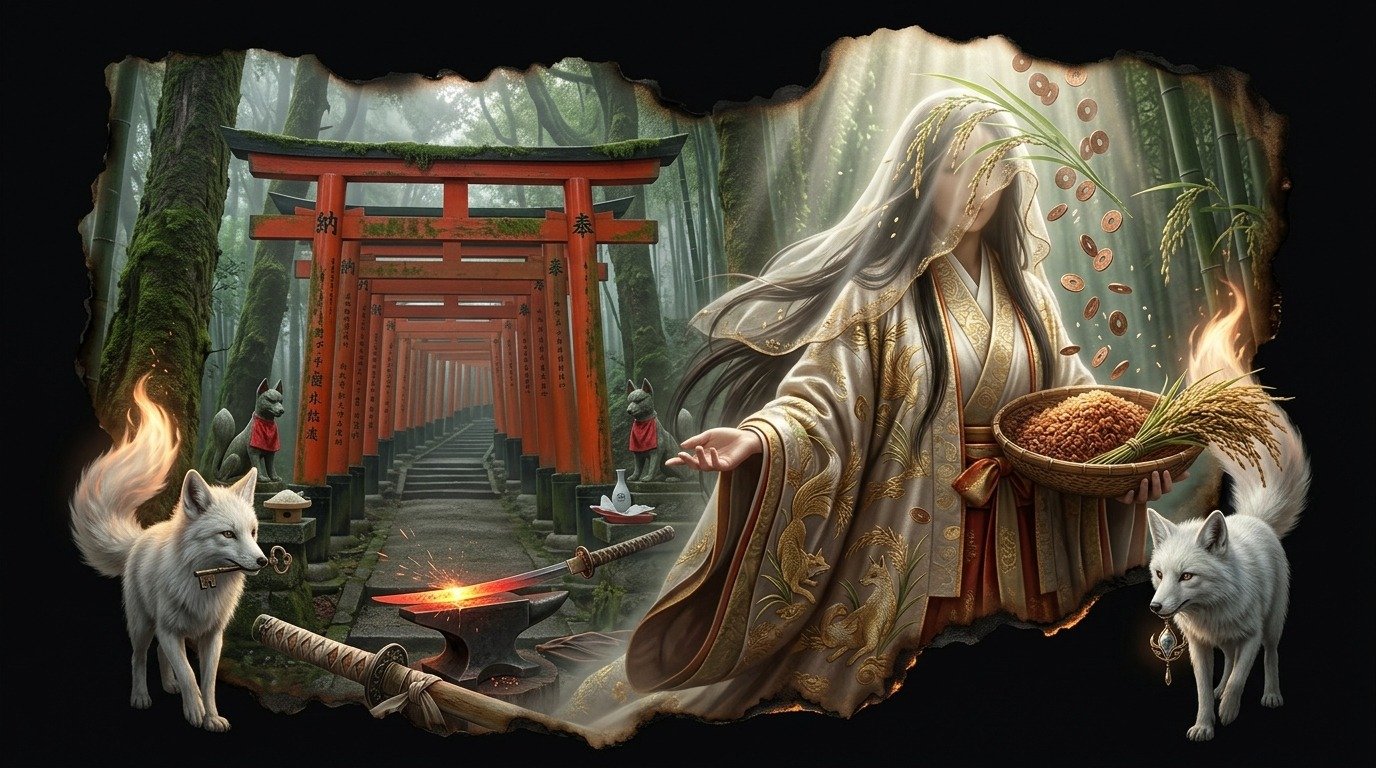
Inari Ōkami: The Whisper of the Fox and the Sprout of the Earth
The Deity with No Fixed Face
Inari is the presence that dwells in the rustle of rice leaves and the gleam of copper coins. It does not possess a single form, but rather manifests according to the needs of those who seek it: sometimes it is a venerable old man laden with sacks of grain, other times a beautiful woman with long hair wrapped in silk robes, or even a stream of light descending from the sacred mountains. It is the deity of sustenance, success, and constant transformation.
Its worship originated in the forested hills of southern Kyoto, where farmers discovered that the earth responded with prodigious fertility to the offerings placed at the roots of ancient trees. Over the centuries, as society changed, Inari left the cultivated fields to enter the workshops of blacksmiths, the teahouses of the cities, and the offices of great merchants, demonstrating a unique plasticity to bless any human activity that required effort and generated prosperity.
The White-Furred Messengers
The mortal world connects with Inari's palace through the *kitsune*, celestial foxes with snow-white fur and tails that glow with sacred fire. These animals are not the deity itself, but rather its divine emissaries, jealous guardians of its temples and cultivated fields. Inari's foxes carry in their mouths bronze keys that open imperial granaries, jewels representing the soul of the harvests, or scrolls of parchment containing esoteric secrets.
A sacred bond exists between these messengers and humans. It is said that the foxes watch the intentions of those who approach the shrines; they reward honesty and generosity with unexpected strokes of fortune, but severely punish the greedy and those who harm nature, bewildering them with illusions and mental labyrinths from which they can never escape.
Tempered Steel and the Tide of Vermilion
Inari's power is manifested not only in the softness of the rice grain, but also in the rigor of the fiery arts. The blacksmith Munechika, commissioned by the emperor to forge a sword of unparalleled power, found himself without a worthy assistant to strike the metal at the same rhythm as his hammer. Desperate, he prayed at Inari's temple. From the shadows of the shrine emerged a mysterious youth who joined the task. Together, to the beat of superhuman strength, they forged the sacred sword Kogitsune-maru. Upon completing the work, the youth vanished, revealing his true identity as an emissary of the deity who had guided the hammer to temper the perfect steel.
Today, the path to Inari is a physical and spiritual trail defined by the color vermilion. Thousands of wooden gates, called torii, line up one after another, forming vibrant tunnels that ascend the sacred mountains. Each of these gates is a thanksgiving offering from a merchant, a farmer, or a family who received the blessing of prosperity. To walk beneath their shadow is to step into the womb of the deity, where the scent of incense, wet stone, and the protective silence of the foxes promise that abundance always returns to those who work the land with respect.
Comments
Share information, an experience, or a source to help enrich this entry. They are automatically reviewed before being published.
Loading comments...