Jorōgumo
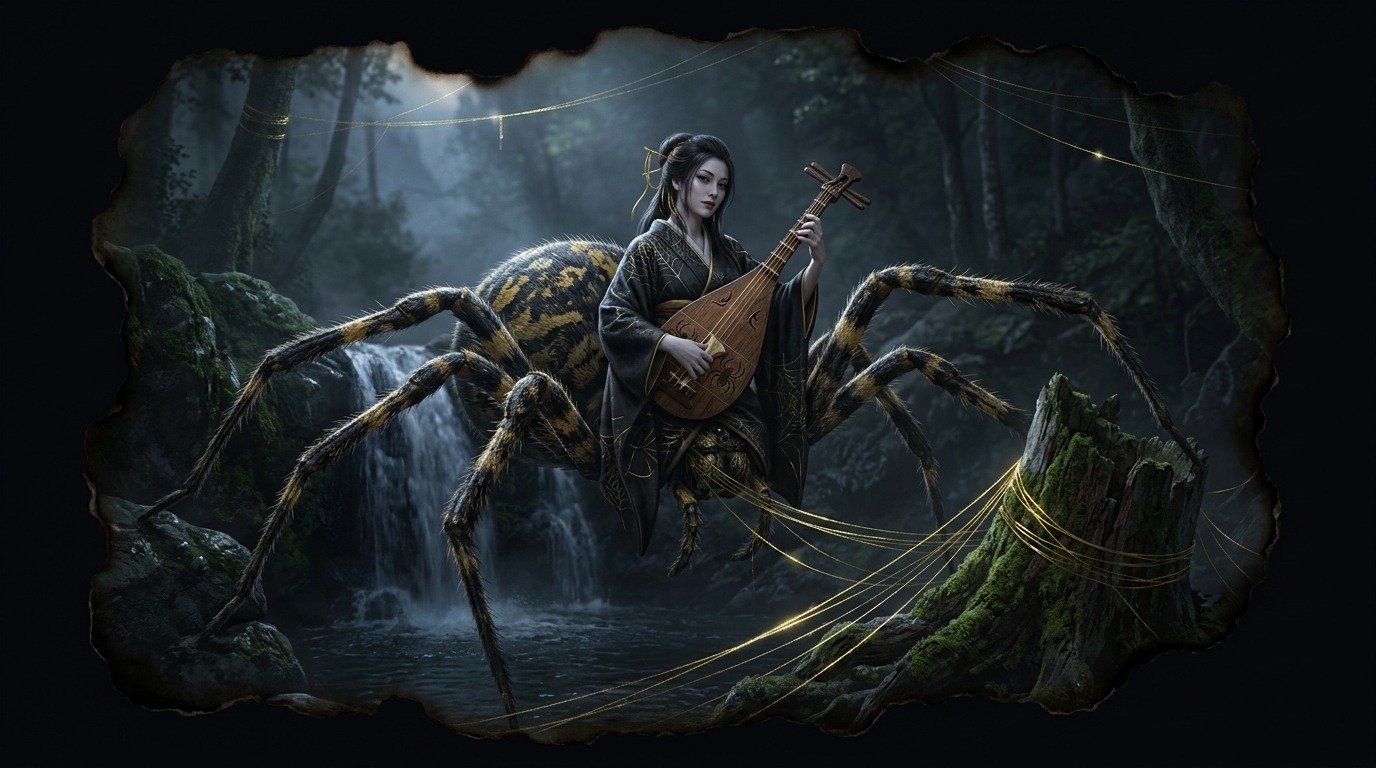
Jorōgumo: The Weaver of Destiny and Flesh
Origin and Nature of the Weaver
The Jorōgumo (絡新婦, "entangling bride", or 女郎蜘蛛, "courtesan spider") finds its roots at the intersection of descriptive zoology and the animism of Japan's Edo period. The myth originates from the golden silk spider (*Trichonephila clavata*), a real specimen whose threads possess a golden luster and unusual strength. In Japanese folklore, it is believed that when one of these spiders reaches four hundred years of age, its accumulation of *ki* (vital energy) and cunning allows it to undergo a physical transmutation, acquiring the ability to shapeshift at will.
The usual manifestation of the Jorōgumo is that of a woman of breathtaking beauty, refined and intelligent, who frequents pleasure districts or isolated areas near bodies of water. Under this disguise, she seduces young, vigorous men, luring them to her dwelling with *biwa* music or carnal promises, only to later wrap them in cocoons of undetectable silk and slowly consume them. In her true form, she retains the upper torso of an anthropomorphic woman fused with the opisthosoma and the eight jointed limbs of a giant spider.
Regional Legends and Variants of the Thread
The geographical dispersion of the myth reveals significant variations in the entity's nature. At the Jōren-ji temple, by the Jōren Falls (Izu), the Jorōgumo is not merely a man-eating monster, but the tutelary deity of the watery abyss. In this variant, a logger accidentally drops his axe into the water, and a beautiful woman emerges from the depths to return it to him, demanding under pain of death that he never reveal her existence. Years later, upon breaking his oath while in a drunken state, the logger falls into an eternal sleep from which he never wakes, demonstrating the entity's role as a guardian of silence and forbidden boundaries.
On the other hand, in the legends of Kashikodachi (Sendai), the Jorōgumo presents herself as a subtle destructive force. The tale describes how an invisible thread attaches itself to a traveler's ankle; suspecting trickery, he ties the end of the thread to a heavy tree stump. Moments later, the stump is ripped from the ground and dragged to the bottom of the river by a colossal force, saving the man's life through pure instinct for self-preservation. This version highlights the creature's superhuman physical strength and her passive yet relentless hunting method.
Symbolic Anatomy and the Tapestry of Illusion
From an esoteric perspective, the Jorōgumo embodies the archetype of the *femme fatale* in its most biological expression, devoid of human morality. She represents the illusion of matter (*Maya*) and the trap of sensory desire. The spiderweb is the microcosmic equivalent of fate: an invisible net where every vibration alerts the predator.
In depth psychology, the creature symbolizes the devouring of the rational self by repressed instincts. The Jorōgumo's venom paralyzes not only the muscles but also the initiate's will, plunging him into a state of lethargy where pleasure and the dissolution of identity occur simultaneously. She is the weaver who transforms man's vital force (*shingetsu*) into sustenance for her own immortality.
Methods of Containment and Warnings
In the esoteric tradition of *Onmyōdō*, dealing with a Jorōgumo requires extreme mental clarity and the use of geomancy. The creature is vulnerable to purifying fire and to weapons blessed with Sanskrit characters (*bonji*) consecrated to Fudō Myō-ō, the deity who cuts the bonds of illusion.
For the seeker traversing forested areas or abandoned temples near waterways, the traditional protocol demands: 1. **Attention to the surroundings**: The presence of golden threads suspended at a great height, which do not correspond to the scale of a common spider, indicates a marked territory. 2. **Resistance to fascination**: If you encounter a solitary woman playing an instrument in the thicket, you must not interact with her or accept gifts or food, which are usually illusions concealing human remains or spider nests. 3. **Use of tobacco or camphor**: Strong vapors and the smoke of traditional tobacco (*kiseru*) weaken the creature's sensory capabilities, forcing her to reveal her arachnid segmentation before she can initiate her attack.
Comments
Share information, an experience, or a source to help enrich this entry. They are automatically reviewed before being published.
Loading comments...