Dokkaebi
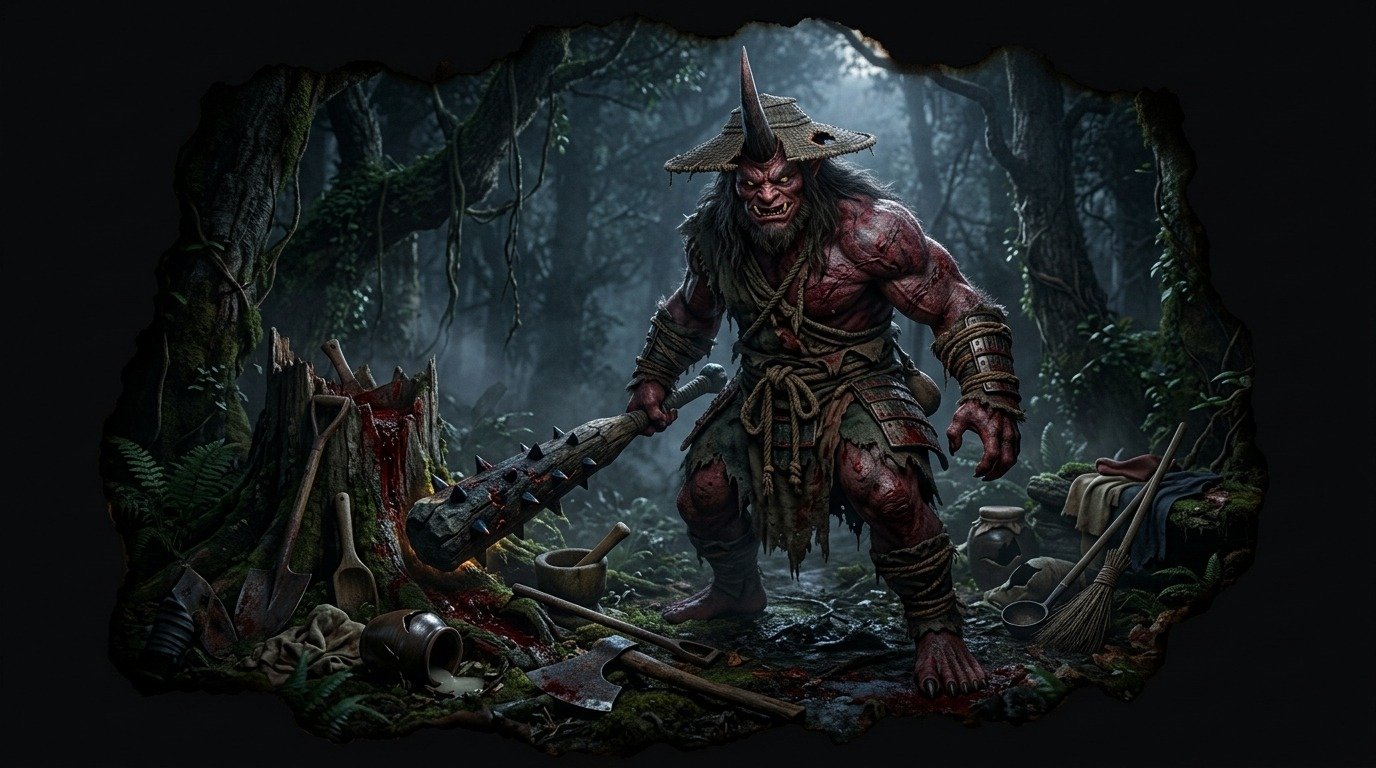
Dokkaebi: The Spirit of Broken Things and Blood
Genesis of Objects Consecrated by Blood
Unlike ghosts (*Gwishin*) or monsters imported from other folklore, the Dokkaebi (도깨비) is a spiritual entity native to Korea that personifies the transformation of inanimate matter through contact with the essence of human life. It is not born from the death of a living being, but from the impregnation of human blood—particularly blood spilled in battle, menstrual blood, or blood on everyday tools that have been discarded or abandoned in the forest.
A typical Dokkaebi is formed from an old wooden or metal household utensil: a worn-out broom, a kitchen mortar, a fireplace poker, or a farmer's hoe. When these objects come into contact with blood and are left to rot in nature, the psychic residue of their former owners merges with the spirits of the earth, giving life to a mischievous creature with reddish or green skin, tangled hair, a single horn on its forehead, and colossal physical strength.
Theurgic Attributes: The Club and the Hat of Shadows
The nature of the Dokkaebi is intrinsically linked to two magical artifacts of incalculable esoteric value that are often the object of desire for greedy humans: - **The Dokkaebi Bangmangi (도깨비 방망이, the Dokkaebi's club)**: This wooden or stone mallet has the power to instantly summon any physical object in existence. However, the Dokkaebi's magic does not create matter from nothing; it acts under the law of transfer. If the Dokkaebi summons gold, that gold has been extracted directly from the coffers of a miser or from a hidden treasure elsewhere in the world. Its unauthorized use usually brings about the entity's wrath and geomantic misfortune. - **The Dokkaebi Gamtu (도깨비 감투, the Dokkaebi's hat)**: A felt or straw hat that grants absolute invisibility to whoever wears it. If the hat is damaged or loses a single thread, the part of the body exposed through the hole will become visible, symbolizing that the Dokkaebi's magic always has a flaw or a hidden price.
Symbology of Animated Matter and Chance
On the plane of the peninsula's spiritual philosophy, the Dokkaebi represents benign chaos and the randomness of the universe. It is neither a purely malevolent nor benevolent entity; it is capricious and playful. Its personality reflects that of the peasants who created the tools from which it originates: it loves banquets, drinking rice wine (*makgeolli*), singing at the top of its lungs in the forests, and challenging travelers to traditional wrestling matches (*ssireum*).
The Dokkaebi also embodies poetic justice and the redistribution of wealth. It rewards the pure of heart with unthinkable treasures (though often obtained by stealing from the rich) and mercilessly punishes hypocrites, the greedy, and the pedantic, subjecting them to public humiliation or stripping them of their possessions through illusory tricks.
Interaction and Containment of the Playful Spirit
Interacting with a Dokkaebi requires a deep understanding of its rustic psychology and its cognitive limitations. If a practitioner encounters one on a mountain path, they must apply the following survival rules: 1. **The Ssireum Challenge**: The Dokkaebi will block the path, demanding a *ssireum* match. It is physically impossible to beat it with brute force due to its mineral or metallic origin. The secret lies in attacking it from its right side (its weak side, as it lacks perfect balance due to the asymmetry of its horn) or attempting to trip it by sweeping its single central leg, depending on the morphological variant being interacted with. 2. **The Use of the Horse's Head**: Dokkaebi suffer from an extreme phobia of horse blood and horse heads, as well as the deep red color of the red bean (*pat*). Scattering red bean porridge (*patjuk*) around a house or placing a horse's head at the main entrance will completely block the entity's access, preventing it from stealing household goods. 3. **The Return of Matter**: If wealth is obtained through a Dokkaebi, it must be treated as a temporary loan. If the recipient shows greed or tries to show off their fortune, the Dokkaebi will transform the gold back into broken roof tiles, manure, or rotting wood, restoring the original balance of matter.
Comments
Share information, an experience, or a source to help enrich this entry. They are automatically reviewed before being published.
Loading comments...