Yuki-Onna
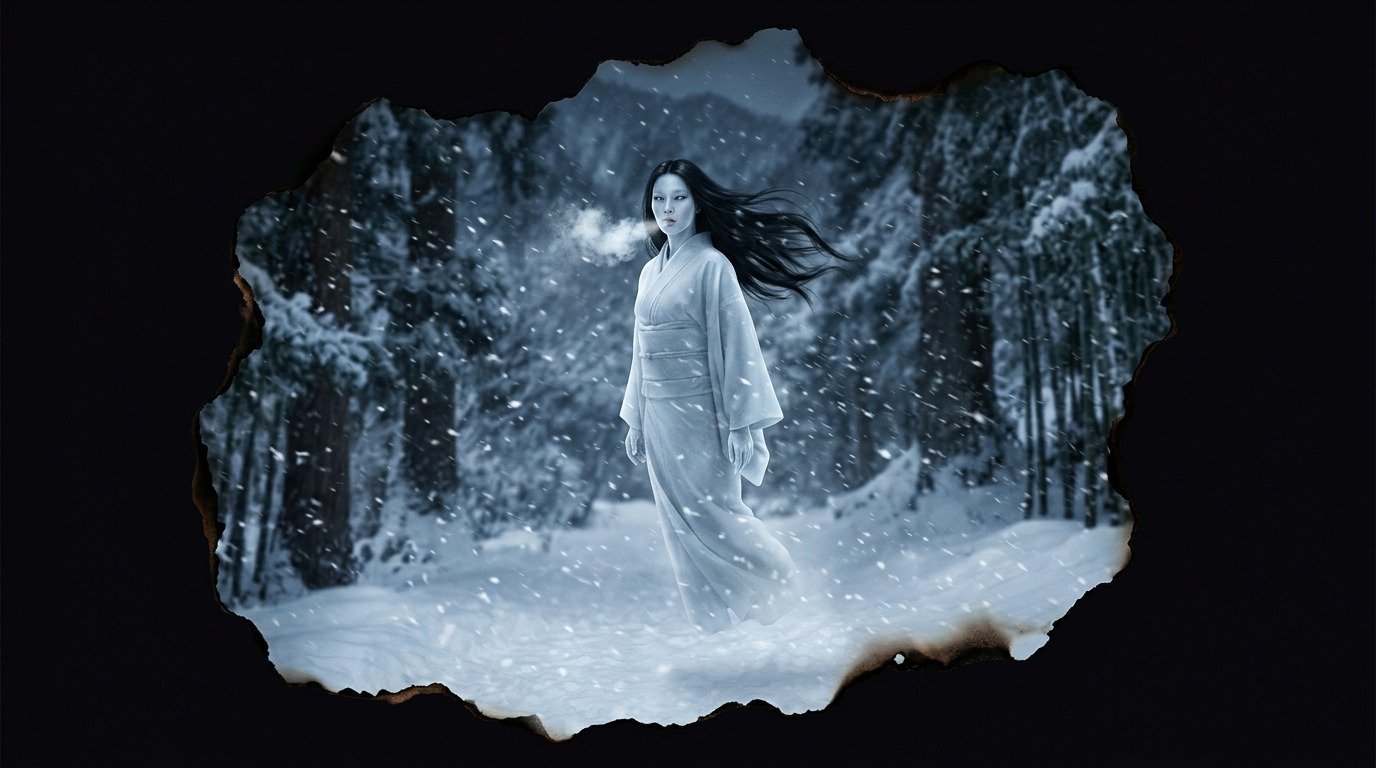
Yuki-onna: The Pale White Death and the Breath of Winter
Origin and Legend
The *Yuki-onna* (雪女, "snow woman") is one of the most beautiful, melancholic, and lethal apparitions in the mythology of Japan's cold regions. Her earliest written record dates back to the Muromachi period in the work *Sōgi Shokaku Nikki* by the monk and poet Sōgi, and she achieved global literary immortalization in the 20th century through the pen of Lafcadio Hearn (Koizumi Yakumo) in his work *Kwaidan* (1904). La Yuki-onna manifests in mountain passes and boreal forests during nights of severe blizzard (*Fubuki*). She is described as a woman of superhuman and ethereal beauty, with skin so white and translucent that it seems carved from the purest ice. She wears a subtle white kimono that blends with the falling snow; her hair is black, long, and silky, and her eyes possess a glacial gleam that instills terror and fascination in equal measure. She lacks feet, floating over the snow cover so fluidly that she leaves no footprint in her wake.
Historical and Regional Evolution
The Yuki-onna has multiple geographical variants that reflect the diverse human attitudes toward the rigors of winter in northern Japan: - **In Iwate Prefecture:** She is known as *Yuki-onba* or *Yuki-musa*. She often takes on the role of a beggar asking locals for hot water; if her wish is granted, she melts before their eyes, leaving only a puddle of oily water. If she is refused, she freezes the inhabitants of the house to death. - **In Niigata Prefecture:** She is described as a being who kidnaps children during snowstorms, or as the vengeful spirit of a woman who froze to death after being abandoned by her husband in the mountains. La canonical story collected by Hearn presents an unusual facet of mercy and vulnerability: she spares the life of a young woodcutter named Minokichi due to his youth and beauty, under the strict condition that he never reveal to anyone what he saw that night. Years later, Minokichi marries a beautiful, mysterious woman named Yuki, with whom he has several children. One day, while looking at her face by candlelight, Minokichi breaks his promise and confesses the encounter of his youth. Yuki then reveals her true nature as the Yuki-onna; however, instead of killing him, she abandons him forever because of the love she feels for their shared children, warning him that he must take good care of them or she will return to claim his life.
Esoteric or Symbolic Meaning
From the perspective of esoteric anthropology, the Yuki-onna is the personification of the *Sweet Death* from hypothermia. In its final stages, bodily freezing produces an illusion of warmth and comforting visions, a peaceful surrender to winter sleep that folklore anthropomorphizes into the seductive figure of the snow woman. She is the relentless yet majestic aspect of wild nature that cannot be tamed by man. Symbolically, she represents the fragility of esoteric pacts. The silence demanded by the Yuki-onna represents the sacred secret of the encounter with the numinous. By verbalizing the sacred experience and profaning the mystery before the everyday nature of the profane world (represented by Minokichi's domestic home), the connection to the higher plane is irreparably broken, returning the human being to their original state of helplessness.
Manifestation, Testimonies, and Protection Protocols
The Yuki-onna does not attack through brute physical violence; her primary weapon is her breath, a frigid mist known as *Yuki-iki* that instantly freezes the blood and heart of human beings. - **The Rejection of Sleep:** The greatest danger in the presence of the Yuki-onna is the drowsiness induced by her song or her hypnotic gaze. A traveler caught in a blizzard must avoid sitting down or closing their eyes at all costs. Keeping up physical activity and forcing the mind to solve complex problems breaks the aesthetic trance that the creature projects onto her prey. - **The Presence of Consecrated Fire:** The Yuki-onna cannot tolerate extreme heat or the proximity of a fire consecrated by Buddhist or Shinto rituals (*Kagurabi*). Lighting a bonfire by rubbing sacred pine branches drives away the entity's presence, as the proximity of the heat weakens her spectral consistency, threatening to dissolve her physical form into ordinary water. - **The Absolute Silence:** If a face-to-face encounter with the Yuki-onna occurs in the mountains, the safest protocol is to kneel, look at the ground with respect, and not utter a single word. The creature often spares those who show reverent submission to the majesty of the storm, interpreting the silence as an acknowledgment of winter's sovereignty.
Comments
Share information, an experience, or a source to help enrich this entry. They are automatically reviewed before being published.
Loading comments...