Tengu
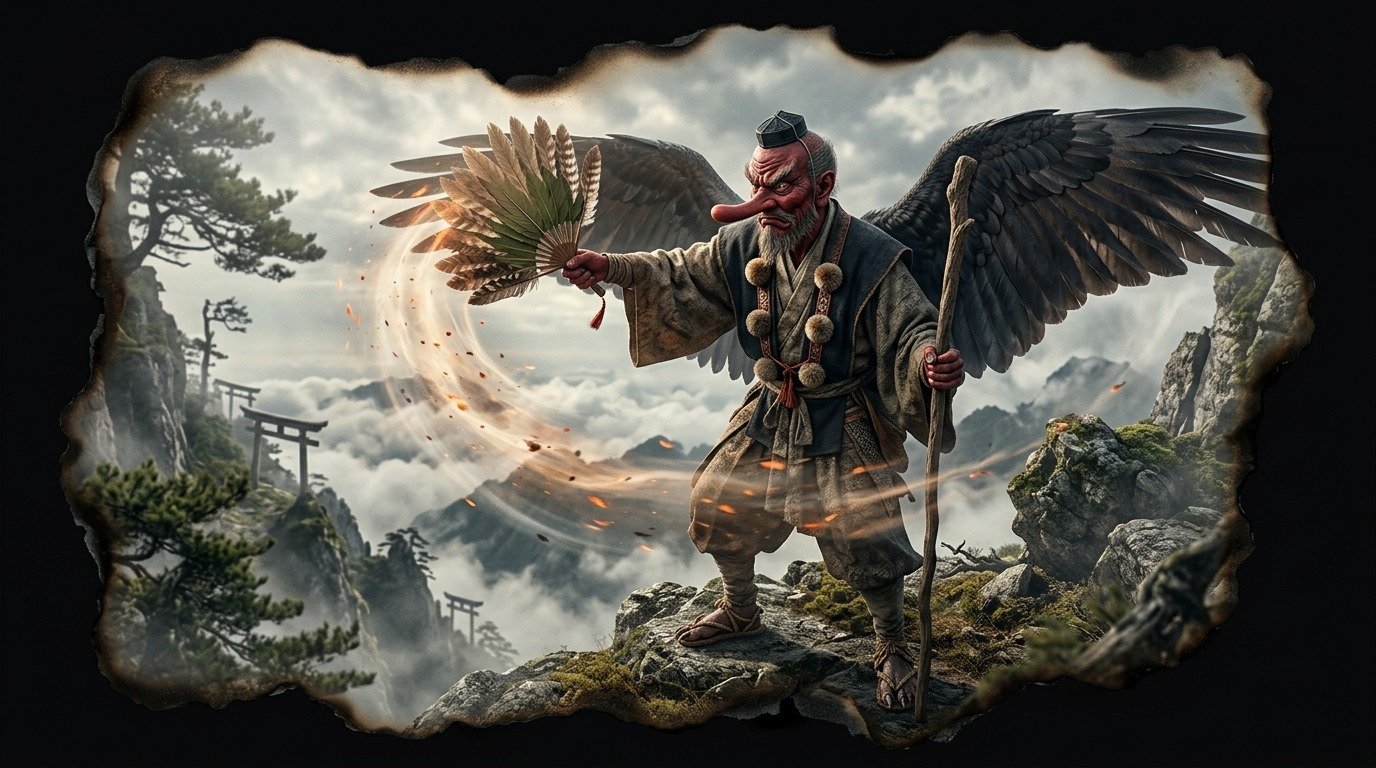
Tengu: The Scourge of Pride and Guardian of the Sacred Peaks
Origin and Legend
The genesis of the Tengu takes us back to a deeply complex syncretism between the Chinese *Tiāngǒu* (a meteoric demon in the form of a celestial canine that devoured the sun during eclipses) and the ancient mountain spirits (*Yama-no-Kami*) characteristic of Japanese Shinto animism. Upon its introduction to the archipelago, the Tengu abandoned its original canine form to adopt a hybrid physiognomy of a bird of prey, later known as *Karasu-tengu* (crow tengu), characterized by dark wings, sharp talons, and a curved beak capable of tearing apart human flesh and illusions. These creatures inhabited the dense forests of the sacred mountains (such as Mount Kurama or Mount Takao), zones of liminal transition between the world of men and the realm of the gods. In the Chronicles of the *Konjaku Monogatarishū* (12th century), the Tengu is portrayed as a fierce enemy of Buddhism, a herald of chaos who kidnapped monks to drive them mad, set fire to temples, and used mystical arts to deceive devotees through false apparitions of the Buddha.
Historical and Regional Evolution
As the doctrine of *Shugendō*—a synthesis of Shinto, esoteric Buddhism (Shingon and Tendai), and practical Taoism—became consolidated in the mountains, the perception of the Tengu underwent a drastic evolution. The mountain ascetics, the *Yamabushi*, came to live in close proximity to these entities in their geographical isolation. The Tengu ceased to be a simple destructive demon and became a fierce protector of the *Dharma* (Buddhist law) and the sacred boundaries of the wild wilderness. A taxonomic differentiation then occurred within the hierarchy of these entities: 1. **Daitengu (or Hanataka-tengu):** More human in appearance, with bright red skin and a prominent phallic nose replacing the crow's beak. He wears the traditional attributes of the *Yamabushi* (the *tokin* crown, the *yuigesa* pom-pom sash, and the *hauchiwa* feather fan). They are wise, fearsome, and master the arts of war and weather. 2. **Karasu-tengu (or Kotengu):** Subordinate to the former, wilder and more impulsive in nature, excellent swordsmen, and executors of the Daitengu's will. Legends from the 14th and 15th centuries, such as those contained in the *Heike Monogatarishū*, attribute the military training of the legendary hero Minamoto no Yoshitsune in the art of invisible swordsmanship to the Daitengu of Mount Kurama, King Sojōbō, allowing him to defeat entire hordes of enemies with superhuman agility.
Esoteric or Symbolic Significance
On the initiatory and hermetic plane, the Tengu is the embodiment of the most devastating danger on the spiritual path: spiritual pride or intellectual arrogance (*Tengu-do*, the path of the Tengu). It was held that those monks, priests, or scholars who accumulated immense knowledge or mystical power, but lacked humility and were consumed by the ego, inevitably reborn in the realm of the Tengu after their physical death. Their long noses are the direct anatomical representation of their excessive pride. On the other hand, the Tengu represents the raw, unleashed power of the mountain (*Yama*). Its feather fan (*hauchiwa*), typically made of *Aralia japonica* leaves or bird of prey feathers, symbolizes absolute control over the elements of air and fire; with a single wave, it can unleash gales, whip up storms, and purify or destroy an entire settlement. It is the guardian of the secrets of plant and mineral alchemy, which are only revealed to true ascetics who have transcended the attachments of the material world.
Manifestation, Warnings, and Protection Protocols
An encounter with a Tengu is usually preceded by abrupt meteorological phenomena in high-altitude areas: unusual gusts of wind without storm clouds, shrill laughter echoing in the treetops, or the sighting of a red glow amidst the thick fog of forbidden trails. To interact safely with these entities or appease their wrath if their territory has been desecrated, the following guidelines are prescribed: * **Self-Abnegation of the Ego:** When entering mountains ruled by a Tengu, the practitioner must maintain strict silence and refrain from any boasting or showing off of physical or spiritual ability. Weakness attracts their contempt, but arrogance unleashes their destructive violence. * **Offerings of Respect:** Placing cooked rice, sake, or rice cakes (*mochi*) at the roots of the oldest cedar trees (*Goshinboku*), which serve as axial portals between terrestrial dimensions and the realms of the Tengu. * **Use of Sacred Sound:** The blowing of the conch shell (*horagai*) or the sound of the monks' ringed staff (*shakujō*) dispels the illusions of wind and fire created by lower-ranking Tengu, aligning the vibrational frequency of the environment with cosmic purity. ---
Comments
Share information, an experience, or a source to help enrich this entry. They are automatically reviewed before being published.
Loading comments...