Rokurokubi
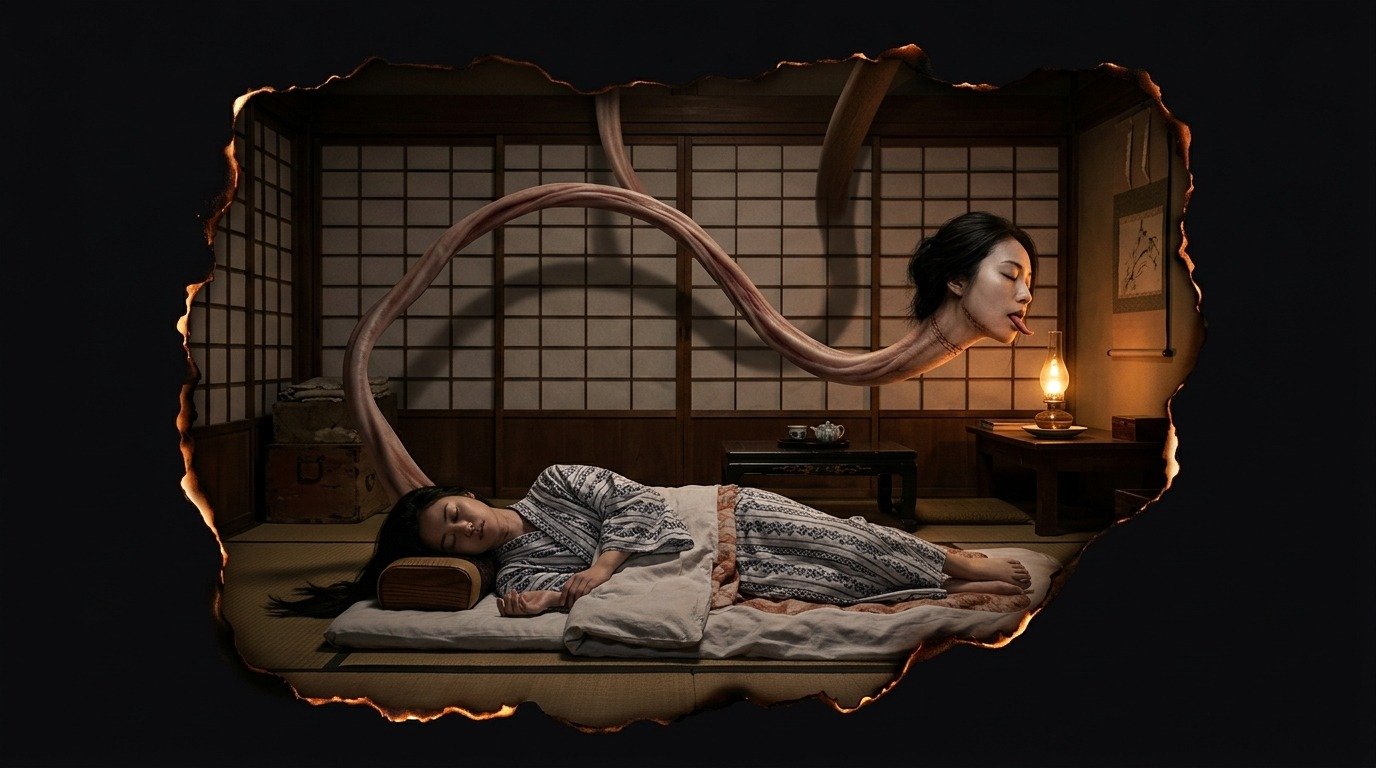
Rokurokubi: The Detachment of the Soul and the Neck of Transgression
Origin and Legend
The *Rokurokubi* (ろくろ首) represents one of the most disturbing anatomical anomalies in the catalog of Japan's urban and rural *yōkai*. The term probably derives from *rokuro* (a potter's wheel or a well pulley), alluding to the rotating, ascending, and fluid movement of the creature's neck. Historically, the phenomenon is divided into two distinct typologies in Edo period treatises, such as the *Shokoku Hyaku Monogatari* (1677): 1. **The True Rokurokubi:** Ordinary human beings during the day who, when night falls and they reach deep sleep, undergo an excessive and elastic stretching of their necks, allowing their heads to float independently, connected to the body only by a muscular and dermal filament that resembles an endless tendon. 2. **The Nukekubi (抜け首):** A more archaic and virulent variant where the head detaches completely from the physical body, flying autonomously through the air to feed, leaving the body inert and defenseless. Unlike other creatures born from the wild nature, the Rokurokubi is almost always of human origin. It is an involuntary metamorphosis, a curse that usually affects women primarily, manifesting as a physical symptom of an underlying spiritual affliction.
Historical and Regional Evolution
In the chronicles of the Muromachi period, the stretching of the neck was interpreted as a physical manifestation of *Eshōbunjō* (karmic retribution). A person who committed grave sins against the Buddhist faith, or whose father had committed atrocious acts (such as the killing of sacred animals or family betrayal), inherited this spiritual deformity. During the Edo period, with the flourishing of *Kabuki* theater and horror storytelling in *yose* (storytelling halls), the figure became secularized. In the work *Kasshi Yawa* by Matsura Seizan, it is described that the Rokurokubi's transformation is not always malicious; often, the subject is completely unaware of their nocturnal condition, waking up only with intense fatigue in the cervical area and vague memories of having dreamed of observing the room from impossible overhead angles, or of having licked the oil from *andon* lamps (one of this entity's dietary fixations).
Esoteric or Symbolic Meaning
Esoterically, the Rokurokubi embodies the dissociation between the mind (the head, the conscious self, reason) and the body (instincts, the unconscious, repressed desires). The head that rises and wanders in the darkness represents the uncontrolled astral projection of the human psyche under the yoke of unfulfilled passions, pathological jealousy (*Shinjū*), or excessive ambition. Within the framework of Eastern esoteric medicine, it was believed that the human soul resided in the chest but accessed the outside world through the throat. The elongation of the neck symbolizes an obstructed or corrupt energy channel, where *Qi* (vital energy) becomes deformed under the pressure of unfulfilled desire, forcing the spirit to stretch its physical moorings to seek sustenance on the material plane (by drinking the fish oil from the lamps, which represents vitalized light).
Manifestation and Protection Protocols
To the sharp observer, a Rokurokubi is identifiable even during their daytime state. They present pale, almost imperceptible marks around the neck, similar to strangulation scars or natural suture lines. - **The Interruption of the Return (for Nukekubi):** If a person is suspected of being a *Nukekubi* (detachable head), the traditional method of neutralization consists of locating their sleeping body during the night and changing its position or hiding it. If the head returns before dawn and does not find the neck in the exact orientation, it will crash against the walls and the floor until it loses its strength and dies. The body, deprived of its head, will perish in the same way. - **The Blocking of Desire:** For the elastic-necked Rokurokubi, the cure or appeasement is not physical, but spiritual. The use of purifying sandalwood incense and the placement of a bronze mirror (*Shinkyō*) in front of the suspect's bed act as a reflective shock; when the head attempts to stretch, it will see itself reflected in the consecrated bronze, immediately returning the astral projection to its physical container due to the impact of its own corrupt image.
Comments
Share information, an experience, or a source to help enrich this entry. They are automatically reviewed before being published.
Loading comments...