Tanuki
Tanuki: The Master of Disguise and the Transmutation of Matter
Origin and Legend
The Tanuki (*Nyctereutes procyonoides*, or Japanese raccoon dog) occupies a unique place in the island's bestiary. Unlike the Kitsune, whose mystical genealogy rises toward celestial heights, the Tanuki is rooted in the density of the earth, clay, and damp forests. Its primal mythological origin is found in ancient pre-Buddhist animist beliefs, where it was considered a minor deity of the forests, responsible for the mysterious sounds of nature, such as the nightly drumming on hollow trunks (*Tanuki-bayashi*).
In the earliest written chronicles, such as the *Nihon Shoki* (Chronicles of Japan, 720 AD), the Tanuki is described as a being of an elusive and ambiguous nature, with shape-shifting abilities similar to those of the fox, but lacking its courtly refinement. Its primitive mythology portrays it as an entity capable of altering its form to deceive travelers on mountain paths, transforming into inanimate objects (teapots, stones, trees) or imitating human religious rituals with the sole purpose of obtaining food, drink, or amusement at the expense of others' bewilderment.
Historical and Regional Evolution
The perception of the Tanuki underwent one of the most drastic transformations in all of Japanese folklore. During the medieval period, it was feared in certain regions as a man-eating monster or a mountain demon capable of possessing human beings. However, with the advent of peace in the Edo period, its image was progressively domesticated and reinterpreted through the prism of popular comedy and commerce.
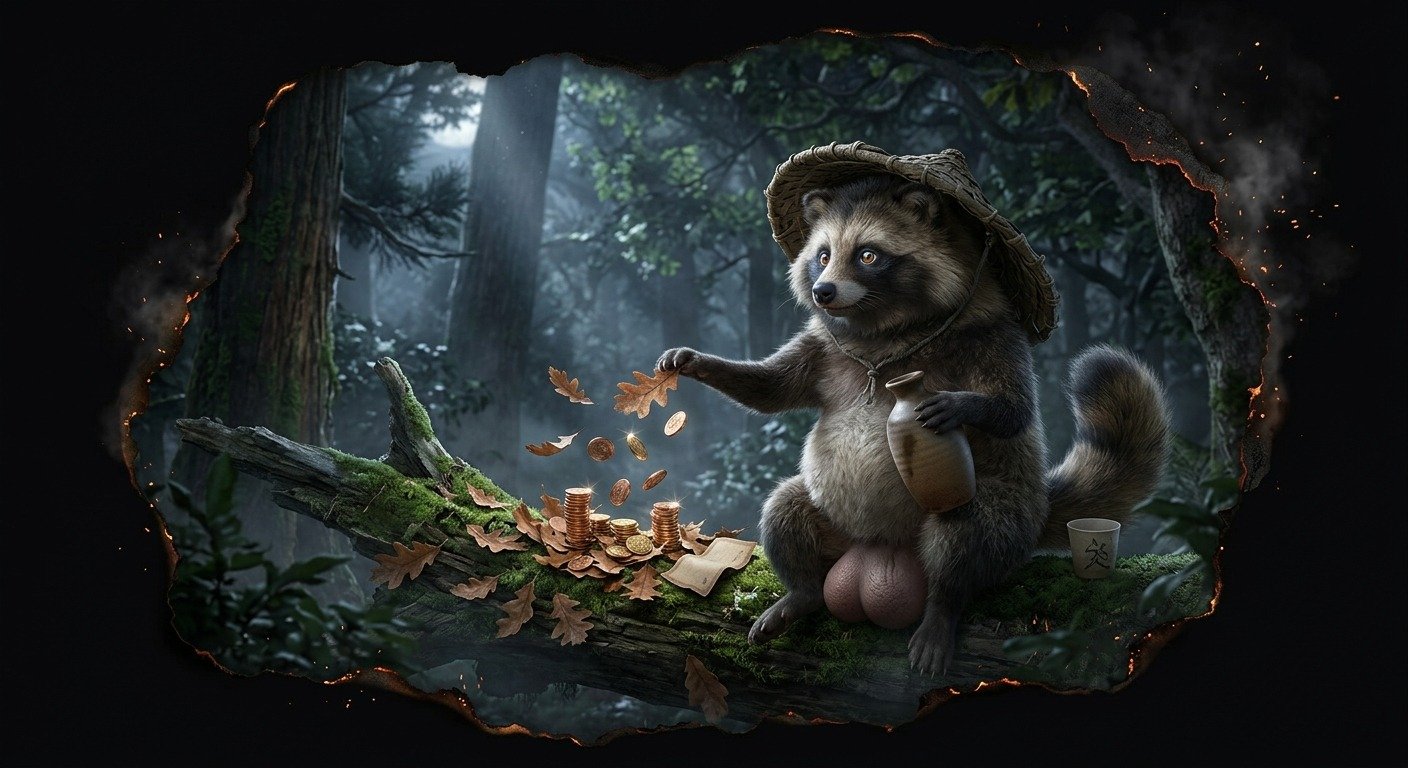
It is during this era that its modern iconographic attributes crystallized, defined by the "Eight Virtues" or good fortune characteristics (*Hachiki*): the straw hat (which protects against misfortune and the weather), the large eyes (to perceive the surroundings and make correct decisions), the sake bottle (representing temperance and gratitude), the thick tail (providing stability and strength until the end), the empty promissory note or credit slip (symbolizing mutual trust), the prominent belly (evoking boldness and calm), and, prominently, its oversized testicles (*kintama*, literally "gold balls"). Far from having a merely lascivious connotation, this last attribute arises from the actual practice of Kanazawa metalworkers, who wrapped gold in Tanuki skin to hammer and stretch it into extremely thin sheets; the elasticity of the animal's skin thus became a metaphorical symbol of the expansion of wealth and the malleability of fortune.
Esoteric or Symbolic Meaning
Esoterically, the Tanuki is the archetype of the everyday alchemist. It does not seek ascetic spiritual elevation, but rather the transmutation of mundane suffering into joy and abundance through humor and adaptability. It represents the power of physical illusion and the manipulation of dense matter: while the Kitsune projects optical and mental illusions that disorient the soul, the Tanuki alters the consistency of physical things (for example, transforming dry leaves into fake gold coins to buy sake, which return to their original state once the Tanuki has departed).
Symbolically, it embodies the resilience of the lower classes in the face of feudal oppression. The Tanuki mocks the rigidity of samurai and Buddhist monks through parody, reminding us that human power structures are as fleeting and empty as its dry-leaf coins. It is the wisdom of the earth refusing to be domesticated by the gravity of dogmatic morality.
Manifestation and Containment Practices
The presence of a Tanuki in its trickster facet is revealed by material inconsistencies in the immediate environment: copper coins that dissolve into leaves upon contact with salt water, rhythmic percussion sounds in the forest with no visible physical origin, or suspiciously short and plump anthropomorphic figures wearing monastic robes but revealing dense fur under the light of the full moon.
To manage or repel the disruptive manifestations of a Tanuki, tradition prescribes:
* **Material Skepticism:** If a suspicious transaction is made at night, wet the received coins with saliva or river water; if it is an illusion of the Tanuki, the transformation will fail immediately. * **Consecration of Protective Figures:** Place a clay statue of a Tanuki at the entrance of businesses or sake breweries, facing outward. This transmutes the energy of deception into attracting clientele, using the nature of the being itself as a magnet for prosperity. * **Humor and Disruption:** Confront its mischief not with anger (which feeds its desire for mockery), but with laughter or indifference. The Tanuki loses interest in its tricks when it notices that its audience is unimpressed by the false gravity of its show.
---
Comments
Share information, an experience, or a source to help enrich this entry. They are automatically reviewed before being published.
Loading comments...