Yokai
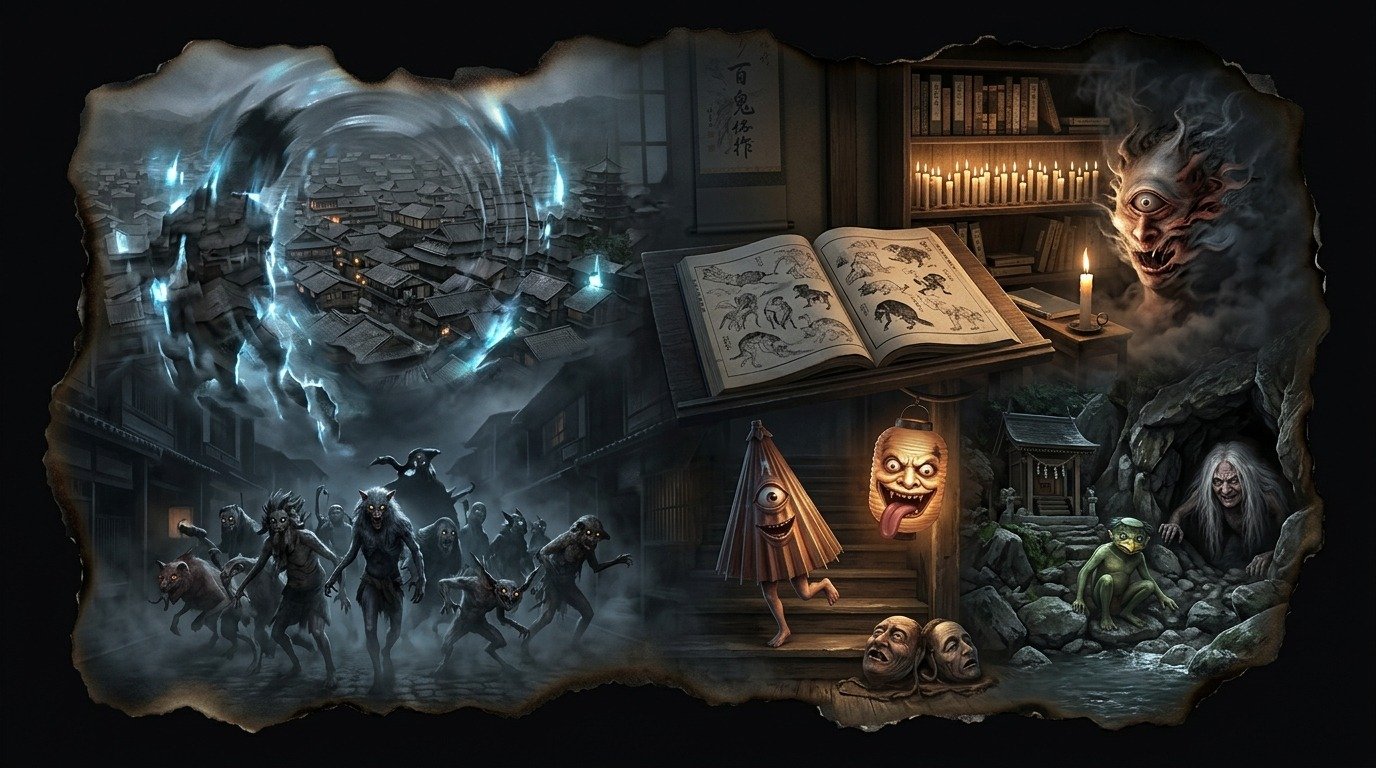
Yokai: The Taxonomy of the Liminal and the Whisper of Otherness
Origin and Legend
The word *Yōkai* (妖怪) is composed of two characters of deep esoteric resonance: *Yō* (妖), which denotes the seductive, the suspicious, the calamitous, or the supernatural that attracts and misleads from the natural order; and *Kai* (怪), which means mystery, suspicion, apparition, or inexplicable anomaly. Far from being a simple translation of "monster" or "demon," the concept of Yokai encompasses any phenomenological manifestation that breaks the laws of ordinary causality, including spectral apparitions, space-time distortions, inanimate objects that gain consciousness, and animals with physical transmutation capabilities. The roots of the Yokai lie deep within the primitive animism of Shinto, which holds that the physical world is inhabited by eight million deities (*Yaoyorozu no Kami*). Those energies of nature that did not receive proper worship, were forgotten by humans, or suffered a violent death, degenerated from their divine status and fragmented, becoming liminal, capricious, and potentially destructive presences that sought to draw the attention of humans through anomaly.
Historical and Regional Evolution
The history of the Yokai is the chronicle of a process of cultural domestication and rational cataloging. 1. **Heian Period (794–1185):** Yokai were primarily known as *Mononoke* (the essence of things that disturb). They were invisible forces that caused inexplicable illnesses and madness. The population lived under the terror of the *Hyakki Yagyō* (the Night Parade of One Hundred Demons), a procession of supernatural hordes that marched through the streets of the capital during nights of unfavorable astrological conjunction; beholding this parade caused instant death unless specific protective amulets were carried. 2. **Edo Period (1603–1867):** With the advent of printing and social stability, an explosion in the systematization of Yokai occurred. Artists like Toriyama Sekien, in his monumental work *Gazu Hyakki Yagyō* (1776), compiled and illustrated hundreds of these creatures, providing them for the first time with fixed names, standardized physiognomies, and specific backgrounds. This process transformed primal panic into folkloric and playful entertainment. The game of *Hyakumonogatari Kaidankai* (A Gathering of One Hundred Supernatural Tales) emerged, where one hundred candles were lit and one was extinguished after each tale; when the last candle was put out, it was believed that a real entity would manifest in the room. 3. **Meiji Period (1868–1912) onward:** The philosopher Inoue Enryō founded the discipline of *Yōkaigaku* (Yokaicology) with a rationalist purpose: to study the myths of Yokai to demystify them through modern science and psychology, freeing the people from superstition. However, this effort served to academically preserve the immense symbolic richness of these entities, a task that would later be continued by the folklorist Yanagita Kunio.
Esoteric or Symbolic Significance
The Yokai is the herald of otherness. It is the manifestation of the collective unconscious projected onto the gaps of geography and the rifts of daily life. Each Yokai responds to a specific psychological, moral, or social need: * **The Tsukumogami (Objects with a Soul):** Everyday objects (umbrellas, lanterns, sandals) that, upon reaching one hundred years of existence, acquire a soul (*kami*) and come to life. Esoterically, they represent the animist principle that matter is not inert; it is a warning against waste, excessive consumption, and the lack of gratitude toward the tools that sustain human life. * **Geographical Entities (Kappa, Yamamba):** Personifications of the real dangers of nature (treacherous water currents in the case of the Kappa; the isolation and madness of the mountains in the Yamamba). They function as moral and survival barriers to delimit the safe space of the village against the untamed chaos of the outer forest. The Yokai is, ultimately, the poetic and terrifying translation of the ontological mystery: the certainty that the human being is not the sole owner of the space they inhabit, but a temporary tenant in a world whose edges always remain open to mystery.
Practical Classification of Manifestations and Defense Protocols
Due to the immense variety of the Yokai category, traditional defense protocols are structured according to the nature of the detected anomaly: #### 1. Anomalies of Household Objects (*Tsukumogami*) * **Manifestation:** Strange noises in the attic, objects that change places on their own, or that develop eyes and limbs during twilight hours. * **Protocol:** Do not discard old utensils violently or carelessly. Perform rituals of gratitude and retirement of old tools at temples dedicated to this purpose, known as *Kuyō* (for example, the *Hari-Kuyō*, or memorial service for used needles), where the soul of the object is peacefully surrendered to the flow of nature. #### 2. Liminal Encounters on Roads and Bridges (*Boundary Yōkai*) * **Manifestation:** Appearance of strange beings that block the way, such as the *Nurikabe* (an invisible wall that prevents advancement) or the *Kuchisake-onna* (the slit-mouthed woman who asks deadly rhetorical questions). * **Protocol:** When facing the *Nurikabe*, strike the base of the invisible wall (where its hidden feet are located) with a staff to instantly dissolve the illusion. When facing Yokai with trick questions, respond with ambiguities or logical contradictions that confuse their rigid mental structure, giving the traveler time to cross the safe threshold. #### 3. Aquatic Disturbances (*Kappa*) * **Manifestation:** Unusual agitations in deep rivers and ponds, mysterious disappearance of livestock, or recurring drownings. * **Protocol:** Carve the names of family members onto cucumbers (the Kappa's favorite food) and throw them into the water before swimming to establish a non-aggression pact. In case of direct physical confrontation, perform a deep bow; the Kappa, due to its strict sense of honor and etiquette, will be forced to return the greeting, spilling the water contained in the cavity on top of its head (*sara*), thereby losing all its mystical strength and being forced to retreat or grant a favor to regain its vitality.
Comments
Share information, an experience, or a source to help enrich this entry. They are automatically reviewed before being published.
Loading comments...