Gashadokuro
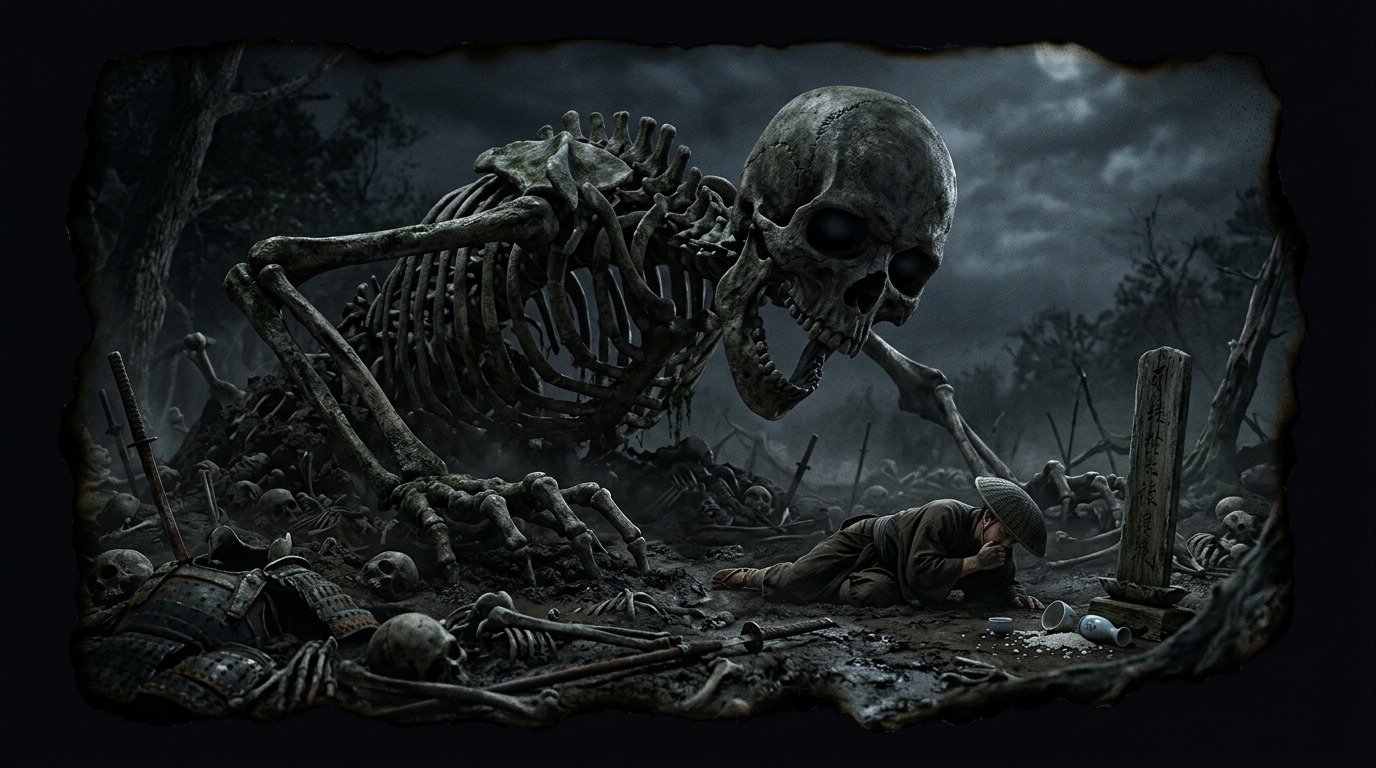
Gashadokuro: The clamor of skeletal remains and the wrath of the mass grave
Origin and Legend
The *Gashadokuro* (がしゃどくろ), also known as *Odokuro*, is one of the most terrifying and physically imposing apparitions of modern and late Japanese folklore. Unlike other *yōkai* that arise from the degradation of a natural spirit, the Gashadokuro is a composite aggregate: a giant skeleton, approximately fifteen meters (49 feet) tall, formed by the physical and spiritual cohesion of the scattered bones of thousands of people who died on the battlefield or from starvation, and whose bodies did not receive proper funeral rites (*Muendokoi*). Although the iconography of the giant skeleton was popularized through the famous *ukiyo-e* woodblock print by Utagawa Kuniyoshi (1844), *Takiyasha the Witch and the Skeleton Specter* (where Princess Takiyasha summons a colossal skeleton to terrorize the Emperor's samurai), the consolidation of the specific myth of the Gashadokuro, with its precise hunting mechanics, was established in the second half of the 20th century through the compilations of modern folklorists and the rise of horror manga.
Anatomy and Mechanics of Pain
The Gashadokuro is the physical embodiment of *unaddressed collective wrath*. When a massive number of human beings perish with a feeling of extreme injustice, despair, and acute physical pain, their individual souls cannot cross the *Sanzu* River. Instead, their consciousnesses merge into a hive mind driven solely by *Aragoto* (the violent spirit) and *Kegare* (spiritual impurity). The creature wanders after midnight. Due to its colossal size, it is virtually invisible until it is upon its prey; however, its approach is preceded by a sharp, persistent ringing in the victims' ears, mimicking the sound of its own skeletal structure creaking (*gachi-gachi*). The Gashadokuro crouches silently, grabs lone travelers with its giant hands, bites off their heads, and drinks the blood directly from their arteries to satisfy the eternal void of its thousands of non-existent stomachs.
Esoteric or Symbolic Meaning
Esoterically, the Gashadokuro represents the danger of *historical oblivion* and the accumulation of a community's psychic trauma. It is the mass grave coming to life to devour the living who have ignored the sacred duty of remembrance and the purification of ancestors. In terms of spiritual alchemy and comparative Kabbalah, it represents the force of the *Qliphoth* in its state of structural decay: empty shells of ego that, devoid of an individual divine spark, unite to form a giant simulacrum of life, a macabre imitation of creation that can only be sustained through the parasitic absorption of tempered life force (the warm blood of the living).
Manifestation and Protection Protocols
Physical combat against a Gashadokuro is futile; its body is made of already dead bones that cannot be harmed by conventional swords or arrows. - **The Ringing in the Ears:** If a night traveler suddenly perceives a deafening ringing in their ears that blocks out the sound of crickets and the wind, it is a sign that the Gashadokuro is leaning over them. The only effective action is to immediately throw oneself to the ground, cover oneself with a dark-colored cloak to blend in with the earth, and remain absolutely still, holding one's breath. The creature lacks functional eyes; it detects its victims by the warmth of their breath and their heartbeat accelerated by fear. - **The Purification Offering of the Ground:** To permanently dissolve a Gashadokuro, it is necessary to perform a Shinto ritual of soul pacification (*Chinkon*). Burying the scattered skeletal remains in the area in a dignified manner, erecting a memorial mound (*Ireihi*), and making libations of sake and purified rice breaks the cohesion of the psychic aggregate, allowing the individual souls to detach from the colossus and ascend to the plane of the ancestors. The giant skeleton immediately crumbles, turning into harmless dust.
Comments
Share information, an experience, or a source to help enrich this entry. They are automatically reviewed before being published.
Loading comments...