Book of Enoch
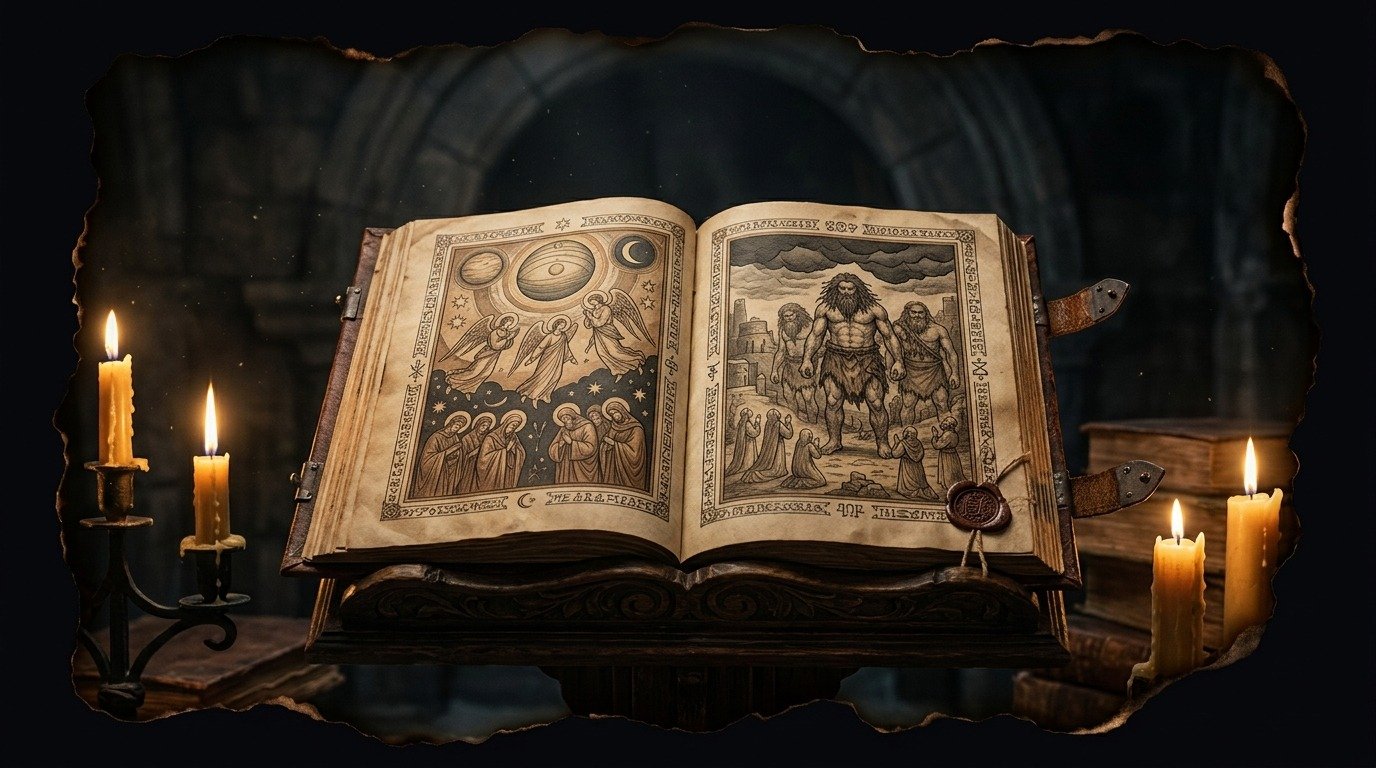
Book of Enoch: The Forbidden Text on Fallen Angels and the End of the World
The Book of Enoch is the most influential apocryphal text of Judeo-Christian antiquity. Written centuries before the Common Era, this manuscript details the rebellion of the Watchers, a group of divine angels who descended to Earth to unite with human women and father a race of destructive giants known as the Nephilim. Its fame and subsequent exclusion from most biblical canons are due to its explicit revelations about the origin of evil, forbidden magic, and the geography of hell—content that ecclesiastical authorities considered too destabilizing and heretical for official doctrine.
Secrets of Heaven and the Rebellion of the Watchers
The most disturbing core of the Book of Enoch is found in the Book of the Watchers. Its pages narrate how two hundred high-ranking angels, led by Semyaza and Azazel, make a pact on the summit of Mount Hermon to disobey the Creator. These beings not only lust after human flesh, but also decide to reveal to humanity the secrets of the universe that God kept hidden. The text describes how Azazel teaches men the art of metallurgy to make swords, knives, and breastplates of war, sowing violence in the world. To women, he teaches the use of cosmetics, the beautifying of the eyelids, and the alchemy of precious stones to arouse lust. Other fallen angels reveal the arts of incantations, medicinal botany, astrology, divination by the clouds, and the course of the moon. The offspring of these angels and the daughters of men are the Nephilim, colossal giants who devour the resources of humanity. When food becomes scarce, the giants begin to consume human beings themselves, drinking their blood and unleashing absolute chaos upon the Earth. The manuscript recounts how the clamor of wounded humanity reaches the gates of heaven, prompting God to send the Great Flood to cleanse creation and to chain the Watchers in the dark abysses of the Earth until the Day of Judgment.
The Mystery of Its Authorship and the Dead Sea Scrolls
Tradition attributes the authorship of the text to Enoch, the seventh patriarch after Adam and great-grandfather of Noah, a biblical figure who, according to the Book of Genesis, "walked with God" and disappeared because God took him without experiencing death. The chapters of the book present Enoch's cosmic visions during his journeys through the heavens and the abysses, guided by the archangels Michael, Gabriel, Raphael, and Uriel. The historical reality indicates that the Book of Enoch is a composite work written by several authors in different periods, primarily drafted between the 3rd century BCE and the 1st century BCE. For centuries, skeptics doubted its actual antiquity, suggesting it was a late Christian invention. However, in 1947, this debate came to a drastic end. Among the manuscripts discovered by Bedouin shepherds in the caves of Qumran, on the shores of the Dead Sea, several fragments of the Book of Enoch written in Aramaic were found. These scrolls proved that the text was already widely circulating and considered sacred by Jews before the birth of Jesus.
The Ecclesiastical Purge and the Refuge in Ethiopia
During the first centuries of Christianity, the Book of Enoch enjoyed immense popularity. Apostolic-era authors and Church Fathers such as Justin Martyr, Clement of Alexandria, Origen, and Tertullian cited it in their writings as a prophetic text of great authority. In fact, the Epistle of Jude itself, included in the New Testament of the Bible, directly quotes a prophecy of Enoch regarding divine judgment. However, as the Church institutionalized its doctrine in the 4th and 5th centuries, the book began to be viewed with suspicion. Its detailed angelology, the idea that celestial beings could have physical relations with human women, and the physical description of the end of the world were uncomfortable. Influential figures such as Saint Augustine of Hippo and Saint Jerome vigorously rejected the text. Finally, the book was classified as apocryphal, its copying was banned, and it was systematically destroyed throughout the Roman Empire. For more than a thousand years, Europe believed that the Book of Enoch had been lost forever. But the manuscript survived in the isolation of the mountains of East Africa. The Ethiopian Orthodox Tewahedo Church never accepted the exclusion decreed by Rome and Byzantium. For Ethiopian Christians, the Book of Enoch retained its status as canonical sacred scripture and was zealously preserved in their sacred language, Ge'ez. In 1773, the Scottish explorer and traveler James Bruce reached the source of the Blue Nile and managed to acquire three complete copies of the Ethiopian manuscript. Bruce brought the books to Europe, breaking a silence of centuries. In 1821, the scholar Richard Laurence published the first English translation, returning the forbidden prophecies of the patriarch to the Western world.
The Manuscript Today: Between Heresy and Revelation
Today, the most valuable copies of the Book of Enoch are kept in prestigious institutions such as the Bodleian Library at the University of Oxford, the National Library of France, and the Vatican Library. The text is no longer an absolute secret, but reading it still causes discomfort in traditional theological circles due to its raw description of celestial corruption. Only the Ethiopian Orthodox Church and the Eritrean Orthodox Church keep it within their official Bibles today. For the rest of the world, the book remains a window into an alternative and dark theology, where the boundaries between heaven and earth were catastrophically blurred.
An Echo of the Abyss
In the desert of Dudael, according to the text of Enoch, lies the fallen archangel Azazel, bound hand and foot, covered with sharp rocks in eternal darkness by order of the Creator. Anyone who journeys through the pages of this manuscript does not read a simple ancient fantasy, but the record of a cosmic panic: the certainty that evil on Earth was not born of man, but of the covetous eyes of the very guardians of heaven.
Comments
Share information, an experience, or a source to help enrich this entry. They are automatically reviewed before being published.
Loading comments...