Book of Jubilees
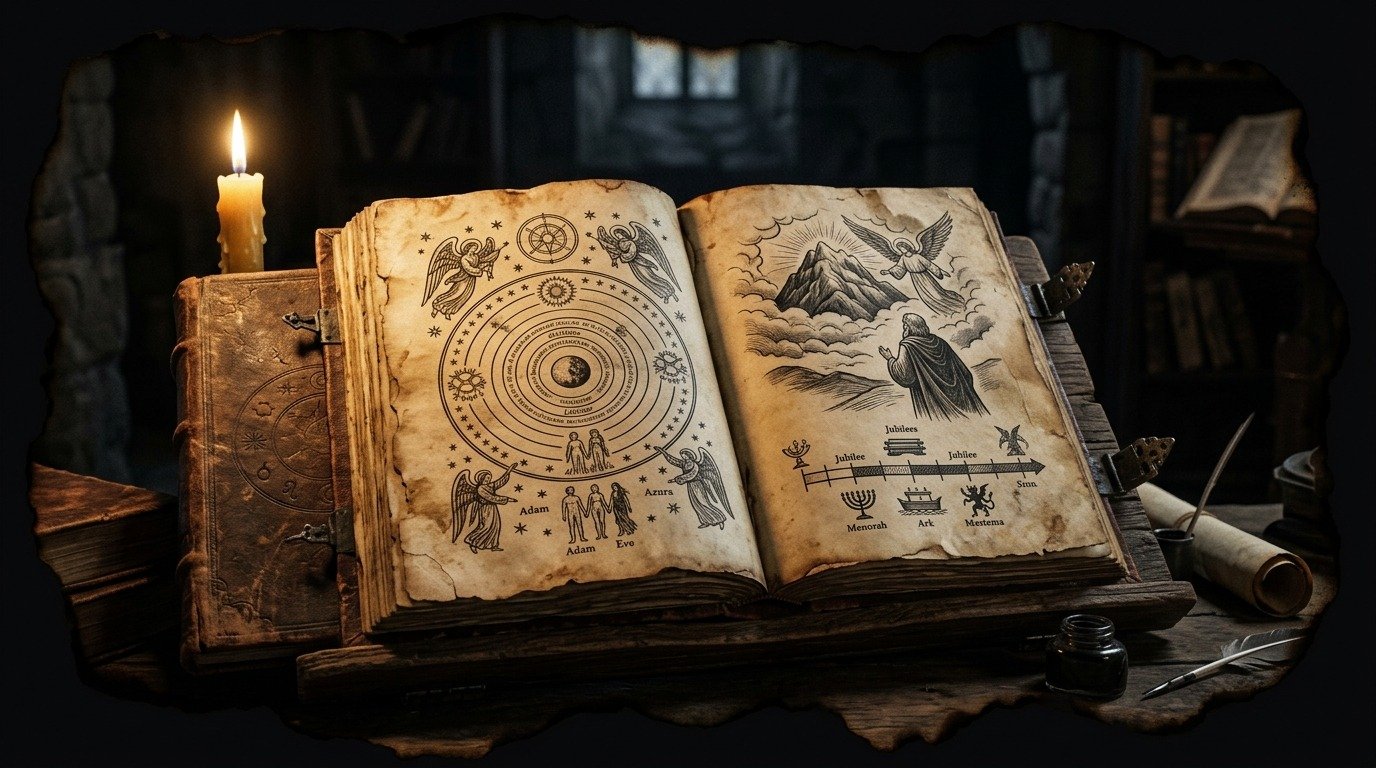
Book of Jubilees: The Secret Chronology of Genesis
The Book of Jubilees, also known historically as the *Lesser Genesis*, is an ancient Hebrew sacred text written in the mid-second century BC that rewrites the events recounted in the books of Genesis and Exodus. The manuscript restructures the history of the world under an immutable system of time composed of forty-nine-year periods called "jubilees." It is famous and feared for revealing details omitted from the canonical Bible, such as the names of the wives of the first human beings, the origin of evil through the rebellion of the Watchers, and the role played by the demon prince Mastema in God's plan.
The Revelation on Mount Sinai
The narrative is presented as a direct heavenly revelation delivered to Moses by the "Angel of the Presence" during the forty days the Hebrew leader spent atop Mount Sinai. The angel reads to Moses from the "heavenly tablets," a celestial record containing the destiny of the world and the eternal laws of creation. The book reveals the names of the women of the world's first era: Awan, the wife of Cain, and Azura, the wife of Seth, thereby resolving one of the mysteries of biblical genealogy. Unlike conventional Genesis, the Book of Jubilees imposes a strict 364-day solar calendar, divided exactly into fifty-two weeks. The author of the text sternly warns that any deviation from this solar calendar—such as following the lunar cycle adopted by the priests of the Temple of Jerusalem—profanes the sacred festivals and corrupts the celestial order, plunging the people into sin and causing them to forget God's appointed times. The manuscript also explicitly exposes the origin of demons, identifying them as the disembodied spirits of the giants born from the forbidden union between the fallen angels, known as the Watchers, and the daughters of men.
The Author of the Sacred Calendar
The composition of this manuscript is attributed to a Jewish author belonging to the dissident priestly currents of the Maccabean period, closely linked to the Essene movement. Its writing is dated approximately between 160 and 150 BC. The author wrote this work in Hebrew with the firm purpose of defending the purity of the Law of Moses against the growing influence of Hellenistic culture in Judea. For the author, the laws of the Torah are not temporary historical mandates, but eternal cosmic decrees that the patriarchs already practiced long before the revelation at Sinai: Abraham celebrated the Feast of Tabernacles, and Enoch was the first man who learned to write to record the celestial signs of the cosmic order.
The Banishment from Orthodoxy
The Book of Jubilees enjoyed great prestige among various Jewish communities of antiquity. However, at the beginning of the Christian era, both the rabbis of official Judaism and the leaders of the nascent Christian Church in Europe decided to exclude the book from their sacred collections. Its solar calendar, incompatible with the official worship in Jerusalem, and its complex theories about demons made the hierarchies seeking to unify dogma uncomfortable. The Hebrew text and its Greek and Latin translations almost completely disappeared from Western Europe and the Middle East. The survival of the book was guaranteed thanks to the Ethiopian Orthodox Church, which included it within its official canon of Holy Scriptures under the name *Mets'hafe Kufale* (the Book of Division). Monks in the monasteries of the Horn of Africa faithfully copied the manuscript in the Ge'ez language over the centuries, preserving the complete work for posterity. The validity of these Ethiopian copies was irrefutably confirmed when fragments of the original Hebrew text were discovered among the Dead Sea Scrolls in the Qumran caves in the mid-20th century.
The Immutable Time
Today, the manuscripts of the Book of Jubilees are preserved mainly in ecclesiastical libraries in Ethiopia and in special collections such as the Vatican Library and the National Library of France. The text represents one of the most valuable sources for the study of apocalyptic thought in Second Temple Judaism. The Book of Jubilees remains as the testimony of a faith that attempted to order the chaos of the world through the sacred mathematics of celestial time. The manuscript proclaims that the universe is not moved by human chance or the whim of the kings of the earth, but by the invisible ticking of the jubilees dictated by the Angel of the Presence atop the sacred mountain.
Comments
Share information, an experience, or a source to help enrich this entry. They are automatically reviewed before being published.
Loading comments...