Testament of Solomon
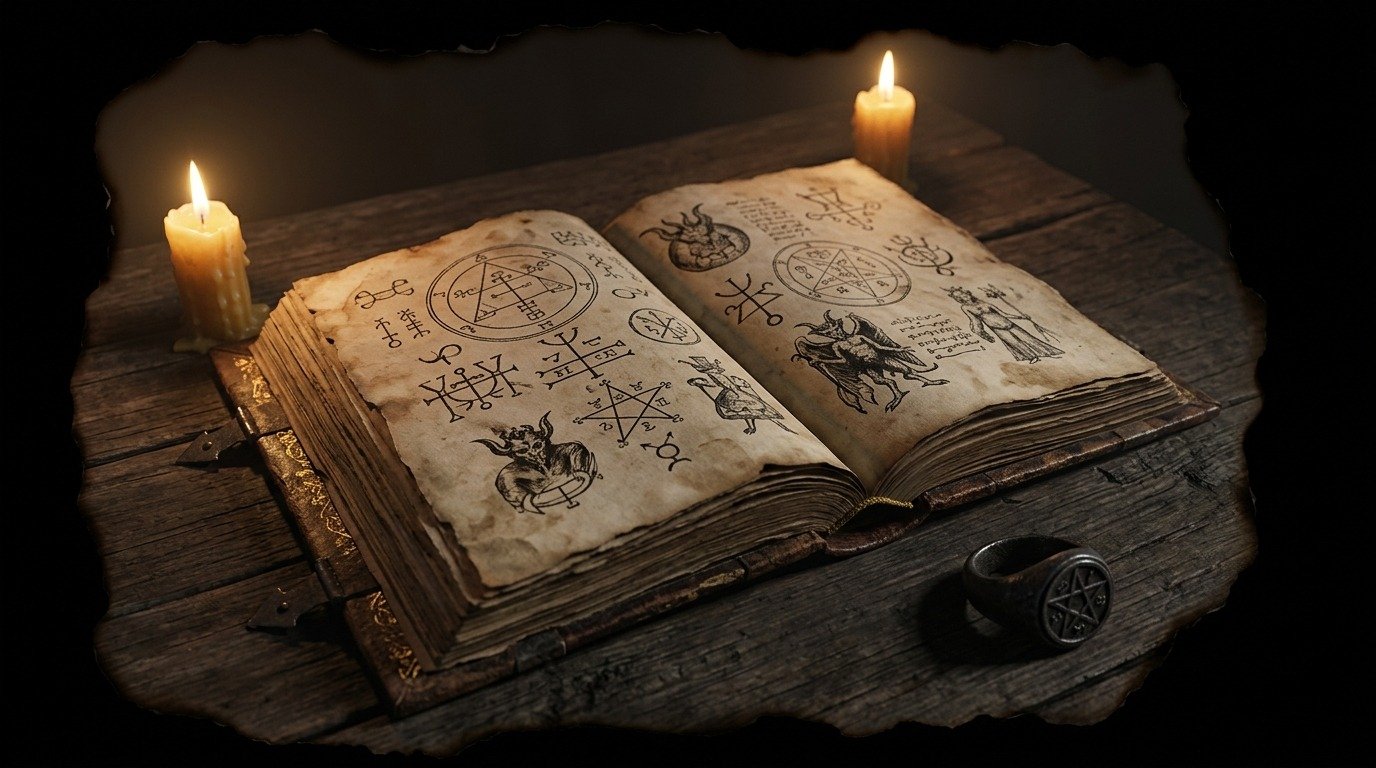
Testament of Solomon: The Ring That Chained Hell
The Testament of Solomon is a grimoire written in Ancient Greek, compiled in its definitive form between the 1st and 5th centuries of our era, which details the magical methods used by King Solomon to subdue and enslave the hosts of hell. The book reveals the secret names of dozens of demons, their physical forms, the illnesses they cause in human beings, and the precise angelic formulas to neutralize them. It is the foundational document of Western demonology and the manual that inspired all the grimoires of Solomonic magic of the Middle Ages.
The Catalog of Demons
The manuscript is presented as a first-person confession written by Solomon himself at the end of his life. The story begins when the demon Ornias harasses the young favorite of the architect of the Temple of Jerusalem, stealing half of his wages and absorbing his vital forces through the thumb of his right hand. Solomon, desperate over his servant's situation, prays in the temple and receives from the archangel Michael an iron ring with a seal engraved on a precious stone containing the five-pointed star.
With this ring, Solomon acquires absolute power over dark spirits. The text describes the interrogations that the king conducts with each of the demons he summons to his presence. Parading before him are figures such as Beelzebub, the prince of darkness; Asmodeus, the demon of lust who conspires against newlyweds; and spirits with grotesque forms like Onoskelis, a woman with the legs of an ass, or Lix Tetrax, a wind spirit that causes fevers and headaches. Each demon confesses under oath before the king which specific angel has the power to defeat them and which magical formula forces them to cut stone, haul water, or carve wood for the construction of the temple.
The Voice of a Wise King
Linguistic and theological analysis of the manuscript shows that, despite its attribution to the famous King of Israel of the 10th century BC, the text was originally written in Hellenistic Greek by an author of Judeo-Christian origin, possibly in Egypt or Asia Minor, during the first centuries of our era.
The author fused Jewish traditions regarding the legendary wisdom of Solomon with Chaldean astrology, Egyptian folk magic, and early Christian beliefs about angels and demons. The text demonstrates how the figure of Solomon underwent a radical transformation in the imagination of the Middle East: from being a ruler of political and intellectual wisdom, he became the supreme magician of the ancient world, the only mortal capable of dominating the invisible forces of creation.
The Birth of the Key
Throughout the centuries, the Testament of Solomon was secretly copied by Byzantine scribes and European medieval monks seeking to learn the secrets of spiritual invocation. Its influence expanded underground through monastery libraries and the archives of alchemists. From this manuscript emerged the direct foundations of famous grimoires of the Late Middle Ages and the Renaissance, such as the *Key of Solomon* or the *Lemegeton Clavicula Salomonis* (The Lesser Key of Solomon).
One of the most important surviving medieval manuscripts of the text is cataloged as *Parisinus Graecus 2419* in the National Library of France in Paris. This document, copied in the 15th century, allowed modern philologists to reconstruct and translate the original text, rescuing the ancient conjuration formulas that the magicians of antiquity believed to be effective against the forces of evil.
The Weight of the Ring
Today, the Testament of Solomon is studied in major European academic institutions as a fundamental link between organized religion and clandestine magical practices. The manuscript reveals that King Solomon's great work, the Temple of Jerusalem, was not erected solely by the strength of free men, but upon the chained shoulders of the demons that the king subdued under the power of a ring engraved with the name of God.
Comments
Share information, an experience, or a source to help enrich this entry. They are automatically reviewed before being published.
Loading comments...