The Great Flood
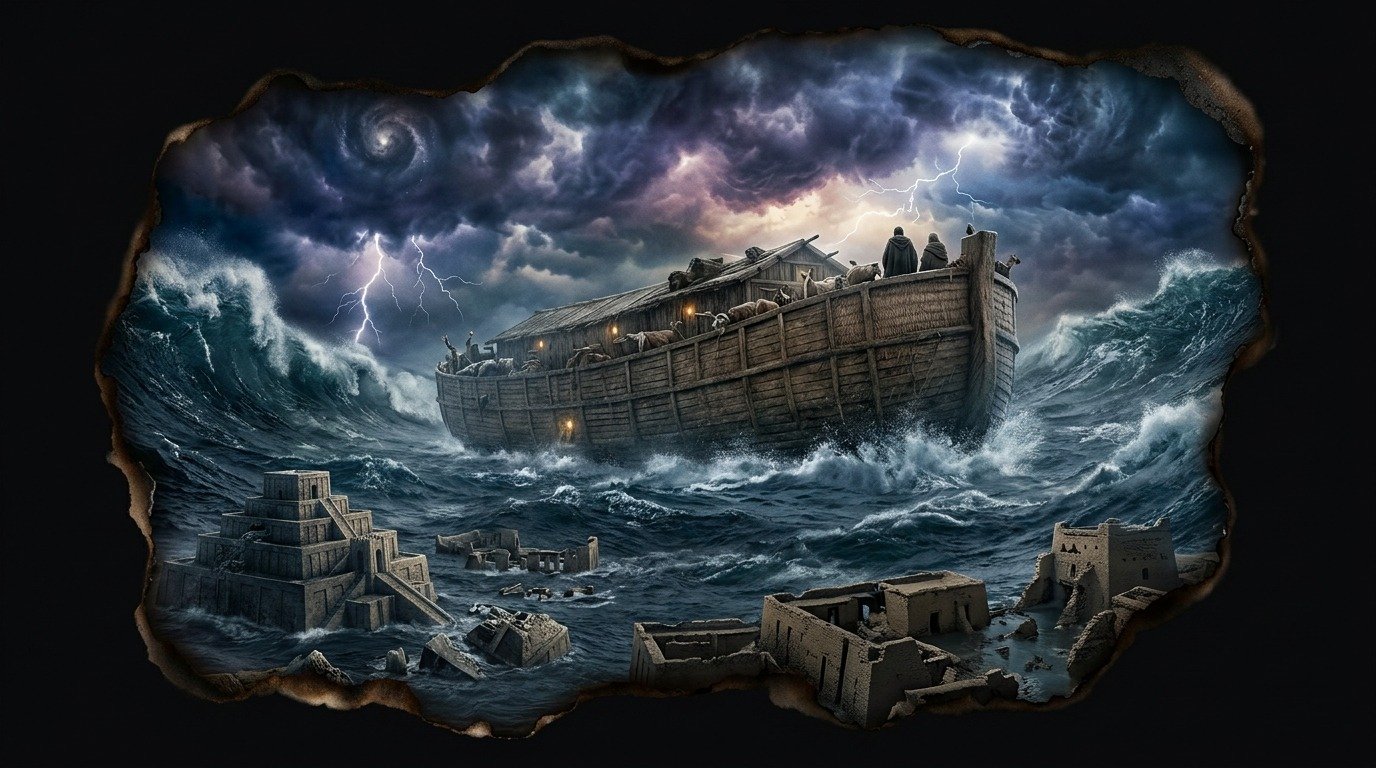
The Great Flood: The Day the Floodgates of Heaven Opened
On December 3, 1872, before the Society of Biblical Archaeology in London, George Smith presented the translation of an Assyrian clay tablet found in the ruins of Nineveh. Smith revealed that the text, known today as the *Epic of Gilgamesh*, contained the account of a global flood ordered by the gods, an ark built to save animals, and a dove released to search for dry land. The discovery shocked the Victorian world by demonstrating that the story of the Great Flood was not exclusive to the Book of Genesis, but rather a prophecy of destruction by water shared by the oldest civilizations on the planet.
The myth of the Great Flood represents the end of a cosmic cycle through purification by water. The prophecy, present in the traditions of Mesopotamia, Greece, India, the Americas, and China, warns that when humanity reaches an intolerable level of corruption, disobedience, or noise, the creator deity decides to wipe life from the face of the Earth to restart creation. Water is not seen merely as a punishment, but as the return of the universe to the primordial liquid chaos from which it emerged, allowing a single righteous man and his family to preserve the seed of a new humanity.
The Cataclysm in Different Cultures
The Mesopotamian version of the myth, reflected in the *Epic of Atrahasis* and the *Epic of Gilgamesh*, relates that the god Enlil, annoyed by the incessant noise of humans that kept him from sleeping, convinced the assembly of the gods to send a devastating flood to exterminate humanity. The god Enki, taking pity, secretly warned King Utnapishtim (Atrahasis), ordering him to tear down his reed house to build a massive vessel to house his family and the animals of the fields.
In the Hindu tradition, described in the *Shatapatha Brahmana*, the sage Manu found a small fish that asked him for protection. In exchange for saving it from predators, the fish (which was an avatar of the god Vishnu) warned him that a flood would destroy the Earth and ordered him to build a large vessel. When the waters rose, the fish, which had grown to a colossal size, pulled Manu's boat tied to its horn to the summit of the Himalayan mountains, saving the sage's life and the seeds of creation.
For its part, Greek mythology tells that Zeus, outraged by the impiety of the Bronze Age, unleashed the waters of heaven with the help of Poseidon. Only Deucalion and his wife Pyrrha survived by running aground on Mount Parnassus. Following the instructions of the oracle of Themis to throw "the bones of their mother" (the stones of Mother Earth) behind their backs, the stones thrown by Deucalion turned into men and those of Pyrrha into women, repopulating the world.
The Flood Panic in the Renaissance
Throughout the centuries, the fear of a new great flood reappeared whenever planetary alignments suggested an excess of the water element. At the end of the 15th century, the German astronomer Johannes Stöffler calculated that on February 20, 1524, a conjunction of twenty planets (including the Sun, the Moon, Mars, Jupiter, and Saturn) would occur in the water sign of Pisces. Stöffler publicly announced that this alignment would unleash a global flood that would destroy civilization.
The announcement sparked panic throughout Europe. Thousands of people living near coasts or rivers sold their properties and fled to the mountains. In Toulouse, the nobleman Aurial de Gondran built a three-story wooden ark stocked with provisions for his family and his animals. In Germany, the physician and historian Andreas Aurifaber documented how the citizens of Brandenburg abandoned their homes waiting for the appointed day.
What Really Happened
February 20, 1524, arrived, but the flood prophesied by Stöffler never occurred. In fact, chronicles of the time recorded that the month of February of that year was one of the driest and most arid in living memory in Central Europe. The only recorded disturbance was a light drizzle in some regions of Germany, which provoked the anger of citizens against the astrologers who had caused the collective hysteria.
From a historical and scientific standpoint, geologists argue that the universal flood myth may have originated from real but local catastrophic events at the end of the last ice age, around 5600 BC. The Black Sea deluge, caused by the rising sea levels of the Mediterranean Sea breaching the Bosphorus strait, flooded thousands of square kilometers (thousands of square miles) of inhabited land, leaving an indelible mark on the collective memory of the peoples who populated Mesopotamia and Europe. The water receded, but the warning from heaven remained engraved in stone and in sacred texts around the world.
Comments
Share information, an experience, or a source to help enrich this entry. They are automatically reviewed before being published.
Loading comments...