Ages of Man
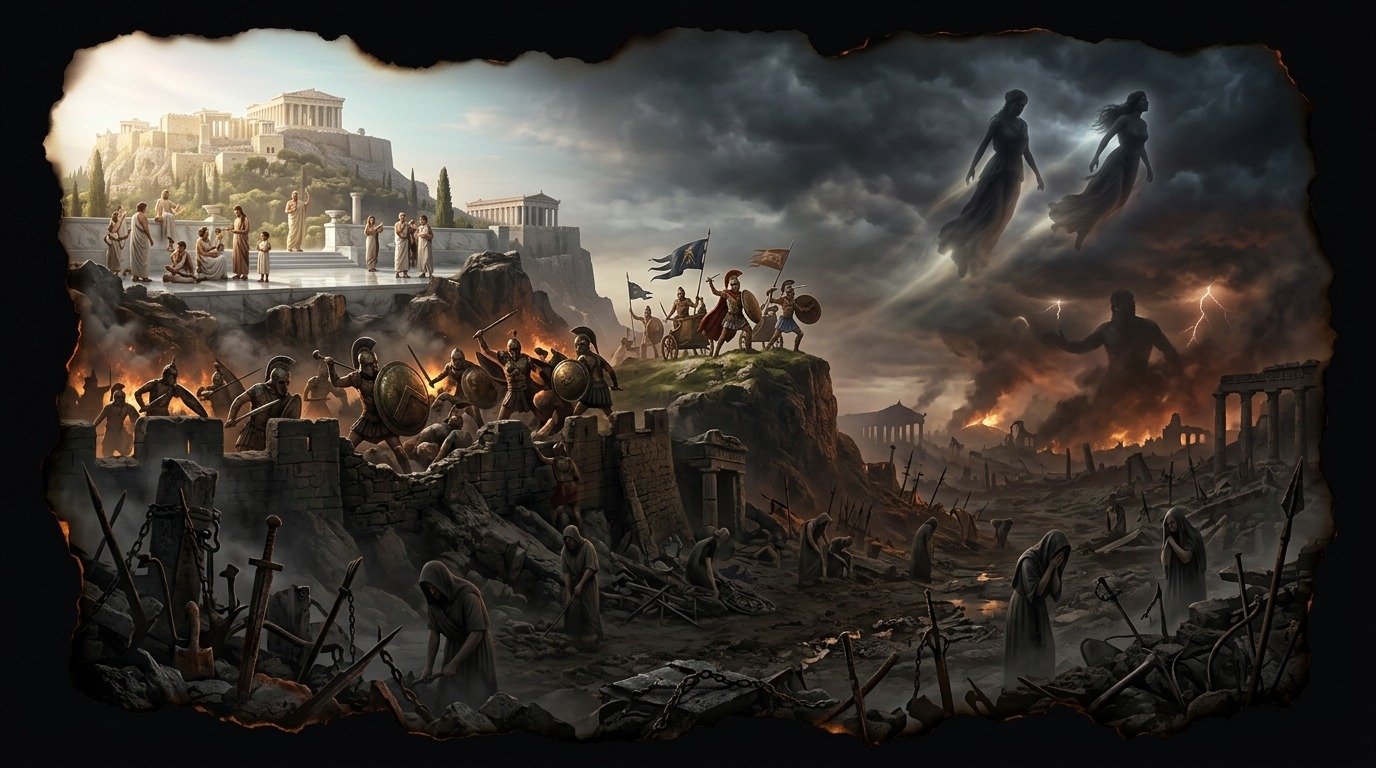
The Ages of Man: The Tragic Descent Toward the Iron Age
Around 700 BC, the Greek poet Hesiod wrote *Works and Days*, a didactic poem in which he warned his brother Perses and his contemporaries that they were living in the worst possible era in history: the Iron Age. Hesiod revealed that humanity does not move toward progress, but is instead trapped in a process of moral and physical degeneration that began in a golden paradise and will inevitably end with the total destruction of society at the hands of Zeus, when children are born with gray hair and parents kill their own children.
This prophecy divides the history of the world into five successive ages created by the gods: the Golden Age, the Silver Age, the Bronze Age, the Age of Heroes, and the Iron Age. Each phase represents a descent in moral quality and peace on earth, where virtue decreases and suffering increases. Hesiod's vision warns that the decline will culminate when the goddesses Aidos (shame in the face of evil) and Nemesis (indignation at injustice) definitively abandon the Earth to return to Olympus, leaving men helpless before a pain without remedy.
The Descent Down the Ladder of Metals
Greek tradition describes the Golden Age as the time of the reign of the Titan Cronus. In this era, men lived like gods, with hearts free of worry, without knowing labor, old age, or disease. The earth produced fruit in abundance spontaneously, and death came like a peaceful sleep. After disappearing, these souls became guardian spirits who watch over justice on Earth.
The Silver Age was created by the gods of Olympus. The men of this cycle were childish and physically inferior; they spent a hundred years being raised by their mothers and lived for a very short time once they reached maturity. Due to their foolishness, they did not worship the gods or perform sacrifices, which angered Zeus, who decided to bury them underground.
Zeus then created the Bronze Age, a race of strong and terrible men who cared only for war and violence. They did not eat bread, they had bronze weapons, bronze houses, and they worked with bronze. They ended up destroying one another with their own hands and descended to Hades without leaving a name worthy of remembrance.
To temporarily break the decline, Zeus created the Age of Heroes. This was a generation of demigods, more just and noble, who fought in the great wars of Thebes and Troy. Upon death, Zeus granted them a life free of pain in the Islands of the Blessed, at the ends of the Earth.
Finally, the Iron Age arrived, the era of Hesiod himself and of present-day humanity. It is a time of unceasing toil, where men do not cease to suffer misery and pain by day or by night, and where the gods send terrible worries.
The Origin of Hesiod's Complaint
Hesiod wrote this prophecy in Boeotia, an agricultural region of Greece, during a time of profound social changes and land disputes (including a lawsuit with his brother Perses over the family inheritance). Observing the greed of local judges and the loss of traditional community values, the poet interpreted the social crisis of his time as a cosmic law of decline.
His work adapted older Near Eastern myths, which already used metals to describe the successive ages of the world. The Hebrew prophet Daniel, centuries later, would use a similar image when interpreting King Nebuchadnezzar's dream of a statue with a head of gold, chest of silver, belly of bronze, and legs of iron and clay, representing the succession of earthly empires that would be destroyed by the Kingdom of God.
The Evolution of the Myth in the Roman Empire
Centuries after Hesiod, the Roman poet Ovid retook the prophecy in his work *Metamorphoses*, simplifying the cycle to four ages by eliminating the Age of Heroes. Ovid detailed how the end of the Golden Age brought the division of land by boundaries, navigation to plunder distant lands, and the excavation of the bowels of the earth in search of iron and gold, the metals that unleashed war.
During the reign of Augustus, the poet Virgil used this structure for political propaganda in his famous *Fourth Eclogue*, announcing that the birth of a child would bring back the Golden Age of Saturn and the end of the iron age. This interpretation deeply influenced early Christian thought, which saw in Virgil's verses a prophecy of the birth of Jesus.
The End of the Iron Age
Hesiod did not leave a precise date for the end of the Iron Age, but he accurately described the signs of its final collapse. The end will come when there is no agreement between guest and host, when brothers do not love each other as before, when children insult their elderly parents, and when the violent and wicked man is praised above the just.
Although the definitive collapse predicted by the poet did not instantly destroy the Hellenic world, the prophecy of the Ages of Man established the cyclical conception of history in the ancient world. The belief that we live in the worst of all possible times continues to resonate in human consciousness whenever society faces a moral or value crisis.
Comments
Share information, an experience, or a source to help enrich this entry. They are automatically reviewed before being published.
Loading comments...