Rougarou
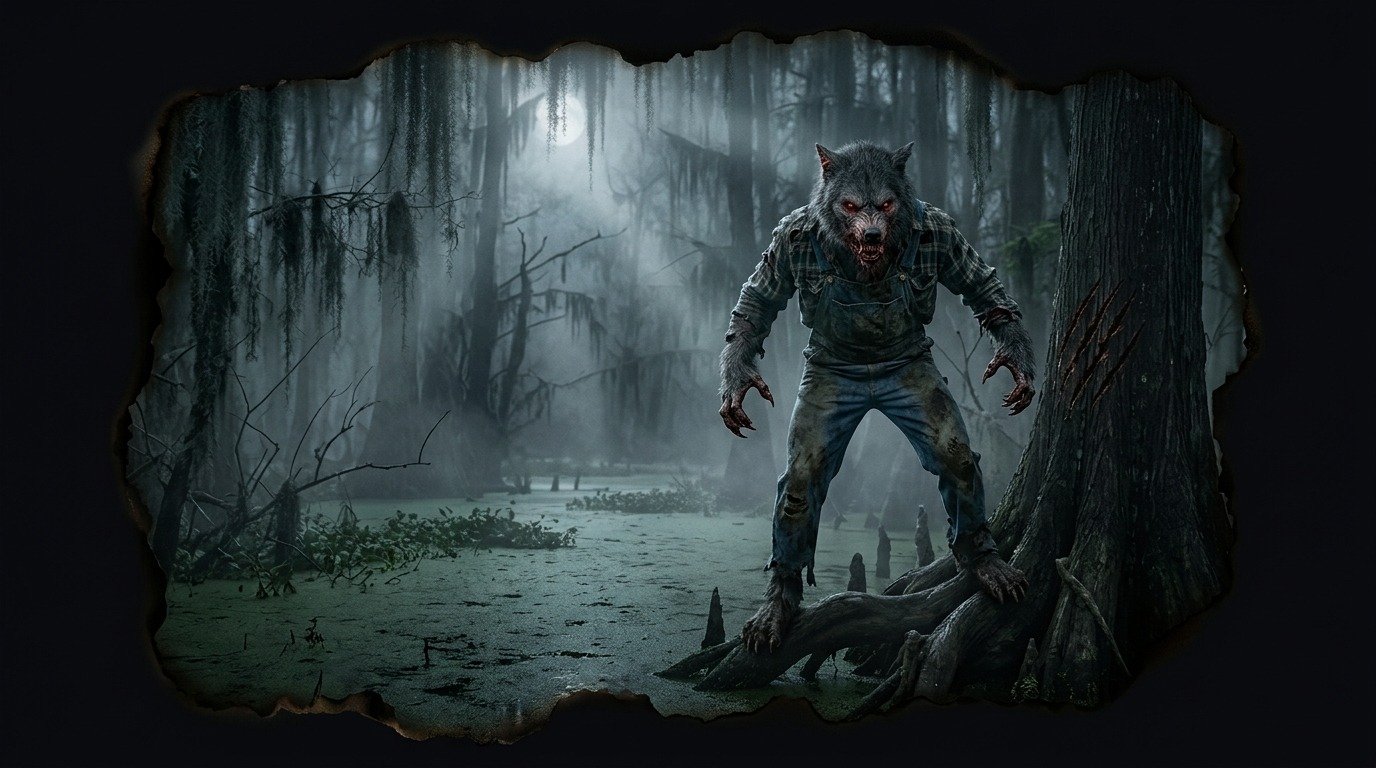
Rougarou: the beast of fever and mud in the Louisiana marshes
Cultural Origin and Migration
The *Rougarou* (alternatively spelled *Rugaroo* or *Roux-Ga-Roux*) is a creature born of exile, geographical isolation, and environmental adaptation. Its origins lie in the folklore of northern and western France, where medieval legends of the *loup-garou* were part of the daily life of rural communities. With the French colonization of Acadia (in present-day Canada) and the subsequent forced deportation of the Acadians in the 18th century to the inhospitable lands of southern Louisiana, the myth mutated to adapt to the new and dense environment of the *bayous* (swamps), the cypress marshes, and Cajun culture. In the process, the European wolf—nonexistent in the Louisiana swamps—was replaced in the collective imagination and oral tales by the feral swamp dog, the alligator, or an anthropomorphic creature with a canine head that stalks amidst the fog and floating vegetation of the wetland.
The Moral Legend, Lent, and Catholic Punishment
Unlike the *Skinwalker* or the *Nahual*, whose background is of a deep mysticism, the *Rougarou* historically functioned as a mechanism of social and moral control within the Cajun community, which was heavily Catholic and cohesive due to strict religious codes. The most common path of transmutation described in Louisiana oral tradition is linked to the breaking of religious precepts: - The individual who breaks the rules of Lent (*Carême*) for seven consecutive years will fall under the curse of the *Rougarou*. The devil or a swamp spirit will take possession of their body as punishment for their moral weakness and ecclesiastical disobedience. - The figure of the *Rougarou* was also used as a "boogeyman" by Cajun parents to prevent children from wandering alone into the treacherous swamps after dark, where currents, alligators, and quicksand represented real and deadly dangers.
Mechanics of Infection and Metamorphosis
The state of the *Rougarou* is not always permanent, but rather manifests as a cyclical affliction that lasts exactly 101 days. - **Blood transmission:** The stigma is spread through direct contact with the beast's blood. If a person is attacked by a *Rougarou* and its blood comes into contact with an open wound, or if the monster bites its victim drawing only a single drop of blood without killing them, the curse is transferred to the victim. - **The rule of absolute silence:** During the 101-day period, the infected person feels an overriding urge to seek the darkness of the cypress groves at night, where they transform into a beast with the head of a giant wolf-dog, bloodshot eyes, and claws capable of tearing through the wood of cabins. However, they retain a glimmer of human consciousness. If they reveal their condition to any living soul before the 101-day period expires, the curse will become irreversible and they will be condemned to wander the marshes eternally as a wild beast.
Manifestation in the Territory and Defense
The *Rougarou* moves with agility over the aerial roots of the bald cypress trees (*Taxodium distichum*) and stagnant waters, emitting a harsh sound that is confused with the croaking of large bullfrogs and the creaking of damp wood. To repel it, Cajun popular culture developed methods based on domestic ingenuity and protective superstition: - **The test of the thirteen stones or grains:** Thirteen grains of sand, small stones, or grains of rice are placed on the threshold of the house door. The *Rougarou*, upon reaching the entrance, is forced by an uncontrollable arithmetic compulsion to count the objects. However, being unable to count past the number twelve (due to its beastly nature and clouded mind), it becomes confused, loses count, and begins the count all over again infinitely until the first rays of the sun force it to retreat into the deep mud. - **The use of the blessed sugarcane leaf:** Placing sugarcane leaves braided in the shape of a cross over windows prevents the entity from entering inhabited spaces. - **Purification by fire:** The only documented way to permanently free a soul from the curse of the *Rougarou* without killing it is to inflict a wound that bleeds profusely using a blessed knife, or to burn part of its fur with a resinous pine torch. Upon spilling the cursed blood onto the swamp floor, the beast instantly regains its human form, breaking the 101-day cycle.
From the loup-garou to the swamp: other versions
In other versions, the migration of the Acadians from France to eastern Canada is situated in the 17th century, and in the new environment of Louisiana, dense, humid, and filled with unknown dangers, the ancient medieval European belief in lycanthropy merged with local superstitions, Santería, New Orleans Voodoo, and Native American narratives. The Rugaru ceased to be the wolf of the forested steppes of Europe to become a predator of the swamps, a creature of fiery eyes that hides among the Spanish moss of the bald cypresses.
The transferred curse
Whoever breaks the rules of fasting and abstinence of Lent for seven consecutive years falls under a curse that deforms their body, transforming them into a beast with the head of a wolf, dog, or wild boar, and a human body covered in coarse, dark fur. In this version, during the 101 days the Rugaru wanders the swamps stalked by an insatiable thirst for blood. To free itself from this state, the creature must bite or wound another human being, spilling their blood. The instant the victim's blood touches the ground, the Rugaru regains its original human form, but the curse is immediately transferred to the attacked person. There is a strict law of silence associated with this process: if the freed person reveals the identity of the creature that attacked them or speaks of their experience before a year and a day have passed, they will turn back into the beast permanently.
The rugaru of the Ojibwe and the Cree
In the north of the continent, particularly in the Great Lakes, the Ojibwe and Cree peoples adopted the French word *loup-garou*, pronouncing it as *rugaru*. However, in these regions, the entity underwent a process of syncretism with the Wendigo. The *rugaru* of the Canadian Indigenous peoples is not simply a Catholic moral lycanthrope, but a man-eating creature born of greed and the violation of ecological taboos. This hybrid version retains the voracious appetite for human flesh and the ability to inhabit the bodies of those who have committed atrocities in times of famine, thus uniting the European heritage of physical transformation with the spiritual possession of Indigenous tradition.
More ways to contain the beast
- **The thirteen pennies:** It is believed that the Rugaru suffers from a mathematical and intellectual obsession that prevents it from resisting counting. If thirteen pennies, grains of sand, or small rocks are placed on the threshold of the door, the creature will try to count them over and over again. Lacking the mental capacity to surpass the number twelve (associated with the apostles and cosmic order), it becomes confused, loses track of time, and flees at dawn before being able to enter the home. - **The spilling of minimal blood:** To cure a Rugaru without killing it, a hunter or family member must track it down and cause it a minor wound (usually a cut on the forehead or the front right paw) using a blessed weapon or a common kitchen knife. As the first drop of blood wells up, the spell is temporarily broken. - **Fire and decapitation:** If the creature is completely wild and has lost all trace of its humanity, Cajun tradition prescribes its death by fire. The body must be completely burned, and the ashes scattered in running waters to prevent the cursed essence from returning to the swamp.
Comments
Share information, an experience, or a source to help enrich this entry. They are automatically reviewed before being published.
Loading comments...