Wendigo
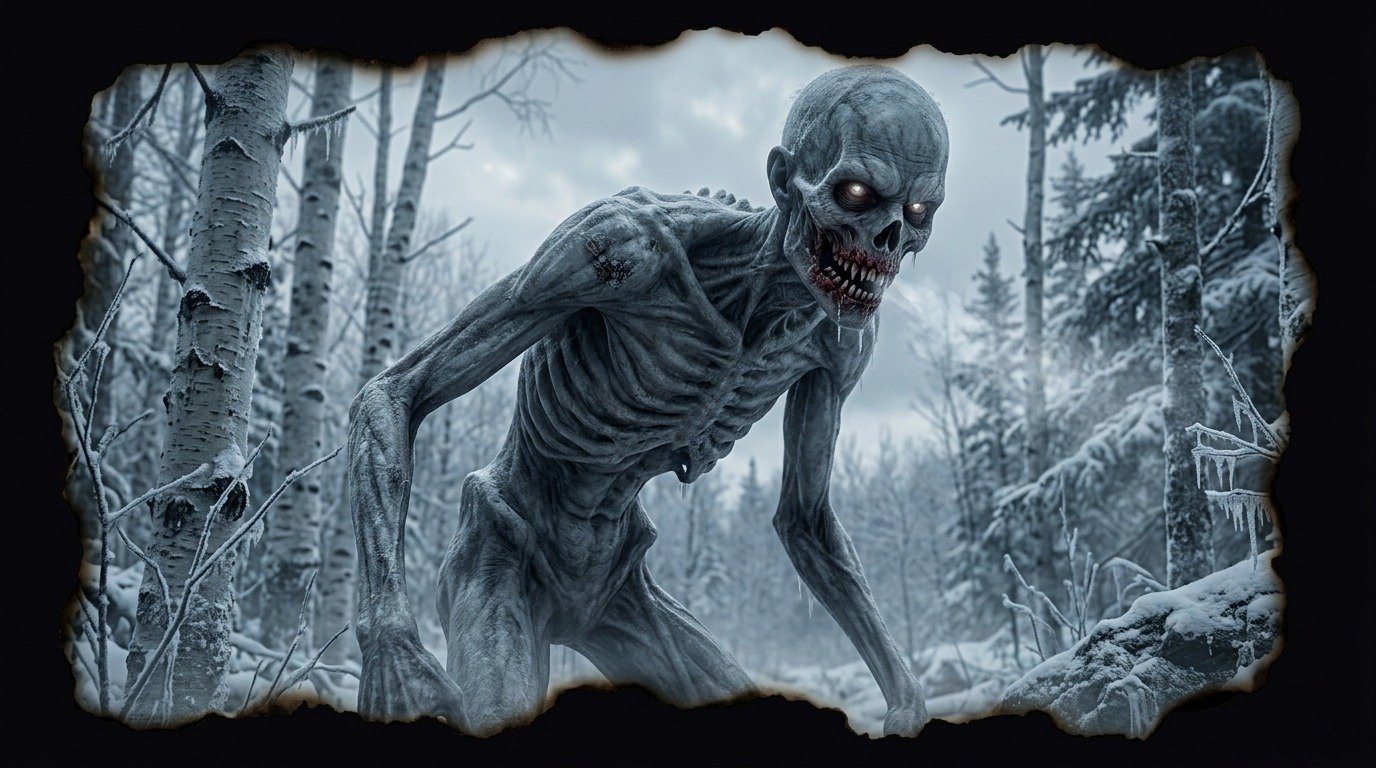
Wendigo: The Absolute Devourer of the White Deserts
Algonquin Origin and Cosmogony
In the northern cold of the forests of the Great Lakes region and the surrounding areas of Canada, the Algonquin nations (including the Cree, the Ojibwe, the Saulteaux, and the Innu) bred the most terrible warning of their cosmogony: the *Wiindigoo* (or *Windigo*). This entity does not belong to the order of zoological monsters, but is a liminal force that embodies the desolation of winter (*Pipoun*), extreme starvation, and the ultimate taboo of human survival: cannibalism. The genesis of the Wendigo is dual. On one hand, it manifests as an incorporeal spirit, a frozen whisper that travels through the leafless forests, searching for minds weakened by isolation and hunger to possess them. On the other, it represents the physical and spiritual metamorphosis of a human being who, having consumed the flesh of their own species to avoid dying of starvation, surrenders their humanity in exchange for a cursed survival. In the Algonquin tradition, winter is not just a climatic season, but a state of mystical vulnerability where the borders of the mind and the environment freeze, allowing the intrusion of this parasitic entity.
Anatomy of Insatiability
Contrary to the iconography popularized by contemporary culture—which erroneously endows it with deer antlers or exposed skulls—the Wendigo of original folklore is a creature of shocking thinness. Its silhouette is the very personification of hunger. The testimonies passed down by Algonquin elders describe a being of colossal proportions that grows in size directly proportional to what it devours; in this way, no matter how much it consumes, it always remains skeletal and starved. Its skin is an ashen gray, similar to the color of a decaying corpse, and clings tightly to its ribs and prominent bones. Its eyes are sunken deep into their sockets, burning with a feverish and inhuman glow. Its lips are usually chewed, torn by its own teeth in a desperate attempt to satisfy its hunger by devouring itself. It exhales a stench of an open grave, of damp flesh and winter rot, and its voice mimics the cracking of trees under ice or the whistling of the arctic wind.
Psychosis and Spiritual Possession
The phenomenon of the Wendigo transcends mere folkloric superstition to enter the annals of medical anthropology and forensic psychiatry under the term "Wendigo psychosis" (*Wendigo psychosis*). Documented in native communities during the 18th and 19th centuries, this psychological affliction manifested in individuals exposed to long periods of winter starvation. The patient presented a paranoid obsession with cannibalism, claiming that the spirit of the Wendigo had entered their chest or that their own heart was turning into pure ice. From the perspective of deep esotericism and shadow psychology, the Wendigo represents the archetype of the devouring and unbridled ego. It is the destructive consumption that does not generate nourishment, but more hunger. In modern esoteric treatises, it is interpreted as the ultimate psychic parasite: a larval force that feeds on despair and isolation, inducing the subject to break the basic social bond to become a solitary predator.
Prevention and Traditional Exorcism
For the Algonquin tribes, the treatment of an individual suspected of transforming into a Wendigo was a matter of extreme urgency and community danger. Once the person's heart turned to ice, the process was considered irreversible. The medicine men or shamans of traditional medicine (*Midewiwin*) employed intensive purification rituals with smoke cleansing of sage and cedar to repel the influence of the spirit in its initial phases. However, if the person had already consumed human flesh or showed clear signs of irreversible possession, the protection protocol dictated their execution. The most documented method consisted of destroying the creature's heart, which was believed to be a solid block of ice. The body of the possessed had to be decapitated and their heart extracted to be burned in a sacred bonfire until reduced to ashes. Only absolute fire could melt the frozen core of the Wendigo and free both the soul of the possessed and the community from being targeted.
A Documented Evil Since the 17th Century
Among the Algonquin-speaking peoples, the Wendigo has phonetic variants such as *wiindigoo*, *windigo*, or *wetiko*, and the fear of it also reaches the Naskapi. The transformation into a Wendigo is closely linked to the so-called "Wendigo psychosis," a mental disorder documented by Western anthropologists and psychiatrists since the 17th century. Those affected manifested early symptoms of alienation, followed by an obsessive conviction of being possessed by the spirit of the monster, which triggered an extreme aversion to common foods and a violent, uncontrollable desire to consume human flesh. In many documented historical cases, individuals who fell into this state requested to be executed by their own clan to avoid becoming a lethal threat to the community.
The Archetype of Infinite Consumption
From a perspective of deep psychology and comparative esotericism, the Wendigo is the archetype of destructive gluttony, absolute selfishness, and ecological imbalance. The concept of *wetiko* has been used by indigenous philosophers and intellectuals, such as Jack D. Forbes, to describe the spiritual pathology of colonialism, unbridled capitalism, and the systematic exploitation of the earth.
The Wendigo is "consumption for the sake of consumption itself," an entity that destroys its own environment to feed itself, without understanding that its own existence depends on that which it annihilates. In alchemical terms, it represents the deepest *nigredo*: the soul trapped in cold matter, unable to transmute physical hunger into spiritual nourishment, condemned to an eternal cycle of dissatisfaction and internal rot.
What the Ojibwe Hunters Tell
In the traditional chronicles of the Ojibwe hunters, facing a Wendigo required more than physical weapons, as the creature possesses superhuman speed, the ability to mimic human voices to lure its prey into the deep forest, and an aura of terror that paralyzes its victims. - **The fragment of ice:** Traditional stories insist that the body of the Wendigo must be completely incinerated until reduced to fine ashes. If a single fragment of its ice heart remains unmelted, the entity can reform its body or possess the hunter who dares to desecrate its remains. - **The use of sacred metals:** Molten lead or silver daggers tempered in infusions of protective medicinal plants, such as sage or cedar, were employed by shamans (*midewiwin*) to weaken the armor of ice and hardened skin that protects the beast.
Comments
Share information, an experience, or a source to help enrich this entry. They are automatically reviewed before being published.
Loading comments...