Werewolf
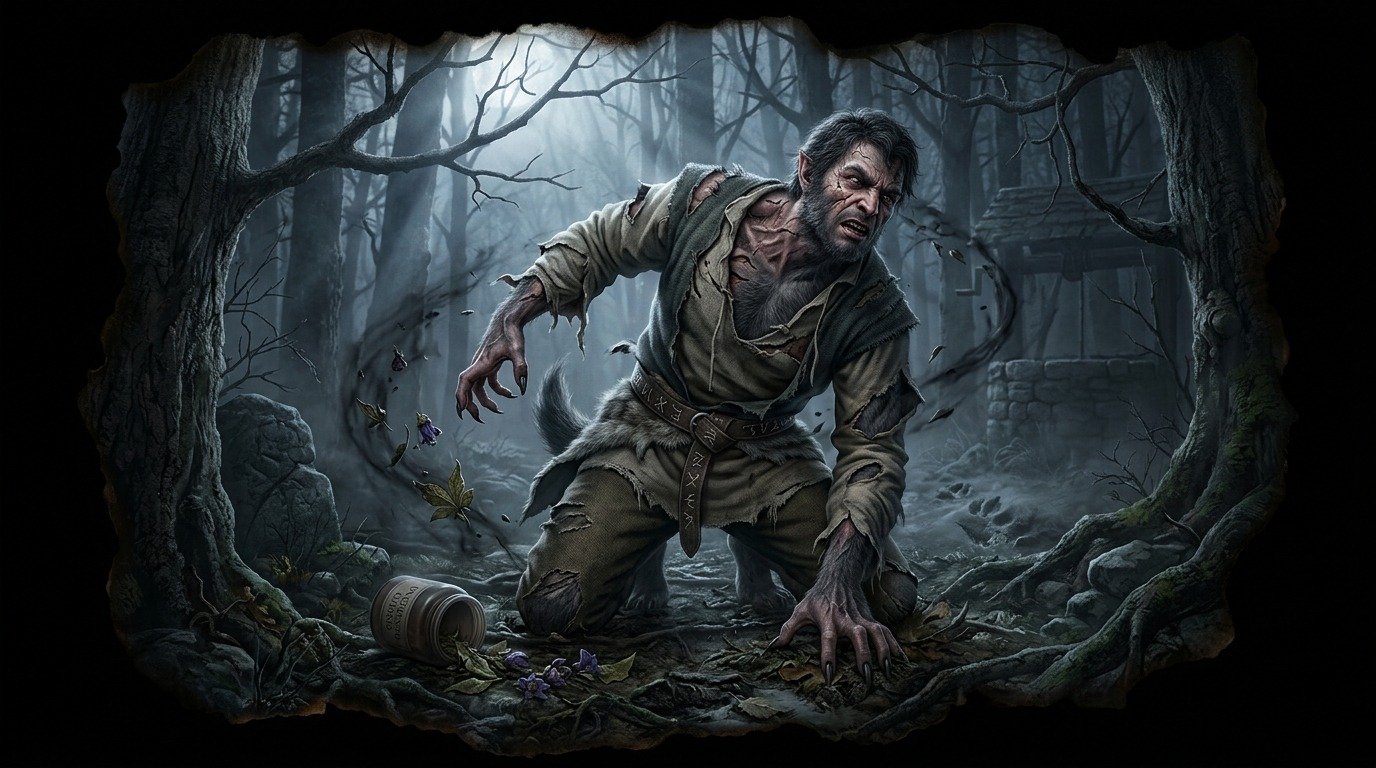
European Werewolf: The Transmutation of the Beast and the Fever of the Forests
Origin and Transmutation
Lycanthropy, as a folkloric and pathological phenomenon, has roots that sink deep into the European Paleolithic and Greco-Roman antiquity. The concept of the French *loup-garou*, a direct heir to the Roman *versipellis* described by Pliny the Elder and Petronius, crystallized in the Late Middle Ages as an amalgam of residual paganism, collective hysteria, and demonic theology. In the forested regions of France, Germany, and the Baltic States, the transformation was not seen merely as a physical aberration, but as a state of spiritual degradation induced by one's own will or divine punishment.
The judicial records of the 16th and 17th centuries in France (such as the trials of Gilles Garnier in Dole, 1573, or Jean Grenier in Bordeaux, 1603) reveal a precise legal and theological doctrine: the devil did not have the power to alter divine creation by changing the physical form of a man, but instead projected an optical illusion (an "aerial body" or glamour illusion) over the creature, or else numbed the senses of the witch while they perpetrated their crimes in a state of ecstatic somnambulism, firmly believing themselves to be a wolf.
The Process of Metamorphosis and Pathology
In classical folklore, the transformation required specific catalysts. Two main pathways of transmutation are distinguished: - **The active or voluntary pathway:** Associated with sorcery. The individual anointed their body with an ointment composed of animal fats combined with solanaceous plants (belladonna, black henbane, aconite) and opium, substances that induced states of delirium and tactile hallucinations (the sensation of having fur and claws). Subsequently, they girded themselves with a belt made of wolf skin cured under specific lunar phases. - **The passive or cursed pathway:** The result of a moral transgression or a family curse. Being born on Christmas Eve, consuming water accumulated in a wolf's footprint, or ecclesiastical excommunication were common causes pointed out by medieval chroniclers.
The medicine of the era, through treatises such as Johann Weyer's *Melancholia*, attempted to demystify the phenomenon by classifying it as "lupine melancholy" or clinical lycanthropy, a mental disorder where the patient experiences the absolute certainty of their beastly nature, rejecting clothing and feeding on raw meat in cemeteries and forests.
Symbology and Esoteric Archetype
From the perspective of depth psychology and Western esotericism, the werewolf represents the violent rupture of the ego's rational container before the push of the Shadow. It is the regressive return to the wild state (*homo homini lupus*), where the intellect is subjugated by territorial, predatory, and sexual instincts repressed by the Christian social order. In alchemy, the wolf (particularly the "gray wolf" or *lupus metallorum*) symbolizes the prima materia in its most chaotic, voracious, and impure state, which must be purified by fire before transmutation.
Manifestation and Containment Protocols
The historical *loup-garou* is characterized by disproportionate strength, relative immunity to physical pain, and a hypertrophied sensory acuity. Unlike modern cinematic representations, vulnerability to pure silver was not a universal element in ancient texts, but a later addition of nineteenth-century Gothic literature (popularized after the case of the Beast of Gévaudan and the blessed silver bullet cast by Jean Chastel).
The traditional methods of neutralization and disenchantment documented in rural Europe included: - **Skinning:** Upon capturing the suspected beast, incisions were made in its skin to check if the fur grew inward (a belief of the *versipellis*, who kept the wolf beneath the human dermis). - **The wound on the forehead:** Making a cross-shaped cut on the wolf's head with a cold iron knife to force the human essence to manifest through the wound. - **Calling by the baptismal name:** Pronouncing aloud the individual's Christian name while in wolf form immediately broke the spell, returning them to their vulnerable state.
Comments
Share information, an experience, or a source to help enrich this entry. They are automatically reviewed before being published.
Loading comments...