Werewolf of Auvergne
Werewolf of Auvergne: The Amputated Transmutation and the Revelation of the Ring
The Incident of the Severed Claw
In the year 1588, in the mountainous province of Auvergne, in the heart of France, one of the most disturbing judicial and folkloric cases of European lycanthropy was recorded. A local hunter (or a local nobleman, according to minor variations in the records) ventured into the dense and dark forests of the region. During his foray, he was attacked with unusual ferocity by a wolf of colossal size and unnatural aggressiveness.
The hunter, accustomed to fighting beasts, managed to repel the attack using his dagger. At the climax of the struggle, he delivered a precise slash that amputated the animal's right front paw. The wolf, howling in pain, fled and vanished into the thicket. The hunter picked up the amputated paw, put it in his leather pouch as a trophy, and headed to the castle of a local nobleman, identified in the chronicles as the Lord of Apcher or the Lord of Chazel, to recount the event.
Historical Context and Judicial Demonization
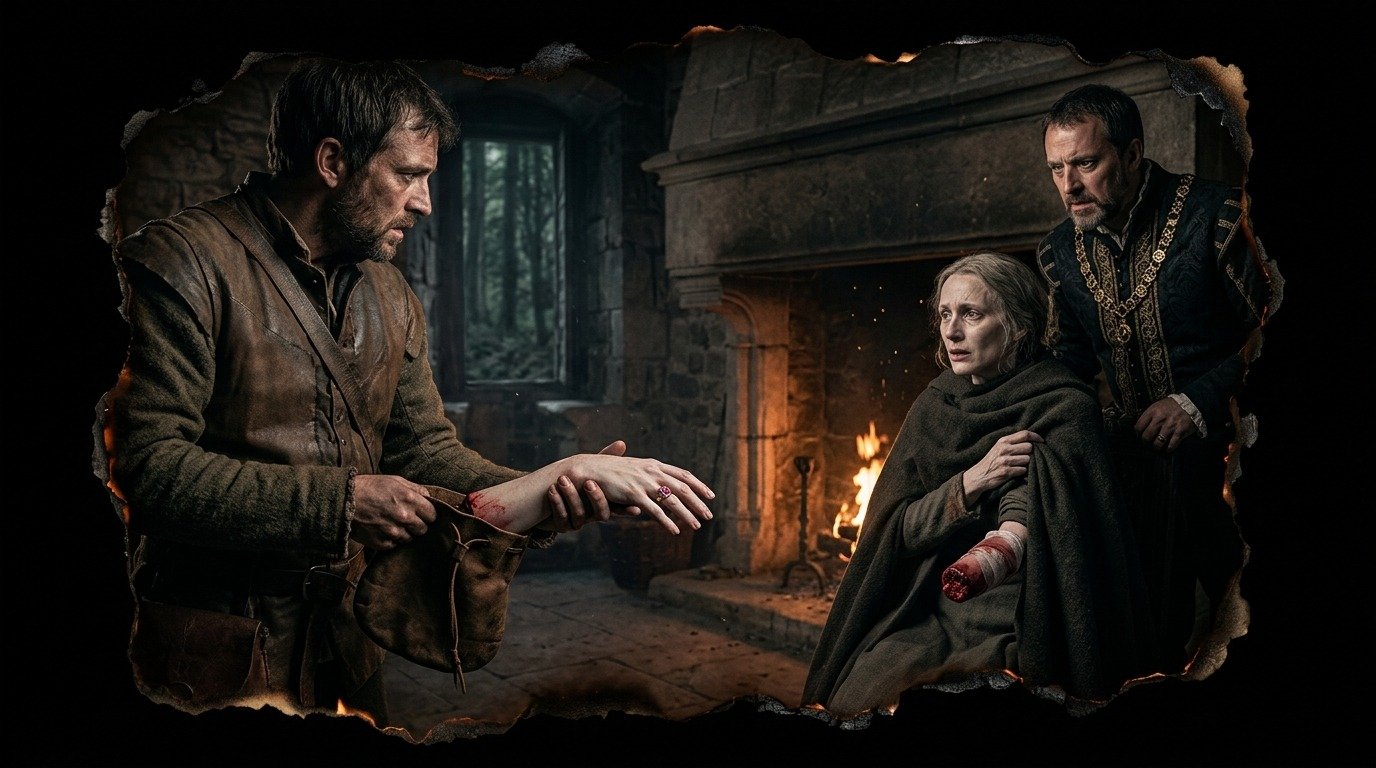
Upon arriving at the castle, the hunter opened his pouch in front of the nobleman to display the wolf's paw. However, what he extracted from the bag was not a canine limb covered in gray fur, but a female human arm, severed at the wrist. On one of the fingers of the pale and bloody hand, a gold ring with a distinctive gem gleamed. The nobleman, horrified, immediately recognized the jewelry: it belonged to his own wife.
The lord of the castle immediately went to his spouse's quarters. He found her sitting by the fireplace, wrapped in a thick cloak and with a livid face. Upon removing her coat, he discovered that her right forearm ended in a bloody stump, roughly bandaged. The woman confessed to having assumed the form of the beast through the use of a magical ointment provided by the Devil. She was summarily tried by the ecclesiastical court of Riom and sentenced to die at the stake, a punishment that was carried out immediately before the community.
Symbology of Female Lycanthropy
The case of the Werewolf of Auvergne (in this case, a werewolf woman) is fundamental to understanding the evolution of the myth of lycanthropy in Early Modern Europe. Unlike Northern Europe, where the wolf was often seen as a herald of shamanic or warrior forces, in the context of the French Counter-Reformation, lycanthropy was completely assimilated into satanic witchcraft. The *versipellis* (he who changes skin) did not suffer from a medical illness, but rather made an explicit pact with the devil to receive the power of transmutation.
The element of the amputated paw that turns into a hand when separated from the body of the beast is a recurring motif in witch-hunt folklore (*Malleus Maleficarum*). It represents the impossibility of maintaining the demonic deception in the face of the reality of the human body. It is the collapse of the satanic illusion (*ludibrium*): the devil can alter the perception of the hunter's senses to make him see a wolf, but the real and immutable matter (the hand with the ring) remains linked to the identity of the sinner.
Detection and Containment Protocols
The demonology treatises of the era, particularly those of Jean de Nynauld (*De la Lycanthropie, transformation et extase des sorciers*, 1615) and Henri Boguet (*Discours des Sorciers*, 1602), used this case as theological jurisprudence. For inquisitors, the detection of a lycanthrope required direct confrontation with their wounded human form. Suspects were examined for wounds corresponding to the damage inflicted upon the beast in the forest.
The containment of these entities did not require silver bullets—a later myth popularized by nineteenth-century literature and cinema—but rather the neutralization of the pact. The use of weapons of blessed iron, the invocation of divine names during the confrontation, and the public burning of the remains were the prescribed legal and religious methods. Destruction by fire not only punished the physical body but also purified the earth of the corrupt fluid of the ointment that enabled the metamorphosis.
Comments
Share information, an experience, or a source to help enrich this entry. They are automatically reviewed before being published.
Loading comments...