Ijiraq
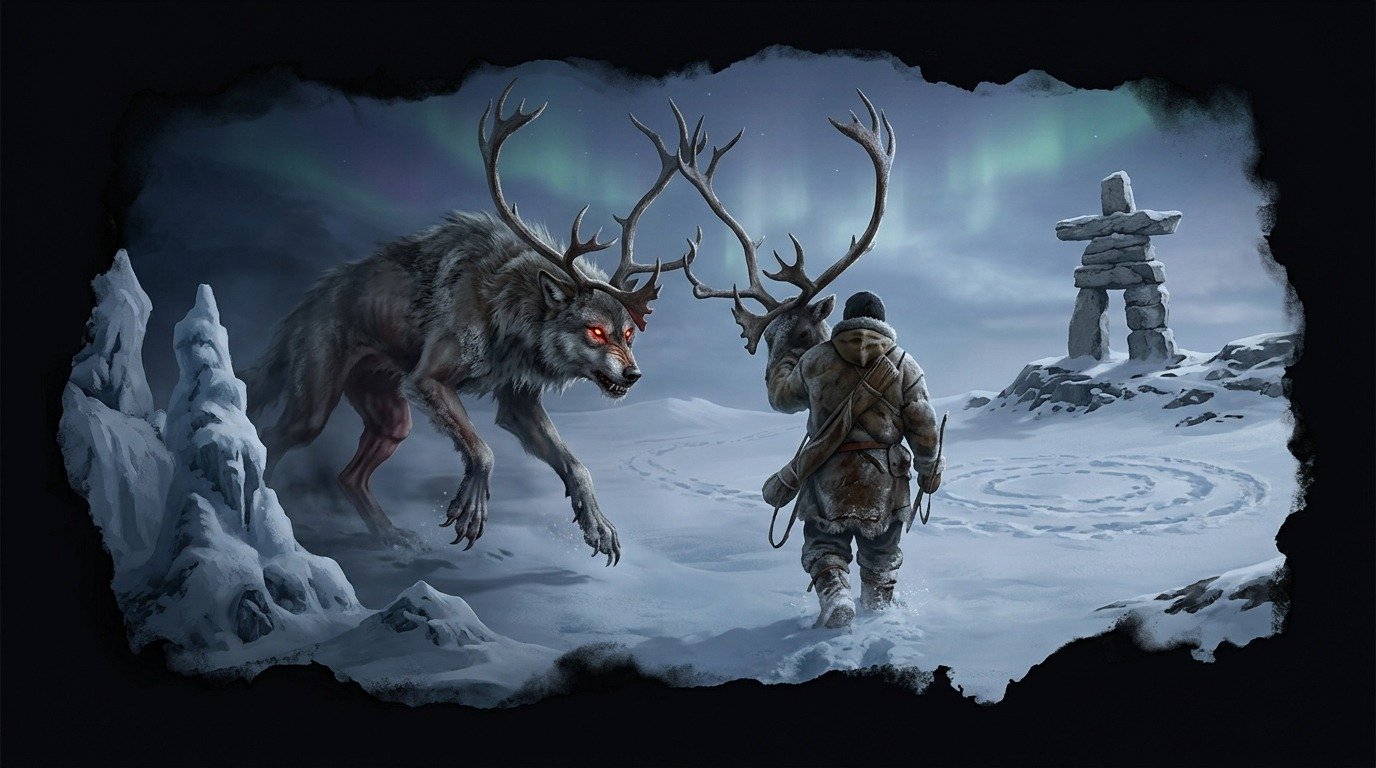
Ijiraq: The Mirage of Shadows in the Arctic Wasteland
The Shadows of the Frozen Wasteland
In the vast and hostile territory of the Canadian Arctic (Nunavut), Inuit cosmology describes the *Ijiraq* (plural *Ijirait*) not as a physical animal infected with rabies, but as a shapeshifting spirit of a liminal and elusive nature. The *Ijiraq* inhabits the intermediate plane between the world of the living and that of nature spirits (*Inua*). Its name translates approximately to "the one who is hidden" or "the one who hides." Unlike European lycanthropes, the *Ijiraq* does not require the moon to transform; its true form is elusive to the direct human eye: it manifests as a swift shadow, a dark anthropomorphic silhouette in the periphery of one's vision that disappears when one attempts to stare directly at it.
The Lycanthropy of the Tundra: Caribou and Wolf
When the *Ijiraq* decides to densify on the material plane, it usually adopts hybrid or distorted forms of Arctic fauna. It can appear as a caribou with wolf claws, or a wolf whose eyes glow with a supernatural red fire and whose hind legs retain a vaguely human shape. However, its most dangerous transformation is that of the *imitative mirage*: it can take the form of a relative or a known hunter to lure travelers away from their settlements. The primary purpose of the *Ijiraq* is the abduction of children and the disorientation of adults. Anyone who enters the territory of an *Ijiraq* is struck by *illunajiut*, a form of spatial amnesia and delirium where the familiar landscape becomes completely alien, leading the victim to freeze to death while walking in concentric circles.
The Sinister Mirage of the Mind
Symbolically, the *Ijiraq* is the personification of Arctic isolation and the fragility of the human psyche before the vast, monotonous white of the tundra. It represents the ancestral fear of becoming lost, not only physically, but mentally (the dreaded "Arctic hysteria" or *pibloktoq*). On the esoteric plane, the *Ijiraq* is the master of illusion (*Maya* in Eastern terms), the veil that distorts the perception of reality. It reminds us that the greatest dangers do not always come from tangible claws, but from the projections and distortions that our own mind generates when deprived of stable reference points.
Safeguards on the Ice
To survive an encounter with an *Ijiraq*, Inuit hunters and initiates of shamanism (*Angakkuq*) employ the following traditional defenses: - **Peripheral Vision:** One must never look directly at a suspicious shadow on the tundra. The *Ijiraq* can only be clearly observed out of the corner of one's eye; a direct gaze allows it to establish its mental anchor on the victim and begin the process of disorientation. - **The Stone Monolith (Inuksuk):** The *inuksuit* (human-shaped stone monuments) act as anchors of reality. The *Ijiraq* cannot approach a well-built *inuksuk*, as these structures represent order, memory, and the presence of the community in the frozen wilderness. - **The Use of the True Name:** If a visitor is suspected of being an *Ijiraq* in disguise, they must be questioned, demanding that they pronounce the names of their deceased ancestors. The spirit cannot replicate the sacred genealogy of the tribe without revealing its grotesque nature.
Comments
Share information, an experience, or a source to help enrich this entry. They are automatically reviewed before being published.
Loading comments...