Wolfssegen
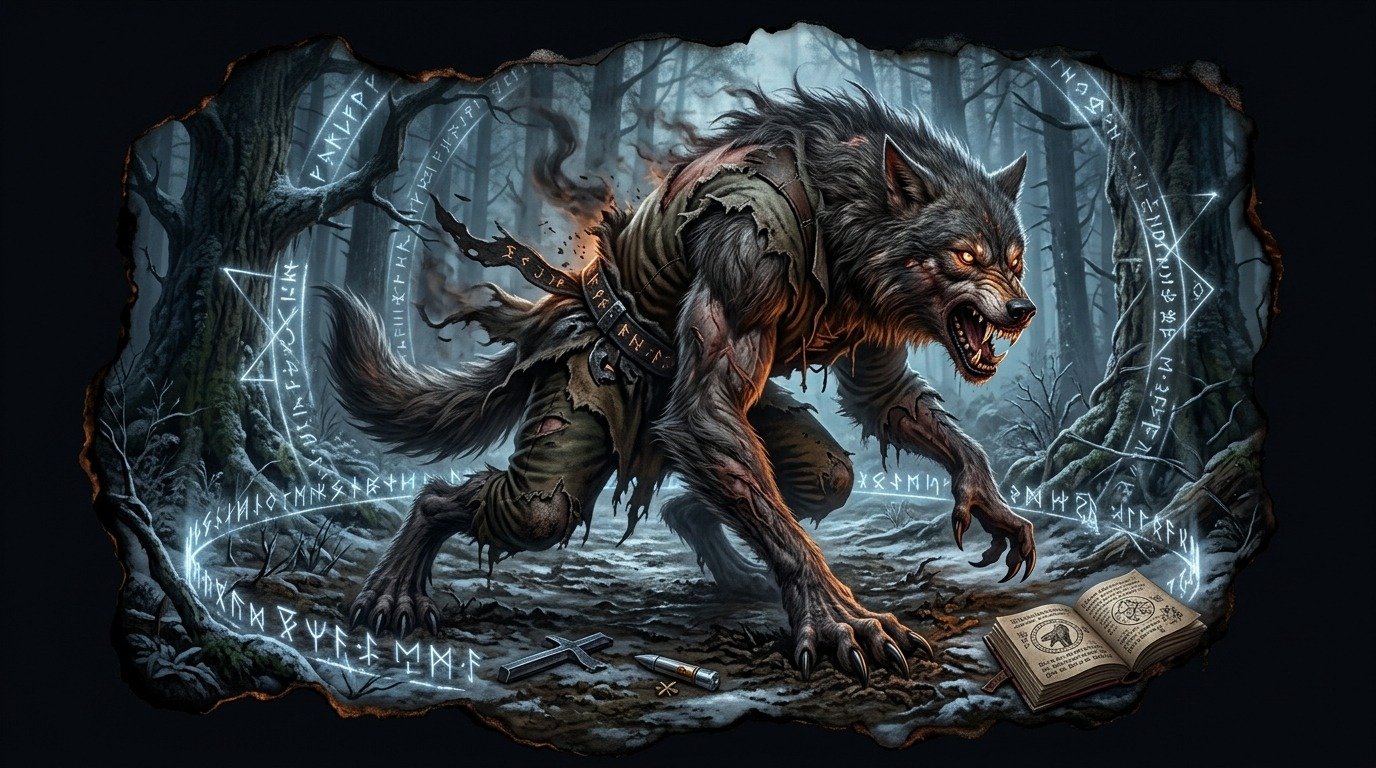
Wolfssegen and the German Werwolf: The Blood Pact and the Binding of the Forest
Genesis and the Pact of the Black Forest
In the dense forests of the Holy Roman Empire, particularly during the sixteenth and seventeenth centuries, the figure of the *Werwolf* (werewolf) transcended agricultural myth to become a legal and theological reality of unspeakable horror. Unlike traditions of involuntary lycanthropy caused by a divine curse, the German *Werwolf* of the early Modern Era was, first and foremost, a sorcerer. The case of Peter Stumpp, the "Werewolf of Bedburg" (executed in 1589), illustrates the core of this belief: the transformation was not an organic metamorphosis, but an act of high sorcery facilitated by a demonic pact. The devil would give the initiate a belt of wolf skin (*Wolfsgürtel*) which, when buckled, projected an irrefutable physical illusion of the beast onto the operator's body.
The Wolfssegen: The Art of the Tamer and the Binding Spell
In contrast to the horror of the *Werwolf*, the practice of the *Wolfssegen* (the wolf's blessing or conjuration) emerged in the Alpine regions and Bavaria. This branch of folk magic and practical demonology, documented in rustic medicine grimoires and hunting texts, was the domain of the *Wolfsbanner* (wolf-binders). The *Wolfssegen* was not a simple protective prayer, but a formula of verbal and runic coercion that froze the wolf's jaws or confined it to an invisible perimeter. These spells used a mixture of Catholic syncretism (invoking the wounds of Christ or Saint Cornelius) and hermetic formulas of symmetrical control: the operator spiritually bound their own will to that of the predator. If the magician made a mistake in the pronunciation of the spell, the current of force was reversed, and the *Wolfsbanner* could be devoured by the pack or, more insidiously, become trapped in the wolf's psyche, becoming an astral *Werwolf* themselves.
Esoteric Hermeneutics: The Therianthropic Shadow
From an esoteric perspective, the German *Werwolf* represents the voluntary descent into the plane of *pure atavism*. The belt delivered by the adversary is the symbol of the suspension of the rational *ego* and the release of the Jungian *Shadow* in its most predatory and primal state. The *Wolfssegen*, on the contrary, represents the sovereignty of the human spirit (the *Logos*) over untamed nature (the *Chaos*). In the mental alchemy of the grimoire, the wolf is the "Antimony Wolf," the devourer of metals that must be controlled and purified. Whoever masters the *Wolfssegen* masters their own destructive instincts; whoever yields to the belt of the *Werwolf* dissolves into the lower astral plane, losing the divine spark in exchange for the freedom of claw and fang.
Protocols of Containment and Dispatch
To neutralize a *Werwolf* under the Germanic tradition, the hunter of the arcane must understand that the creature is vulnerable to the disruption of its magical anchor: - **The Destruction of the Belt:** The most effective method consists of snatching away or cutting the *Wolfsgürtel*. Without this artifact of power, the operator instantly regains their human form, remaining vulnerable and disoriented. - **The Revelation of the Name:** Calling the *Werwolf* by their Christian baptismal name breaks the zoomorphic illusion, forcing the astral body to retract back into human flesh. - **Consecrated Silver and Cold Iron:** Iron forged without coal fire (cold iron) disrupts the flows of demonic energy that sustain the transformation. Silver projectiles, while effective, must be melted with fragments of consecrated hosts or wax from Paschal candles to ensure the dissolution of the pact that animates the beast.
Comments
Share information, an experience, or a source to help enrich this entry. They are automatically reviewed before being published.
Loading comments...