Lycaon
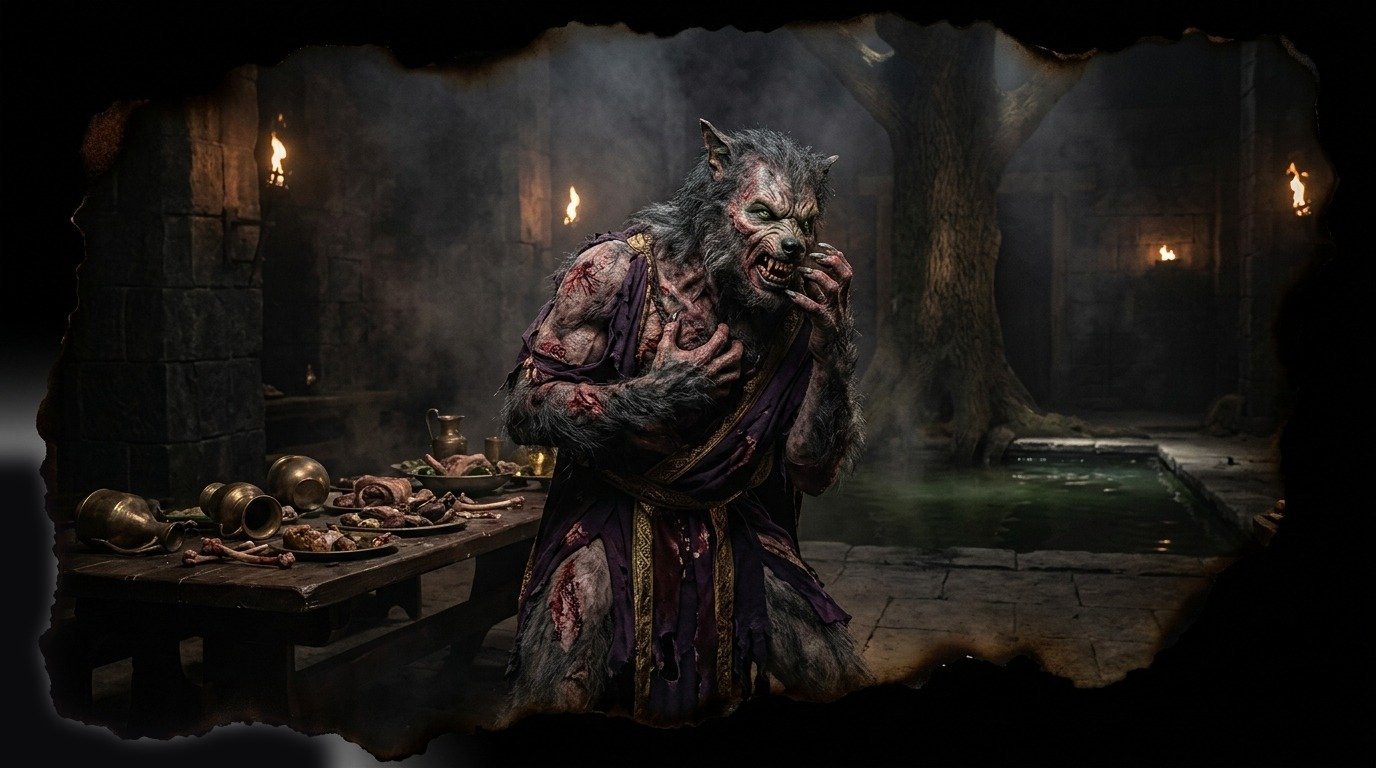
Lycaon: The Archetype of Bestial Degradation and Divine Wrath
The Sacrilege of Arcadia
The genealogy of Western lycanthropy finds its cornerstone in the figure of Lycaon, the mythical king of Arcadia, whose story is detailed by Ovid in Book I of *The Metamorphoses*. Lycaon, the epitome of hubris and tyrannical cruelty, ruled an Arcadia that was still wild. To test the omniscience of Zeus, who was traveling incognito in mortal form, Lycaon committed the ultimate sacrilege against the laws of hospitality (*Xenia*) and sacred order: he murdered a hostage from Molossia (or his own grandson, Nyctimus, according to other versions), cooked his entrails, and served them at a banquet to the Olympian god. Zeus, horrified by the anthropophagic abomination, destroyed the royal palace with his thunderbolt and condemned Lycaon to outwardly embody the monstrosity that already inhabited his soul.
The Cult of Zeus Lykaios and the Initiation Rituals
Beyond Ovid's literary myth, the figure of Lycaon is inextricably linked to real cultic and initiatory practices on Mount Lykaion (Arcadia), documented by Pausanias and Pliny the Elder. In the rituals of the *Lykaia*, consecrated to Zeus Lykaios, an annual human sacrifice was performed where human entrails were mixed with the meat of wild animals. The young initiate who consumed the portion containing the human tissue was immediately transformed into a wolf (*lykanthropos*). According to the tradition of the clan of Anthus, the initiate had to hang his clothes from a sacred oak, swim across a marsh, and live as a wolf in the forests for nine years. If during that time he managed to abstain from eating human flesh, he would regain his original form; if he yielded to cannibalism, he was condemned to remain a wolf forever.
The Transgression of the Anthropophagic Taboo
From a psychological and esoteric perspective, the myth of Lycaon illustrates the process of *moral and spiritual regression*. The transformation into a wolf is not a gift of power, but a punishment reflecting the loss of the human condition through the transgression of the taboo of anthropophagy. Lycaon represents the involution of Bronze Age man toward a state of animal savagery prior to the laws of civilization. In the alchemy of the soul, Lycaon is the unpurified "Nigredo," the putrefaction of the prima materia that refuses to submit to the purifying fire of the spirit and prefers to consume its own children (fixation of heavy matter).
The Clinical and Esoteric Legacy of Lycanthropy
Analyzing the magical current derived from Lycaon requires understanding the difference between physical and astral lycanthropy: - **Clinical Lycanthropy (Lycomania):** Historically derived from the punishment of Lycaon, it is a psychiatric pathology where the subject firmly believes themselves to be a wolf. On the esoteric plane, this is diagnosed as a larval possession of the mental body by egregores of accumulated cruelty. - **The Bloodline Curse:** Unlike infection by bite (an invention of modern Gothic literature), traditional lycanthropy inherited from the rites of Mount Lykaion is a genetic and spiritual transmission of familial guilt. The hunter of the arcane must seek the root of the original blood pact; purification requires an act of sacrificial restitution or the formal exorcism of the ancestral bloodline under the invocation of the most severe aspect of divine justice.
Comments
Share information, an experience, or a source to help enrich this entry. They are automatically reviewed before being published.
Loading comments...