Lobizón
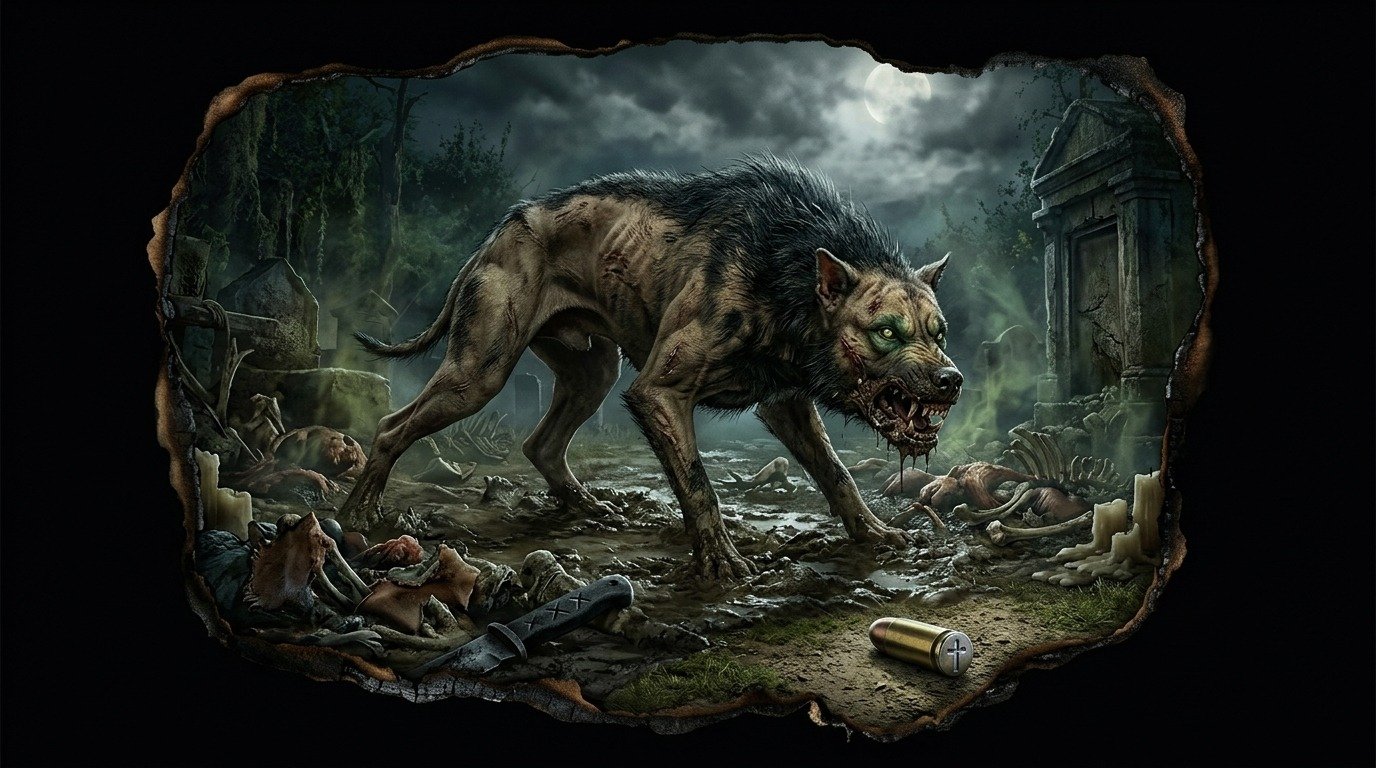
Lobizón: The Stigma of the Cursed Lineage in the Southern Cone
Origin and Guaraní Mythology
The Lobizón (or *Luison* in Guaraní) is a paradigmatic example of cultural syncretism between the pre-Hispanic mythology of the South American littoral and pampas (Paraguay, northeastern Argentina, southern Brazil, and Uruguay) and the European superstitions imported by colonizers and Jesuits. In the original Guaraní cosmogony, *Luisón* is the seventh son of *Tau* (the spirit of evil) and *Kerana* (the personification of kidnapped beauty). Originally, this being was not a canine, but a monstrous and macabre deity, lord of death, graves, and cemeteries, whose mere presence withered vegetation and whose physical contact sealed the funeral destiny of the living. With the arrival of the Jesuits and the assimilation of European werewolf mythology, the mystical figure of Luisón was degraded and merged with the myth of the werewolf, adopting the morphology of a monstrous canid, yet retaining its indissoluble cords with death, filth, and necrophagy.
The Law of the Seventh Son and State Intervention
Popular belief dictates that the curse of the Lobizón inexorably falls upon the seventh male son of an unbroken lineage of sons (with no daughters in between). Upon reaching puberty, the young man carries the stigma of the change. This belief took root so deeply and tragically in the social fabric of the interior of Argentina and Paraguay that, during the 19th and early 20th centuries, it caused numerous cases of parental abandonment, ostracism, and preventive filicide of seventh sons. To mitigate this situation of social violence, a customary practice was institutionalized in Argentina that was later formalized into law: **Presidential Sponsorship** (officially decreed under Law No. 20,843 in 1974). The President of the Nation assumes the sponsorship of the seventh male son, granting him a gold medal, an educational scholarship, and baptism under official protection—an act of strong symbolic weight destined to neutralize social rejection and the magical superstition of the rural environment.
Manifestation, Physiology, and Habits
Unlike the European wolf (nonexistent in the South American habitat), the Lobizón takes the form of a hybrid between a large, mangy, dark-furred dog and a large wild boar. Its hind legs are usually longer than its front legs, giving it a clumsy and dismal gait. - **The transformation process:** It occurs during full moon nights, especially on Fridays or Tuesdays on a recurring basis. The individual seeks an isolated place, generally a mud pit, a corral, or a cemetery, where he performs a wordless ritual: he rolls three times from right to left on the ground or on debris, shedding his humanity while his skeleton dislocates and his skin becomes covered in black bristles. - **Dietary habits:** The Lobizón does not actively seek to hunt humans to consume their flesh, but rather feeds on carcasses, carrion, excrement, cemetery candle drippings, and unbaptized fetuses. Its presence is announced by a nauseating smell of sulfur and rot, and by a mournful howl that paralyzes domestic dogs, who react with absolute terror and submission instead of barking.
Protocols of Protection and Disenchantment
To repel or subdue a Lobizón, the folklorist and the country dweller have a corpus of specific resources at their disposal: - **The blessed silver bullet:** It must have been cast or blessed in three different churches, or have a cross engraved on its tip. - **The blessed iron knife:** Marking the ground with a cross using a common kitchen knife that has been consecrated or moistened with water from seven churches. - **The burning ember:** Direct fire and blows with branches of rue or coronillo thorns are effective to scare it away. If a hunter manages to wound the Lobizón and it sheds blood, the next day the attacker must look for a man in the town with an identical wound in the same place on his body. If the transformation is interrupted by a deep wound, the curse can be permanently broken, but the freed individual will carry a spectral paleness and precarious health for the rest of his days.
Comments
Share information, an experience, or a source to help enrich this entry. They are automatically reviewed before being published.
Loading comments...