Book of Soyga
The Book of Soyga: The Magic Treatise That Obsessed John Dee
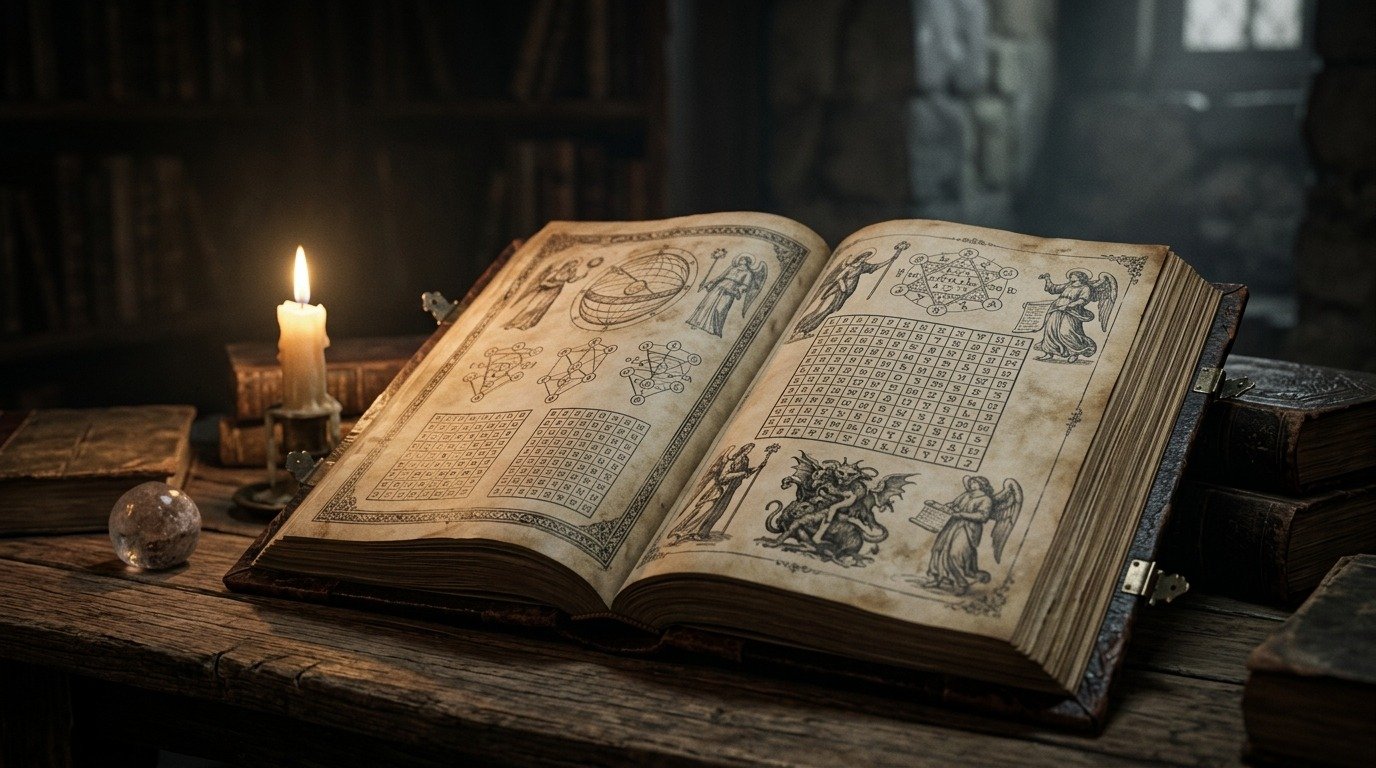
The Book of Soyga, whose Latin title is *Aldaraia sive Soyga vocor*, is a 16th-century grimoire of magic containing treatises on astrology, hierarchies of angels and demons, and thirty-six tables with thousands of letters arranged in seemingly chaotic patterns. The manuscript is legendary for having been the most prized and feared possession of the Elizabethan scholar John Dee, who dedicated much of his life to trying to decipher the algorithm behind its pages, even going so far as to summon angels through mediums to ask them the meaning of a book that, according to tradition, brings death in less than three years to anyone who manages to read it completely.
The Thirty-Six Tables of Celestial Chaos
The content of the Book of Soyga is divided into several sections of ceremonial magic, but its core and main mystery lie in its final pages. There, thirty-six square tables are found, each composed of thirty-six rows and thirty-six columns of handwritten letters. In total, there are more than forty-six thousand letters arranged in these grids.
The text accompanying the tables is written in an intricate Latin that describes methods of divination, planetary correspondences, and names of celestial spirits. The tables are not random; each letter is determined by a precise mathematical formula that depends on neighboring letters and a specific keyword for each table, an encryption system that combines Jewish Kabbalah with Renaissance military cryptography.
The Grimoire in the Magician's Library
The most famous owner of this grimoire was John Dee, a mathematician, astronomer, spy, and advisor to Queen Elizabeth I of England. Dee owned one of the largest libraries in Europe at his home in Mortlake, and he considered the Book of Soyga to be the jewel of his occult collection. However, despite his immense intelligence, Dee was unable to decipher the mechanism of the thirty-six tables of letters.
Dee's frustration led him to seek help in the realm of the supernatural. In March 1582, during a scrying session in London alongside the medium Edward Kelley, Dee claimed to have contacted the archangel Uriel through an obsidian mirror. According to Dee's personal diaries, the magician directly asked the angel if the Book of Soyga was of divine origin and what the tables of letters meant. Uriel's response was evasive yet terrifying: the book had originally been delivered to Adam in the Garden of Eden by angels of God, and the only one capable of revealing the secret of the tables was the archangel Michael.
The Lost Trail of the Queen's Magician
Following the death of John Dee in 1608, his immense library was looted, scattered, and largely destroyed. The Book of Soyga completely vanished from historical records for nearly four centuries. It was assumed that the grimoire had burned in the Puritan riots or had been lost forever to private collectors who feared the curse of reading it.
However, the book's fate changed in 1994. British historian Deborah Harkness independently discovered two copies of the manuscript that had remained hidden under erroneous cataloging in England's most important libraries: one in the British Library in London and another in the Bodleian Library in Oxford. The book that obsessed the Queen's magician had not been lost; it was simply waiting in the silence of public archives.
The Algorithm Revealed
Shortly after its rediscovery, mathematician and cryptographer Jim Reeds took on the challenge of analyzing the tables of letters using modern computer systems. Reeds managed to decipher the mathematical algorithm behind the arrangement of the characters. He discovered that each table is generated from a keyword (such as "Sada", "Angeli", or "Soyga") and that a mathematical rule of progression determines the next letter.
Today, the two copies of the Book of Soyga are available for academic study in Oxford and London. Although the algorithm for constructing the tables has been revealed, the practical purpose of the book and the meaning of the magical names resulting from decoding the tables remain subjects of debate among specialists in Renaissance occultism. The book is preserved as the physical testimony of an era when science and magic shared the same table.
The Fixed Gaze upon the Letters
The Book of Soyga continues to exert a strange attraction. Although modern cryptography has lifted part of the mathematical veil that covered it, the warning attributed to the archangel Uriel still echoes through the halls of the libraries that guard it. The thousands of letters of the grimoire remain there, arranged in their perfect grids, defying those who dare to seek divine patterns in the ink of men.
Comments
Share information, an experience, or a source to help enrich this entry. They are automatically reviewed before being published.
Loading comments...