Codex Seraphinianus
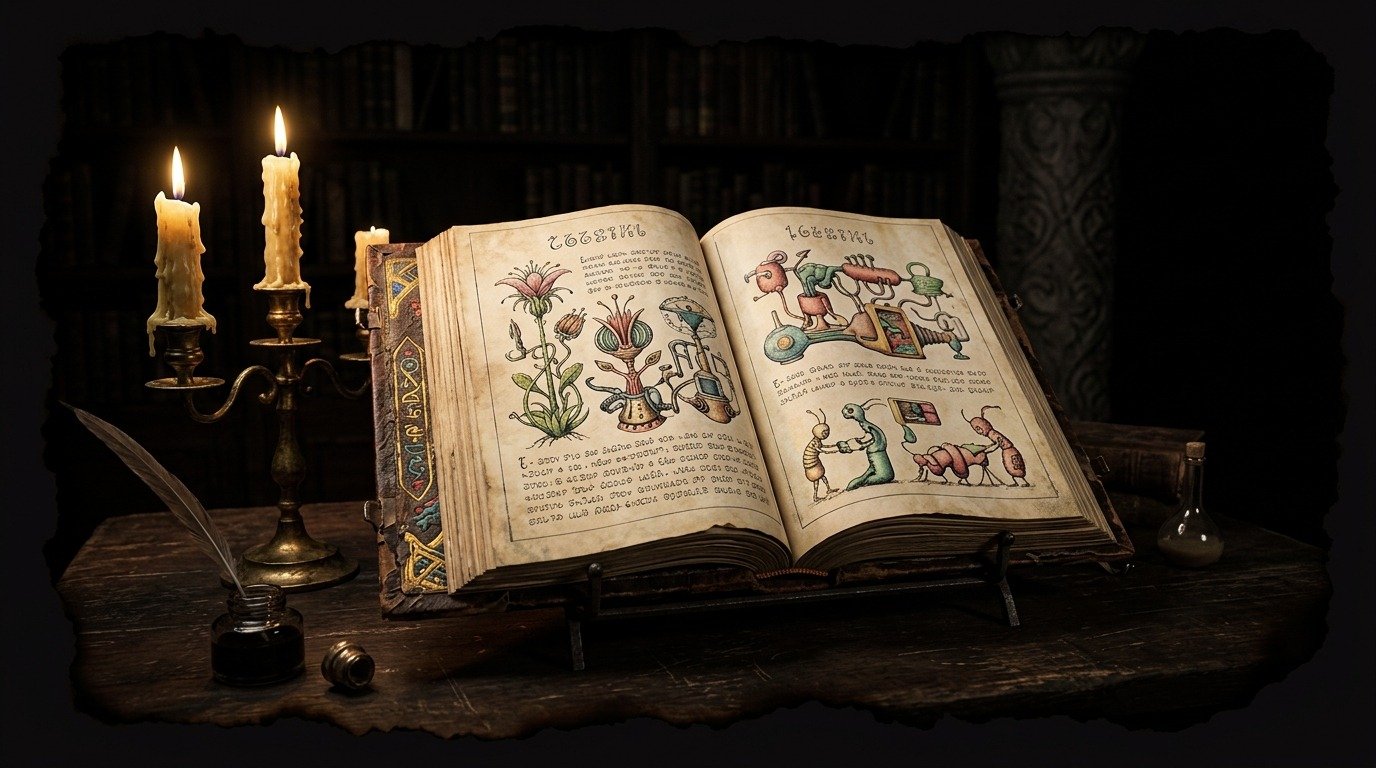
Codex Seraphinianus: The Encyclopedia of an Impossible World
The Codex Seraphinianus is an illustrated encyclopedia of an imaginary world, created in the late 1970s by the Italian artist and designer Luigi Serafini. The book consists of about 360 pages written entirely in an invented, fluid, and indecipherable alphabet, accompanied by thousands of surreal drawings that defy the laws of physics, biology, and the logic of our reality. It is famous worldwide for being one of the most fascinating publishing mysteries of the 20th century, a volume specifically designed to make the adult reader feel the same intrigue that a child feels when looking at a book before learning to read.
The Pages of the Other Reality
Upon opening the Codex Seraphinianus, the reader is met with a systematic catalog of a parallel universe. The book is divided into eleven chapters that mimic the structure of a classical scientific encyclopedia. The first part is dedicated to nature: plants that grow in the shape of gears, flowers that float like hot air balloons, trees that detach from their roots to migrate, and fish that resemble warships or filaments of light.
The second part focuses on human beings, technology, and culture. There are detailed anatomical diagrams where human bodies merge with mechanical prosthetics, pages dedicated to the clothing of non-existent tribes, city maps with impossible layouts, and a famous illustration showing a human couple who, during the sexual act, gradually merge until they become an alligator. All of this is labeled with mathematical precision using a cursive alphabet that mimics human handwriting but contains no real meaning.
The Birth of a Chimera
The origin of the book is completely earthly, though its creation process borders on the obsessive. Luigi Serafini, a young architect and designer who was living in Rome at the time, locked himself in a small apartment on Via del Corso between 1976 and 1978. With colored pencils and India ink, he worked by hand on each of the pages of this compendium.
Serafini presented the project to the celebrated Italian publisher Franco Maria Ricci, known for publishing extremely luxurious art books in limited editions. Ricci, fascinated by the audacity of the proposal, decided to print the first edition in 1981 in two volumes bound in black silk with gold lettering. The book immediately became a cult object among artists, writers, and intellectuals of the caliber of Italo Calvino, who wrote an essay analyzing the work.
The Labyrinth of Ink and Cryptographers
The publication of the book sparked a fever to decipher its contents. Military cryptographers, professional linguists, and enigma enthusiasts spent years analyzing the structure of the text. They discovered that the alphabet consists of a few dozen recurring characters and that it follows consistent grammatical rules, with clearly defined uppercase letters, lowercase letters, and numbers.
However, despite mathematical and character frequency analyses, no one managed to extract a single meaningful sentence. The intrigue grew for three decades, fueled by theories suggesting that the book was a coded map, a modern Gnostic manifesto, or even a text dictated by an extraterrestrial intelligence.
The Secret Behind the Symbols
Today, the mystery of the text's meaning has been solved by its own creator, though its artistic value remains intact. In 2009, during a talk at the Oxford University Society of Bibliophiles, Luigi Serafini publicly declared that the text has no hidden meaning or possible translation.
Serafini explained that the writing process was a form of "automatic writing." His intention was not to hide a message, but to recreate exactly the sensation of illiteracy: he wanted readers to experience the wonder and bewilderment of looking at a book whose signs they cannot understand, returning them to childhood. The paper used for the original editions, the inks, and Serafini's manual technique continue to be studied as a milestone of contemporary editorial design.
A Work That Defies Reason
The Codex Seraphinianus continues to be published today and is coveted by collectors worldwide. The first editions by Franco Maria Ricci fetch astronomical prices at art auctions. The volume remains on the tables of bibliophiles as a paper portal to a cosmos that never existed, reminding us that, sometimes, the absence of meaning is the most unsettling mystery of all.
Comments
Share information, an experience, or a source to help enrich this entry. They are automatically reviewed before being published.
Loading comments...