Voynich Manuscript
The Voynich Manuscript: The Book That No One Could Read
The Voynich Manuscript is a 15th-century illustrated codex, written in a completely unknown alphabet and language that no one has managed to decipher. Its pages house drawings of non-existent plants, indecipherable astrological diagrams, and naked figures in strange pools, making it the most mysterious and frustrating book in literary history. From World War II cryptographers to modern artificial intelligence algorithms, everyone who has attempted to reveal its secrets has failed.
The Labyrinth of Its Pages
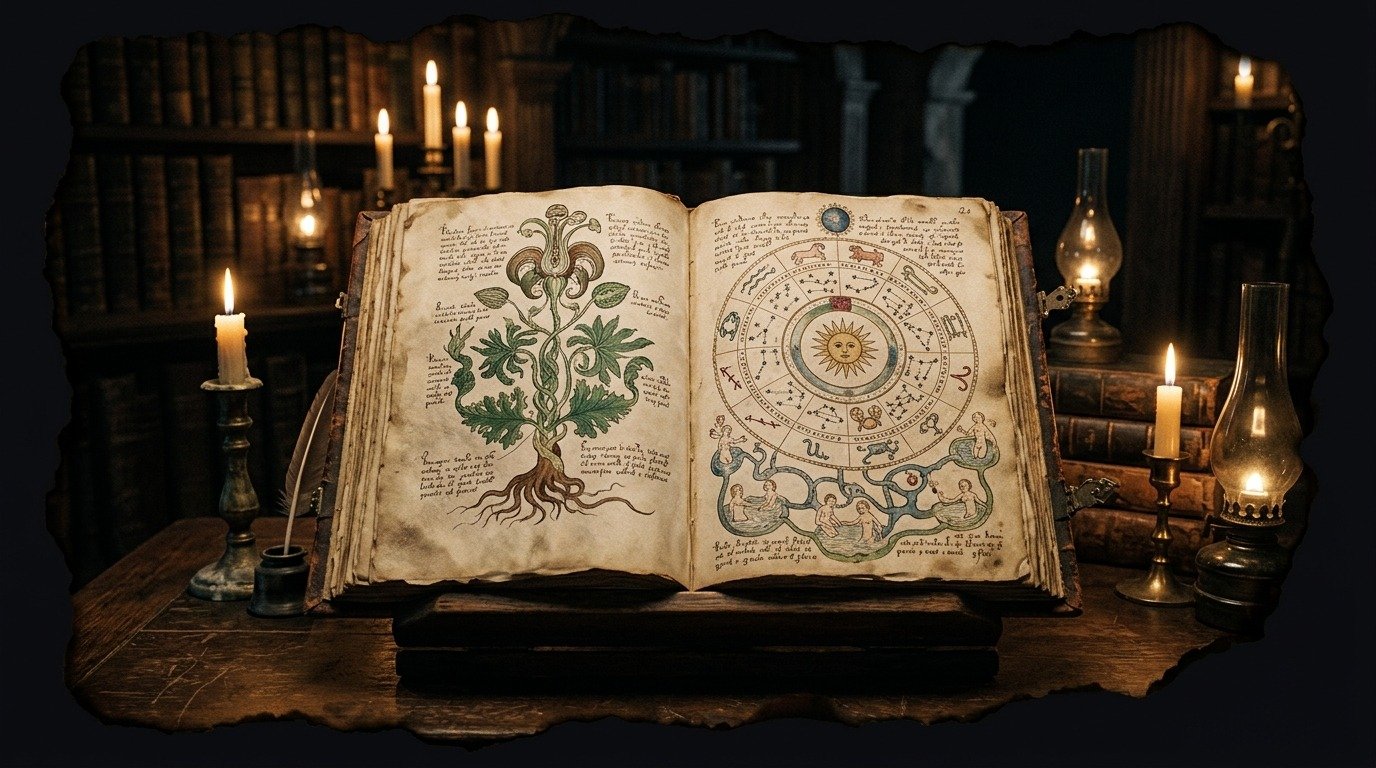
To leaf through the Voynich Manuscript is to enter a botanical and astronomical universe alien to Earth. Its two hundred and forty parchment pages are divided into sections well-defined by their illustrations. The first part is a herbal with detailed drawings of plants that do not belong to any known species; they have monstrous roots, impossible leaves, and flowers that resemble internal organs.
It is followed by an astronomical and astrological section with circular diagrams, suns with human faces, moons, and unknown constellations, accompanied by the signs of the zodiac. The most disturbing section shows naked women bathing in a network of pools connected by organic pipes; some hold strange rods and seem to float in a greenish fluid. Finally, the book closes with a recipe section filled with small drawings of roots and jars next to dense paragraphs.
The text surrounding these drawings is fluid, written from left to right, without a single crossing-out or correction. The scribe wrote the work in a single stretch, perfectly mastering a language that today seems dead or artificial.
The Origin in the Prague Court
Radiocarbon dating places the manufacture of the parchment between the years 1404 and 1438. Its actual authorship remains an enigma. For centuries, it was attributed to the Franciscan friar and philosopher Roger Bacon, famous for his supposed knowledge of magic and alchemy. However, Bacon died in 1292, a century before the creation of the paper.
The first real clue of the book appears in the court of Rudolf II of Habsburg, Holy Roman Emperor in Prague, a monarch obsessed with the occult. Rudolf acquired the codex for the astonishing sum of six hundred gold ducats from an unknown seller, convinced that it contained the formula for the philosopher's stone written by Bacon himself. Among the suspects who might have sold the book to the emperor are the English mystic John Dee and his associate, the medium Edward Kelley.
A Journey of Centuries in Oblivion
After the death of Emperor Rudolf II, the manuscript passed from hand to hand. His signature on the first page proves that it belonged to Jacobus Horcicky de Tepenecz, the monarch's personal physician. It then reached the hands of Johannes Marcus Marci, rector of the University of Prague, who in 1665 sent the book to Rome, to the Jesuit Athanasius Kircher, the most famous scholar of the era in deciphering hieroglyphics. Marci attached a letter asking him to decipher the text, but Kircher, defeated by the complexity of the code, archived it in the library of the Roman College.
The manuscript disappeared for two hundred and fifty years, hidden in the cellars of the Jesuit order to prevent it from falling into the hands of Italian troops during the unification of the country. In 1912, the Polish book dealer Wilfrid Voynich discovered the volume in a chest at the Jesuit college of Villa Mondragone, near Rome, while the order was discreetly selling off part of its assets. Voynich bought the lot and dedicated the rest of his life to trying to decipher the book that today bears his name.
The Enigma Today
Today, the Voynich Manuscript is kept under strict security measures in the Beinecke Rare Book & Manuscript Library at Yale University, registered as MS 408. Its study continues to attract both professional linguists and amateurs from all over the world.
The most recent theories are contradictory. While some analysts maintain that it is a herbal medicine treatise written in an extinct dialect of Latin or in a proto-Romance language, others argue that the text complies with the statistical laws of natural languages, which rules out it being a simple random invention. However, not a single meaningful sentence has been translated.
The Silence of the Codex
The Voynich Manuscript remains a mirror that returns the gaze of anyone who tries to decipher it. Anyone who peers into its pages finds no answers, but rather the echo of an unknown author who managed to create a perfect secret, a book that continues to speak in a language that only they understand.
Comments
Share information, an experience, or a source to help enrich this entry. They are automatically reviewed before being published.
Loading comments...