The Copper Scroll
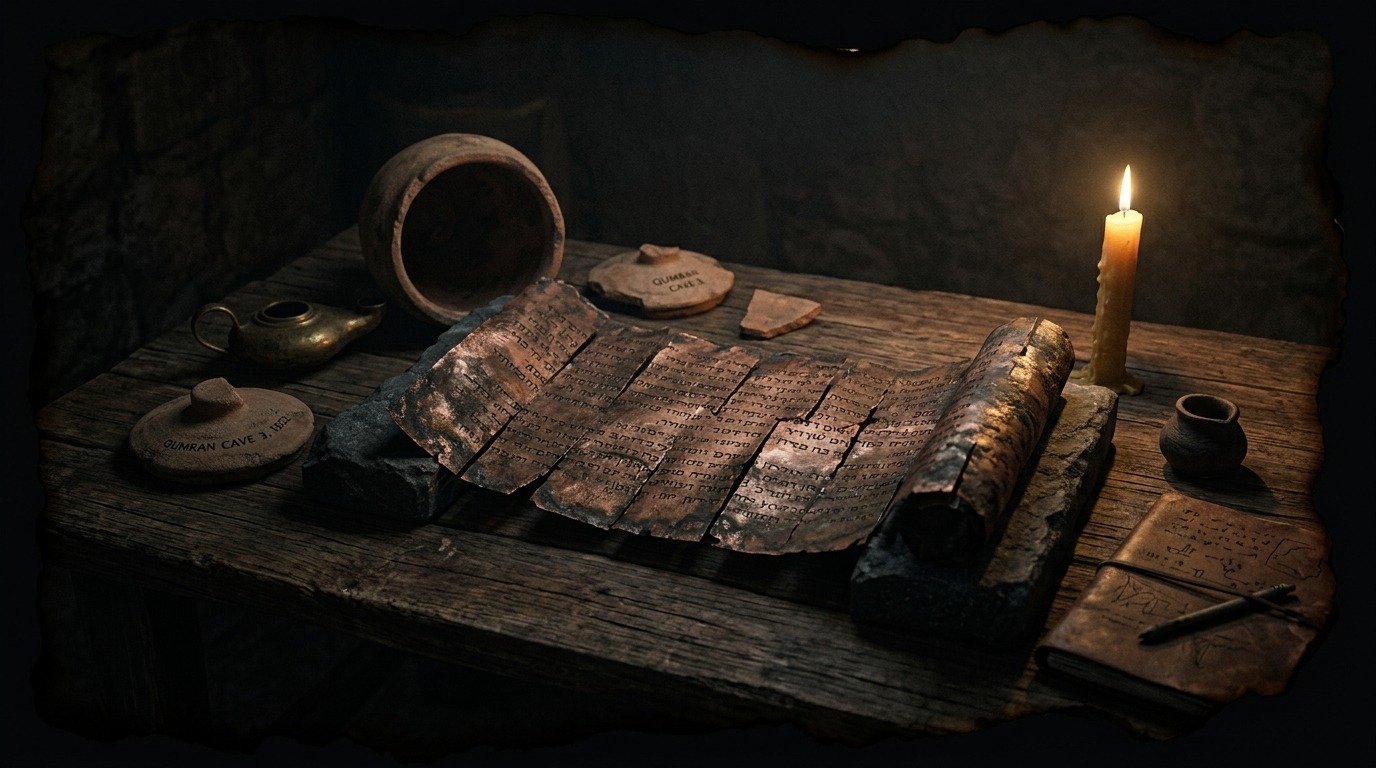
The Copper Scroll: The Inventory of the Sacred Treasure of Jerusalem
The Copper Scroll is a unique manuscript engraved on a thin sheet of metal, discovered in 1952 in Cave 3 of Qumran, among the famous Dead Sea Scrolls. Unlike the other texts of the Essene library, which are religious, prophetic, or historical in nature and written on parchment or papyrus, this scroll is a detailed list describing the exact location of sixty-four hiding places containing immense metric tons (tons) of gold, silver, and sacred censers buried in Judea. Its fame lies in being the oldest and most coveted treasure map in biblical archaeology, an inventory of colossal riches that no one has been able to find.
A Guide to Unimaginable Riches
The text of the Copper Scroll is a dry and precise inventory that lacks any theological or poetic preamble. It is written in a form of colloquial Hebrew with Aramaic influences, engraved directly onto the metal using chisel blows. Each of the sixty-four entries describes a hiding place and details the quantity of precious metals hidden within it. The locations are described with very specific local references that must have been perfectly clear to contemporaries: "In the cistern which is under the wall, on the east, on the spur of the rock: six hundred bars of silver," or "In the tomb of Ben Rabbah, the Babylonian: one hundred talents of gold." The total quantities mentioned in the scroll are astronomical, totaling thousands of talents of gold and silver, which would equal dozens of metric tons (tons) of precious metals, in addition to ceremonial vessels of incalculable historical and religious value.
The Rescue of the Oxidized Sheet
The discovery of the scroll was a feat of post-war archaeology. In March 1952, a team led by archaeologist Henri de Contenson located Cave 3 of Qumran. At the back of the cavity, on a rock shelf, they found two sections of a metal scroll that had oxidized to the point of becoming extremely fragile. The fragility of the corroded copper made it impossible to unroll the document without destroying it into pieces. The manuscript was sent to the Manchester College of Technology, where Professor H. Wright Baker used a precision circular saw specially designed to cut the metal into twenty-three thin strips. Thanks to this procedure, carried out between 1955 and 1956, researchers were able to read the inscriptions hidden inside the scrolls for the first time without losing a single letter of their content.
The Temple Treasure or an Essene Fantasy?
Since the publication of its translation, the Copper Scroll has sparked a heated historical debate. The most solid theory holds that the metric tons (tons) of precious metals inventoried in the document correspond to the accumulated treasure of the Second Temple of Jerusalem. The temple priests would have removed the riches from the holy city and buried them in the Judean Desert before the Roman siege of 70 AD, writing this scroll as a security record to retrieve them after the war. Another line of research suggested that it was a work of folkloric fiction, a legend engraved in metal by an author with an overactive imagination. However, the cost of copper in antiquity and the enormous physical effort required to chisel such a long text onto a metal sheet rule out the idea of a simple joke or a fictional tale; no one would waste such resources to perpetuate a non-existent inventory.
The Lost Geography of Judea
Currently, the twenty-three strips of the Copper Scroll are preserved and exhibited at the Jordan Museum in the city of Amman. The document has been cleaned and restored using advanced techniques, allowing its Hebrew characters to be perfectly legible to specialists. Despite having the complete and translated text, archaeological expeditions and treasure hunters have failed to locate any of the gold or silver deposits. The geographical references in the scroll—such as "the well of the fig tree" or "the canal of the valley of ashes"—are based on local names from two thousand years ago that disappeared after the Roman destruction, making it impossible to geolocate the exact coordinates of the riches without completely excavating the Judean Desert.
The Silence of the Desert
The Copper Scroll remains a map without a compass. Its sixty-four indications remain as clear on the metal as they are unreachable on the earth. The document reminds us that the greatest fortunes of antiquity were not always destroyed by enemy armies, but were sometimes trapped forever beneath the dry dust of the desert, protected by the oblivion of the men who buried them.
Comments
Share information, an experience, or a source to help enrich this entry. They are automatically reviewed before being published.
Loading comments...