Rohonc Codex
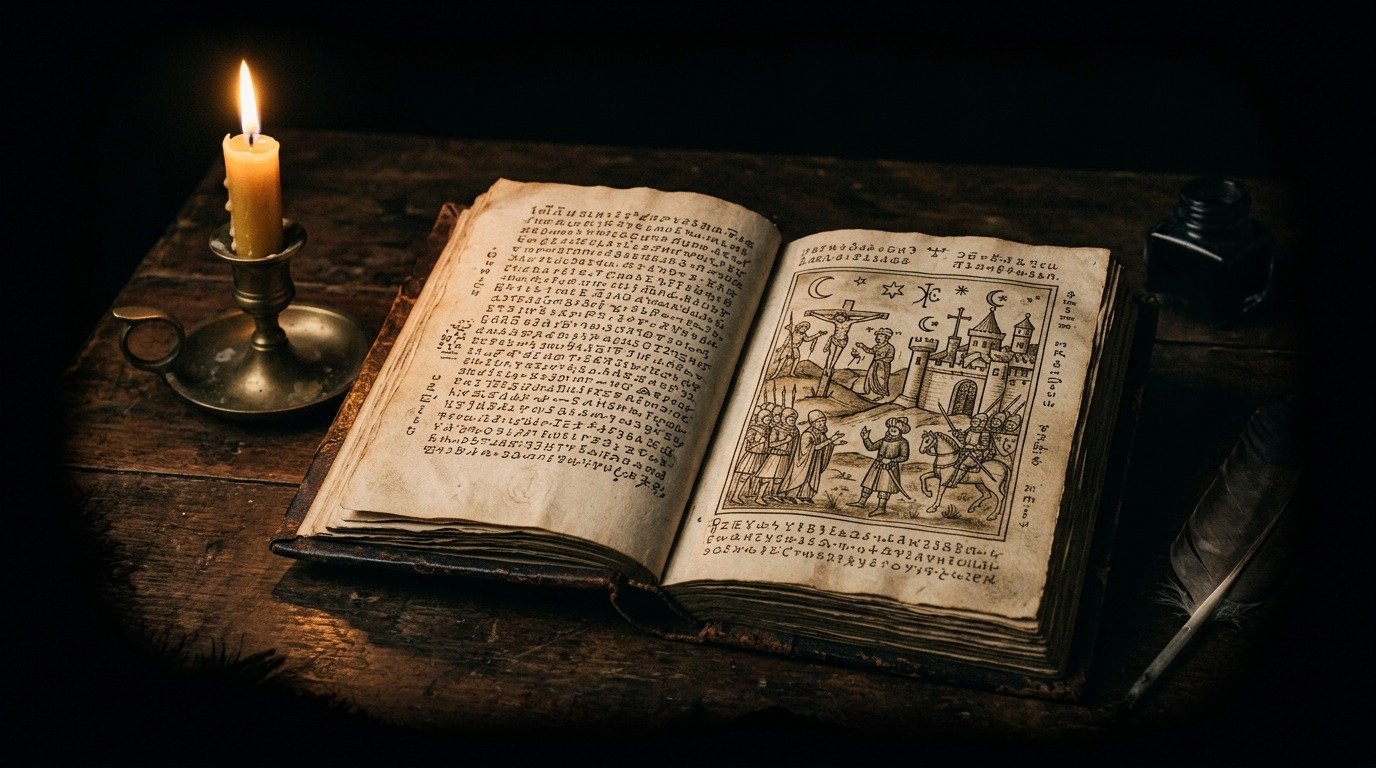
Rohonc Codex: Hungary's Illegible Enigma
The Rohonc Codex is a 448-page illustrated manuscript that emerged in the 19th century in Hungary, written entirely in an unknown alphabet of nearly eight hundred unique characters that no linguist has managed to decipher. The book contains eighty-five crude illustrations that chaotically mix Christian, Muslim, and pagan iconography. It is feared and respected as one of the most impenetrable unsolved codes in history, a document that walks the fine line between the record of a lost faith and the most perfect literary hoax of Eastern Europe.
The Pages of the Crossed Faith
The codex is a small book, about twelve by ten centimeters (4.7 by 3.9 inches), bound in a worn leather cover. Its paper pages house a dense text, written from right to left or left to right (experts still debate the reading direction), structured in well-defined paragraphs.
The most disturbing aspect of the Rohonc Codex is the content of its illustrations. They depict scenes from the life of Jesus Christ and the Passion of Christ, but alongside Christian crosses, symbols of the Islamic crescent and the eight-pointed star recurrently appear, in addition to the sun and symbols evoking pagan deities. On one of the pages, a military scene is observed where soldiers in turbans and Western armor besiege a fortress, all under the gaze of strange characters that seem to judge the scene from the margins of the paper.
The Count's Gift and the Paper Trail
The documented history of this manuscript begins in the year 1838. At that time, the Hungarian count Gusztáv Batthyány donated his entire personal library to the Hungarian Academy of Sciences, in the city of Pest. Among the thousands of donated volumes was this small book, which came from the Batthyány family library in the town of Rohonc (currently Rechnitz, in Austrian territory).
No one in the family library knew where the book had come from or who had brought it there. The first physical investigations of the object yielded a concrete piece of data: the paper of the codex contains a watermark representing an anchor inside a circle, a design characteristic of paper manufactured in Venice in the mid-1530s. However, the wear of the paper and the ink suggest that the text may have been written decades or even centuries after the sheets were manufactured.
The Obsession of the Decipherers
From the moment of its appearance, Hungary's finest scholars attempted to wrest the secret from the pages of the codex. Ferenc Toldy, the father of Hungarian literary history, and Paul Hunfalvy, a prominent 19th-century linguist, studied the volume without obtaining a single result. The number of different characters in the alphabet (nearly eight hundred) ruled out it being a simple substitution cipher of a known language, as conventional alphabets rarely exceed forty letters.
In the mid-19th century, suspicions turned toward Sámuel Literáti Nemes, a well-known Transylvanian antiquarian and collector who had become famous for manufacturing extremely convincing historical forgeries to sell to museums and libraries eager for national heritage. Many assumed that the Rohonc Codex was another of his creations intended to deceive the Hungarian nobility, although no definitive proof of his authorship or forgery tools were ever found in his workshops.
Modern Hypotheses
The manuscript is preserved today in the library of the Hungarian Academy of Sciences, under strict security and conservation measures. During the final decades of the 20th century and the early years of the 21st century, interest in the codex has experienced a resurgence thanks to computer science and statistical analysis.
Some Hungarian and Romanian researchers argue that the text could be an ancient version of a Romanian dialect written in an alphabet invented to protect ecclesiastical rituals from religious persecution, or perhaps an abbreviated writing system for local administrative use on the border of the Ottoman Empire. However, none of these translation attempts have been unanimously accepted by the international scientific community.
The Unbeatable Code
The Rohonc Codex remains a silent challenge. Unlike other manuscripts whose mystery dissipates with technology, this small volume from Rohonc resists the most advanced computer analyses. Its eight hundred characters remain fixed on the paper, guarding a story of saints, armies, and symbols that no one has managed to utter aloud for centuries.
Comments
Share information, an experience, or a source to help enrich this entry. They are automatically reviewed before being published.
Loading comments...