La Mara
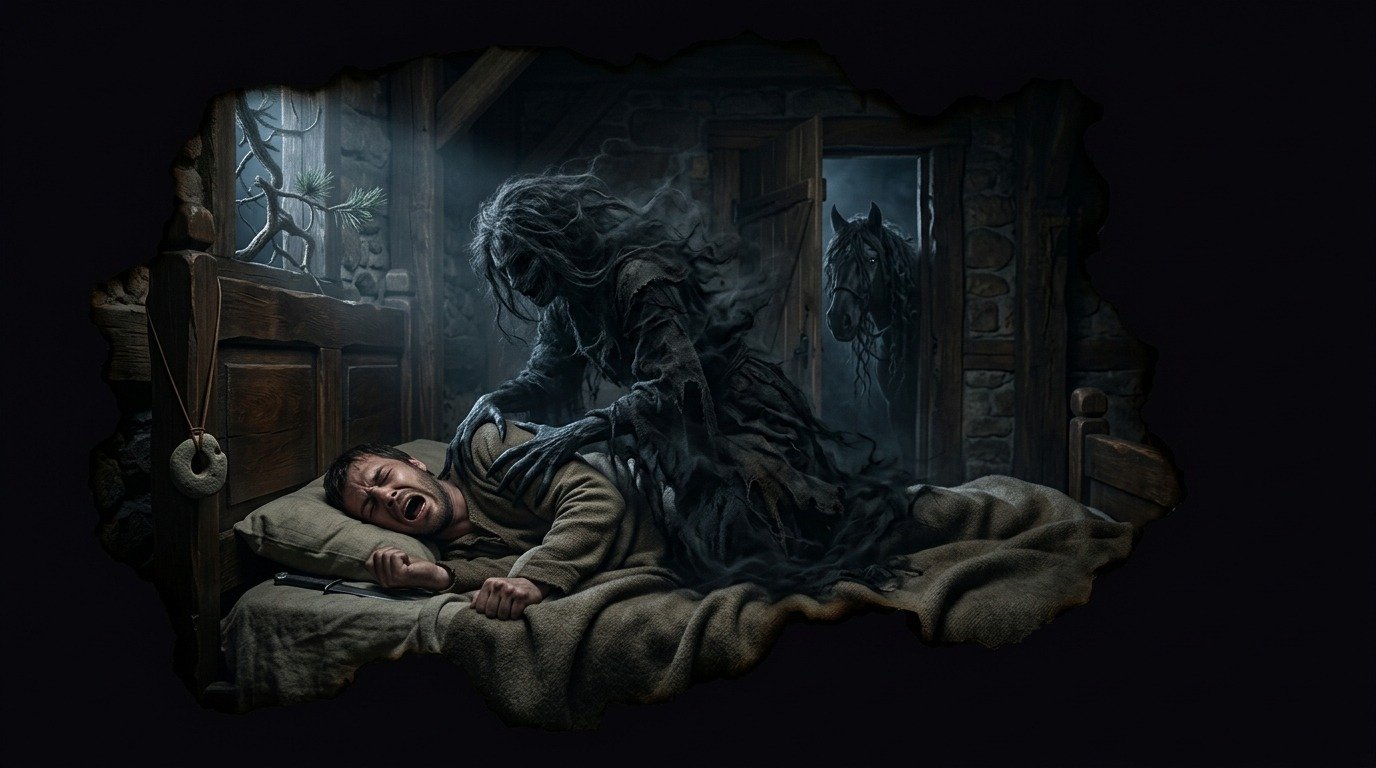
La Mara: the spirit that gave nightmares their name
What is the Mara
The Mara is a nocturnal spirit of Germanic and Scandinavian folklore that sits on the chests of those who sleep and crushes them until they are left without air. It arrives at night, entering through the keyhole or any crack, and the victim wakes up paralyzed, suffocated, and terrified. It is so ancient and so feared that it left its name in several languages: the English word *nightmare* literally means "the mara of the night."
A name that remained in the language
The Mara appears with almost identical names throughout northern Europe: *mara* in Old Norse and Swedish, *mære* in Old English, *Mahr* in German, *mare* in Danish. Dutch still calls a nightmare *nachtmerrie*, and French *cauchemar*, which joins an old verb meaning "to tread, to press" with the same *mare*. In the Slavic world, there is a sister figure, the *mora* or *zmora*.
When someone in any of those languages says they had a nightmare, they are unknowingly naming this spirit.
The king who was crushed to death
The oldest and most famous account is in the *Ynglinga Saga*, written by Snorri Sturluson in Iceland around the year 1230. It tells that the Swedish king Vanlandi married Drífa, daughter of a king of Finland, promised to return, and did not return. After years passed, Drífa paid the sorceress Huld to make him return or, if not, to kill him.
One night, in Uppsala, Vanlandi felt a heavy sleep. As soon as he fell asleep, he cried out that the mara was treading on him. His men rushed to help him, but when they held his head, she trod on his legs until they were almost broken, and when they held his legs, she crushed his head. Vanlandi died suffocated in his own bed.
Who is the Mara
In many Scandinavian traditions, the Mara is not a demon but a living person: a woman, sometimes unknowingly, whose soul leaves her body at night to torment others. According to a Swedish belief, if a pregnant woman slipped under the membrane of a newborn colt to have a painless birth, her daughters would be born maras and her sons, wolves.
While the Mara roams the night, her body remains asleep at home. If someone discovers her and calls her by her name, the spell is broken.
It does not only attack people
The Mara also rides animals. In the Scandinavian countryside, horses that woke up sweaty, exhausted, and with manes full of impossible knots were a sign that the Mara had ridden them all night. Those tangles were called mara-braids, and they were not cut lightly. The same happened with trees: pines with twisted and tangled branches were "mara-pines."
How to protect oneself
Northern European folklore left a long list of defenses:
- **Shoes backward.** Leaving them next to the bed with the toes pointing outward, facing the door, so that the Mara gets confused and leaves. - **Steel in the bed.** A knife, scissors, or an iron object under the pillow or mattress. - **Plugging the cracks.** The Mara enters through the keyhole and the smallest holes. If the hole is plugged while she is inside, she becomes trapped. - **Stones with a hole.** Hanging a stone with a natural hole over the bed or in the stable to protect people and horses. - **Calling her by her name.** If it is suspected who she is, saying her name out loud forces her to leave.
The Mara and science
What all the accounts of the Mara describe (waking up paralyzed, pressure on the chest, lack of air, a malevolent presence in the room) is the same thing known today as sleep paralysis. The Mara is probably the oldest explanation Europe has for that experience, and one of the most persistent: the painting *The Nightmare* (1781) by Johann Heinrich Füssli, with a demon sitting on the chest of a sleeping woman and a mare peeking through the curtains, plays with the double meaning of *mare*, which in English also means a female horse.
The same experience has other names in the world: the incubus and succubus of medieval Europe, the Pisadeira of Brazil, and the *kanashibari* of Japan.
Comments
Share information, an experience, or a source to help enrich this entry. They are automatically reviewed before being published.
Loading comments...