Perchta
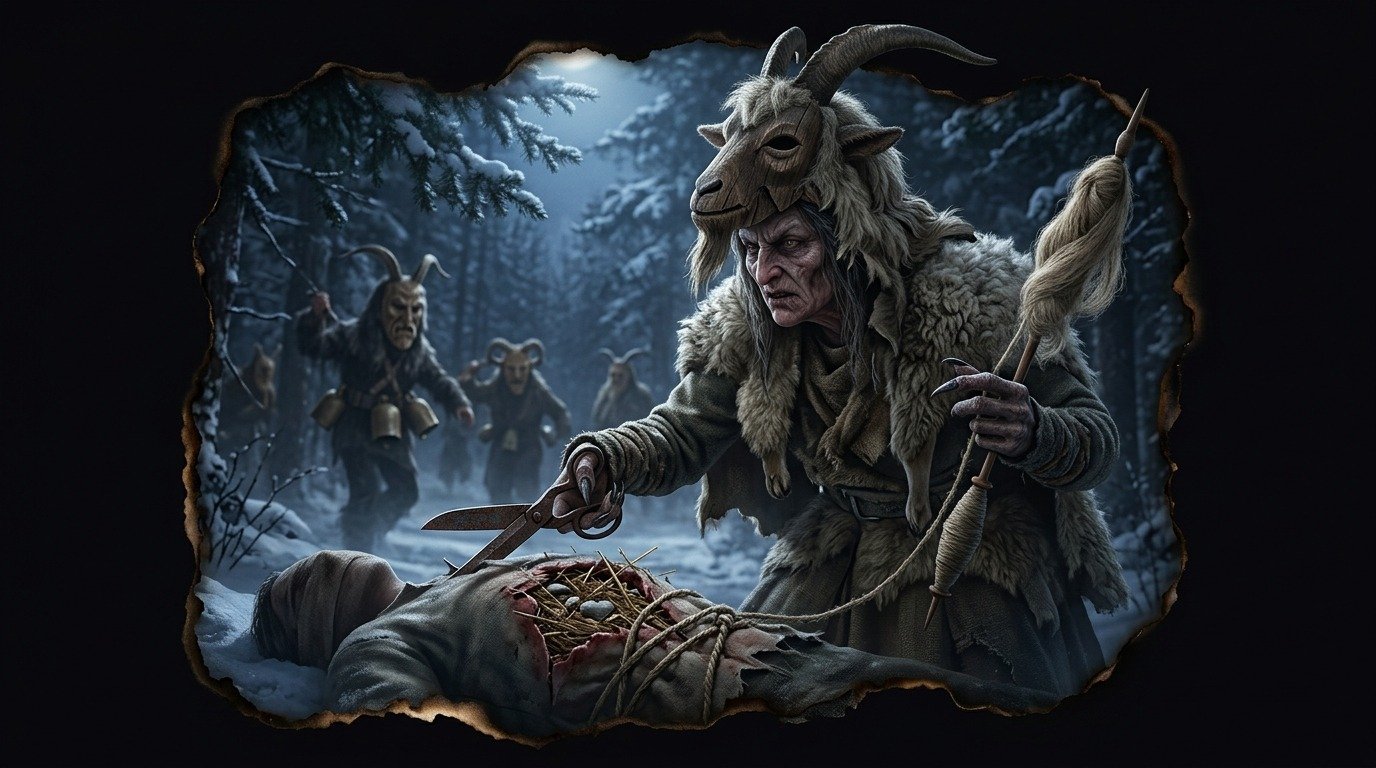
Perchta: The Weaver of the Womb and Lady of the Winter Nights
Origin and Winter Transit
In the depths of Alpine folklore, primarily in the regions of Austria, Bavaria, and Switzerland, beats the memory of Perchta (also known as Berchta or Pehta). Her roots run deep into Germanic and Celtic paganism, sharing a common trunk with the goddess Holda or Hulda. Traditionally, Perchta is the sovereign of the twelve sacred days between Christmas and Epiphany, the so-called *Rauhnächte* or "rough nights," a temporal threshold where the veil between the world of the living and that of the spirits wears thin until it becomes transparent.
Unlike other deities assimilated by Christianity that lost their sharpest edges, Perchta retained a dual and deeply disturbing nature, manifested in two archetypal aspects: the *Schönperchten* (the beautiful Perchta, giver of light, purity, and fertility in the fields) and the *Schiachperchten* (the ugly Perchta, a nightmare being of deformed features, iron claws, and a condemning gaze). This bifurcation is not a moral conflict, but rather the representation of the two faces of winter nature: the protective snow that cradles the seed and the relentless cold that claims the life of the unwary.
Historical Evolution and Demonization
Beginning in the 13th century, the medieval Church undertook a systematic campaign to eradicate her worship, categorizing her as a lesser demon or a succubus associated with witchcraft and the host of Diana (the Wild Hunt or *Wilde Jagd*). In the texts of Late Middle Ages theologians, she is mentioned with horror as an entity that tempts spinners and devours the entrails of sinners.
However, the Alpine peasantry resisted total demonization. Instead of disappearing, the myth fragmented. In the troupes of the *Perchtenlauf* (parades still held in Salzburg and Tyrol during the winter solstice), young men assume the role of the *Perchten* using hand-carved wooden masks with goat horns and sheep pelts, dancing with heavy cowbells to drive away the demons of winter. Here, Perchta acts as an ordering force that uses sacred terror to restore the balance of the land.
Moral Rigor and the Anatomy of Atonement
The most famous and macabre aspect of Perchta is her role as an inspector of domestic and social order. It was believed that she entered homes during the last night of the twelve nights (*Perchtennacht*). Her primary targets were lazy spinners who had not finished spinning their assigned flax before the end of the year, and those who broke the ritual fast by eating something other than the traditional fish and oatmeal gruel (*Zempe*).
For offenders, Perchta's punishment was of a surgical and visceral precision: she used her iron shears to slit open the culprit's belly, extract their intestines, and fill the empty cavity with straw, stones, garbage, or coal, sewing the skin back together with a thread so coarse that it caused a slow agony. In contrast, to those who kept their homes clean, spun diligently, and respected dietary taboos, she left a silver coin in their shoes or water buckets.
Esoteric and Symbolic Significance
From the perspective of depth psychology and runic esotericism, Perchta represents the Law of Return and the inevitability of transformation. Flax and the spindle are universal symbols of destiny, time, and human life; by demanding that the flax be finished, Perchta demands the consummation of personal cycles before the arrival of the new year.
Her act of disemboweling and stuffing with straw or stones is not mere folkloric sadism, but an alchemical transmutation process distorted by popular fear. Straw and stones symbolize spiritual sterility; stripping the individual of their vital internal organs is equivalent to emptying the profane vessel that has failed to cultivate its own light during the darkness of winter. She is the embodiment of the threshold: the reminder that to be reborn in spring, the ego must be torn open and purified by the cold of winter truth.
Comments
Share information, an experience, or a source to help enrich this entry. They are automatically reviewed before being published.
Loading comments...