Scandinavian Troll
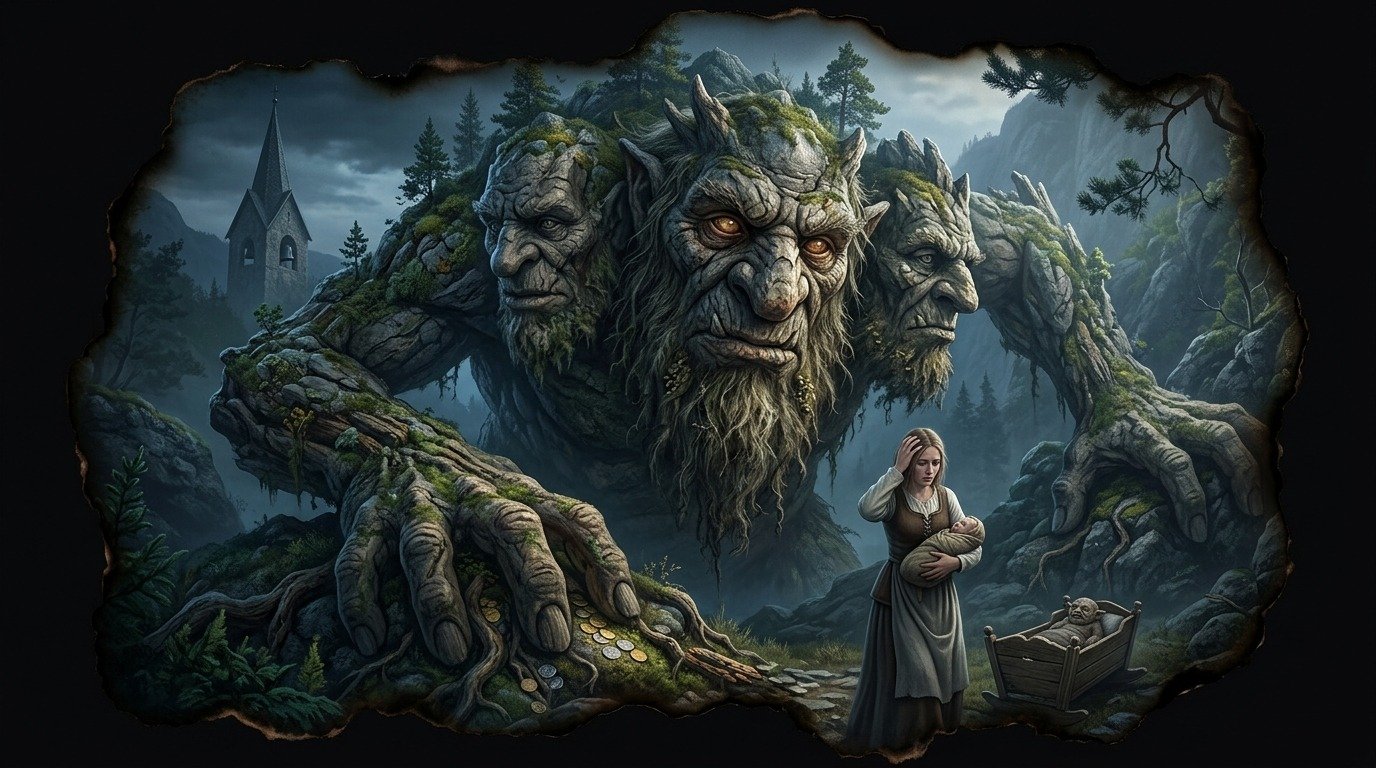
Troll: the echo of stone and the primeval forest
Etymology and Folkloric Roots
In Old Norse, the term *troll* or *tröll* did not designate a creature classified with zoological rigor, but rather functioned as an umbrella term to define the supernatural, the anomalous, the magical, and, frequently, the malevolent. Icelandic sagas and medieval laws used the concept *trolldom* to refer to harmful witchcraft and the manipulation of invisible forces. In the folklore of Norway, Sweden, and Denmark, the troll is the direct heir of the *jötnar* (giants of Norse mythology) who survived Christianization, retreating to the most inaccessible corners of the Scandinavian geography: the interior of mountains (*bergtroll*), deep forests (*skogstroll*), and coastal cliffs. Historical sources reveal a clear bifurcation in their perception depending on the geographical scale: 1. **Giant Trolls (Norway):** Colossal beings, related to the landscape itself. They possess multiple heads (three, six, or even nine), are covered in vegetation and moss, and their physiognomy is so rugged that they are often mistaken for rock formations. 2. **Subterranean Trolls or *Trollfolk* (Sweden and Denmark):** Creatures of human-like size or slightly smaller, organized in parallel societies that mimic peasant life. They possess royal courts beneath the hills, accumulate immense wealth in gold and silver, and practice the husbandry of magical animals.
The Conflict with the Sacred and Petrification
The troll is defined by its fundamental opposition to the human and Christian order. Folkloric literature documents the phenomenon of *trollsplint*, or the trolls' absolute abhorrence of the sound of church bells (*kyrkjeklokker*), which they interpret as an unbearable intrusion into their domains of silence. One of the most consistent characteristics of the myth is their vulnerability to sunlight. This phenomenon, called *steingjen* (conversion into stone), explains the formation of numerous geographical landmarks in Scandinavia, such as the mountain peaks of Troldtinderne or coastal rock formations (which popular belief attributes to trolls caught by the sunrise). This link to geology reveals their elemental nature: trolls are not merely inhabitants of the earth; they are the earth itself, endowed with an archaic, stubborn, and hostile will.
The Abduction and the Changelings (*Bortbanning* and *Bortbyting*)
One of the darkest aspects of troll folklore is the belief in *bergtagning* (literally, "being taken to the mountain"). It was believed that trolls abducted human beings, especially young women and unbaptized children. Victims of *bergtagning* who managed to return were left mentally affected, mute, or plunged into an incurable melancholy, having tasted the food of the subterranean court. Likewise, the myth of the *bortbyting* (the changeling) served to explain congenital malformations, autism, or degenerative diseases in newborns. The troll would steal the human baby and leave a troll pup (*trollunge*) in its cradle, recognizable by its insatiable appetite, extreme ugliness, and inability to develop normally. To force the troll mother to reverse the exchange, traditional protocols suggested inflicting mistreatment on the changeling in full view of the forest, forcing the supernatural creature's intervention out of compassion for its own offspring. ---
Comments
Share information, an experience, or a source to help enrich this entry. They are automatically reviewed before being published.
Loading comments...