Baba Yaga
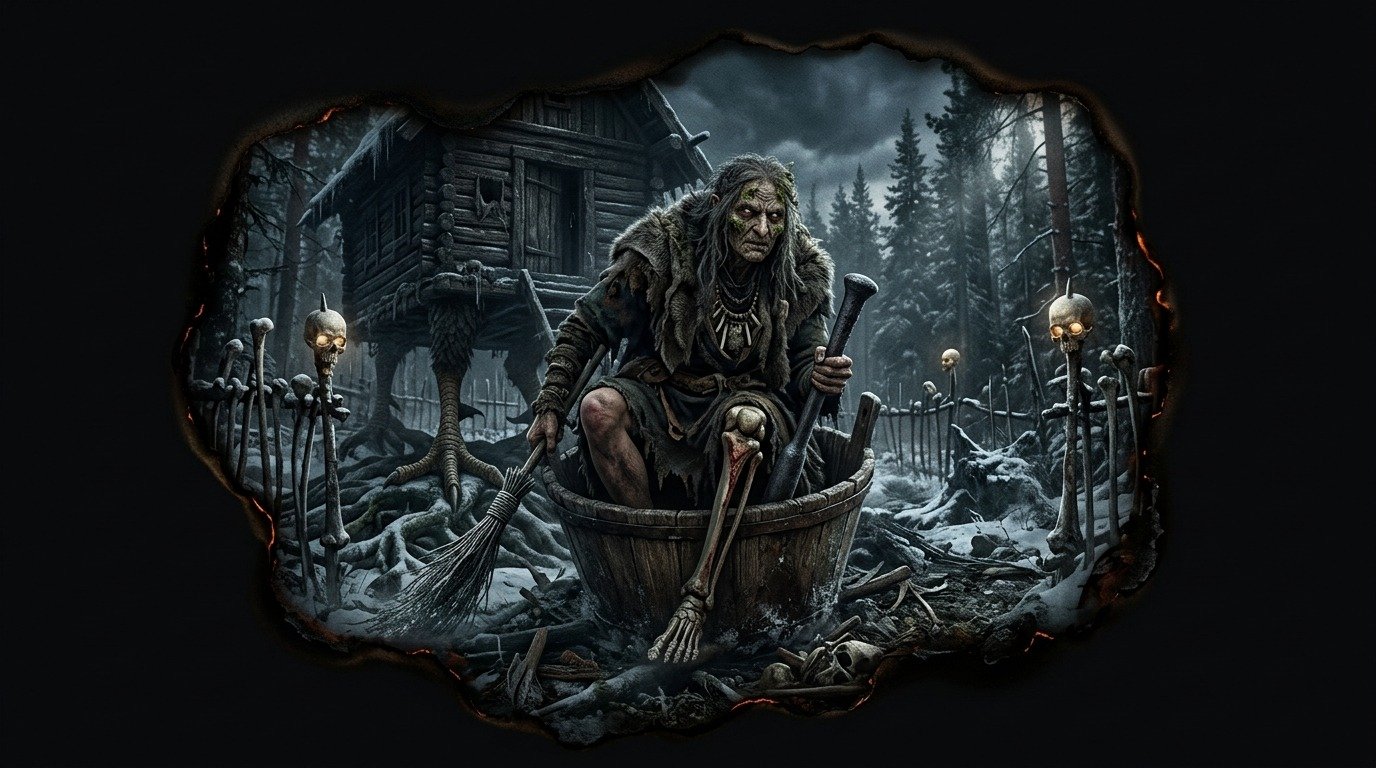
Baba Yaga: The Bony One of the Boundary and the Voracity of the Taiga
Archetype and Classification: Goddess or Beast?
To understand the entity known in Slavic folklore as Baba Yaga, the scholar must strip away the childish caricatures of the Western witch. Baba Yaga is not a simple human sorceress who practices the dark arts; her nature is fundamentally non-human, a liminal and chthonic spirit that rightfully belongs to a Bestiary of the wild rather than to a pantheon of organized deities. While the divinities of the Slavic pantheon (such as Perun or Veles) rule the cosmos, storms, or livestock through structured pacts and cults, Baba Yaga is the very personification of the untamed taiga, of forest decomposition, and of the ruthless law of nature that consumes life to spawn it anew. Her inclusion in this grimoire, under the category of beast-forest entity, is justified by her zoomorphic hybridization, her intimate connection with predation, and her status as a living threshold. She is the consumer of flesh, the crusher of bones, and the guardian of the border between the world of the living (*Yav*) and the realm of the dead (*Nav*).
Historical Origin and Anthropological Roots
Linguistically, the entity's name is divided into two components steeped in antiquity. *Baba* designates an old woman, grandmother, or midwife in Slavic languages, linking her directly to the mysteries of birth and the final transition. The origin of *Yaga* (or *Iaga*) is more complex and obscure; philologists trace it back to Proto-Slavic *\*(j)ęga*, associated with concepts such as pain, sickness, rage, or horror, finding parallels in Sanskrit *yajati* (to offer sacrifice) and Old Icelandic *ekki* (pain, grief). Anthropologically, the figure of Baba Yaga has its roots in Siberian shamanism and the funerary practices of pre-Christian Uralic and Slavic tribes. Her famous dwelling, the hut on chicken legs (*Izbushka na kuryikh nozhkax*), is not a whimsical invention of fairy tales. It is a mythical transposition of the *domoviny*, small wooden ossuaries built on felled tree trunks whose exposed roots resembled bird legs. These elevated structures were used to deposit the cremated or decomposing remains of the deceased, protecting them from terrestrial scavengers. Thus, Baba Yaga's hut is, literally, a breathing coffin, and she is the corpse that inhabits it.
Anatomy, Attributes, and the Bony Threshold
Physical descriptions of the entity in the *bylinas* (epic poems) and Russian folk tales collected by Aleksandr Afanasiev present her with grotesque features that defy conventional human anatomy. She is described as the Bony Leg (*Kostyanaya Noga*), a reference to one of her legs being devoid of flesh, showing only bare bone. This asymmetry is the physical sign of her dual belonging: with her leg of flesh she supports herself on the physical plane, while her leg of bone penetrates the ground of the dead. Her physiognomy is immense and constrained by her own dwelling: ancient texts state that "she lies on the stove, with her nose thrust into the ceiling." This image evokes once again the rigidity of a corpse inside a coffin that is too narrow. She does not fly on a conventional broomstick, but rather travels through the skies and treetops sitting in a mortar of iron or hardwood (*stupa*), propelling herself with a pestle (*pest*) used as a rudder, while erasing her tracks behind her with a silver birch broom. The use of the mortar and pestle is highly symbolic: they are agricultural tools for grinding and crushing, associated both with the preparation of food and the destruction of matter to release the seed, an echo of the ritual anthropophagy attributed to her. The boundary of her domain is bordered by a palisade made of human bones, topped with skulls whose empty eye sockets glow with a spectral fire when night falls. The entrance gate to her clearing is made of human legs, the bolts are arms, and the lock is a mouth bristling with sharp teeth.
Esoteric and Symbolic Significance
From the perspective of depth psychology and archetypal esotericism, Baba Yaga embodies the Great Terrible Mother in her destructive and transformative aspect. She is not intrinsically evil, but amoral; she operates under the laws of the pre-human cosmos. Those travelers who dare to venture into the taiga and seek out her hut face an ordeal of shamanic initiation. At the alchemical level, she represents the phase of *nigredo* or putrefaction: the necessary dissolution of the old form so that new life may emerge. When the entity devours intruders who fail to pass her trials, she performs a transmutation; when, on the contrary, she hands over the sacred fire (often in the form of a glowing skull) to initiated heroines like *Vasilisa the Beautiful*, she acts as the matron of the mysteries who destroys sterile innocence to make way for mature wisdom.
Threshold Protocols and Preservation
For the esoteric operator who must interact with the currents of force associated with this forest entity, folklore preserves rigorous protocols to avoid physical and mental consumption: 1. **The Earth-Turning Formula**: Baba Yaga's hut usually turns its back on the visitor, facing the deep forest (*Nav*). To force it to reveal its entrance toward the world of the living, one must utter the ancient calling formula: *"Izbushka, izbushka, turn your front to me, and your back to the forest"*. This forces the structure to reorient its liminal polarity. 2. **The Recognition of Human Odor**: Upon entering, the entity will invariably exclaim that she smells "Russian flesh" (*Russkim dukhom pakhnet*). This smell is not geographical, but rather the vibration of vitality from the plane of the living. The visitor must remain absolutely calm and immediately demand hospitality—food, a bath, and rest—before answering any questions. This demand activates the universal laws of archaic hospitality, which even Baba Yaga is temporarily bound to respect. 3. **The Control of the Celestial Servants**: Under her yoke operate three mysterious riders: the White Rider (Day), the Red Rider (the Sun), and the Black Rider (Night). Attempting to subdue these riders is futile; they represent the laws of time that Baba Yaga administers. The operator must limit themselves to observing their passage with reverence and silence, for asking too much about divine secrets accelerates old age and death in her presence, just as she herself warns in ancient texts: *"Knowing too much will make you grow old before your time"*.
Comments
Share information, an experience, or a source to help enrich this entry. They are automatically reviewed before being published.
Loading comments...