Banshee
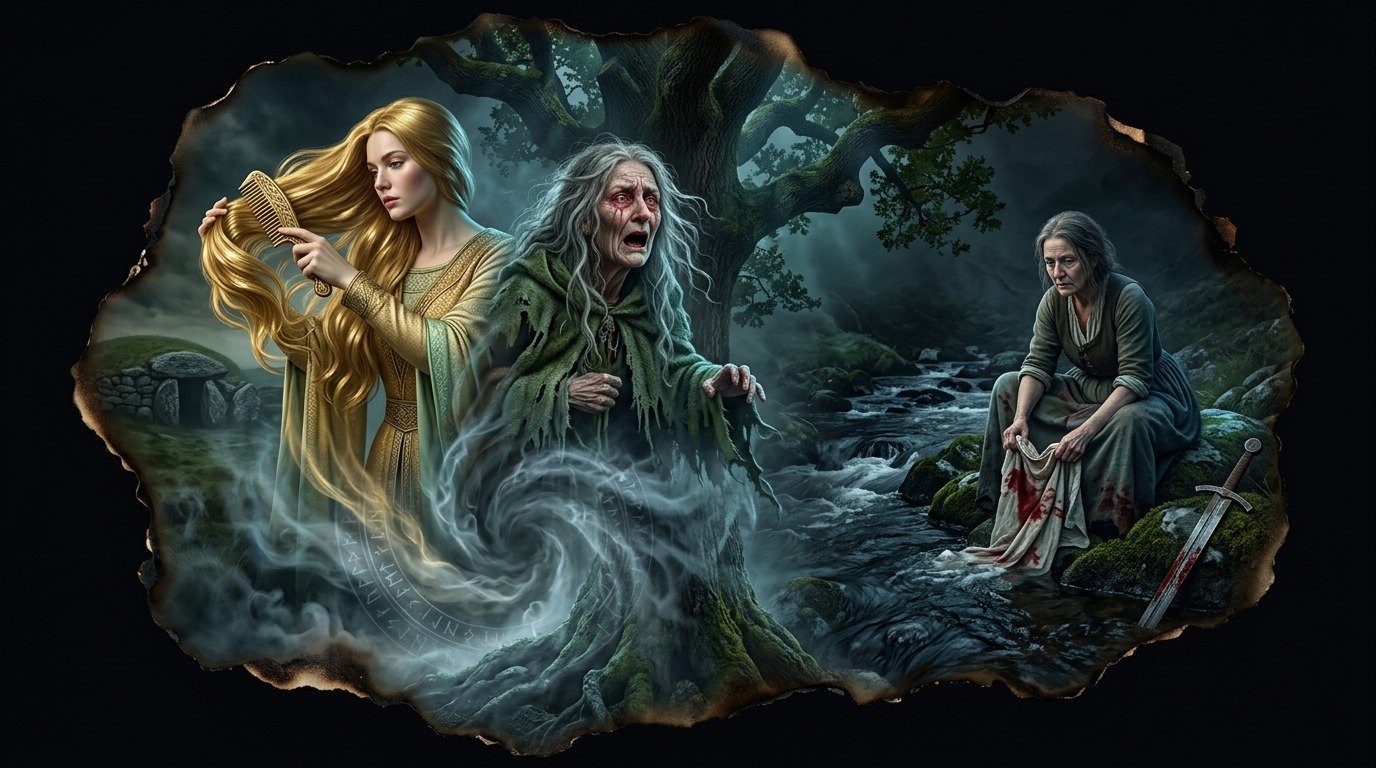
Banshee: the lament of the wounded lineage
Mythological Origins and the Blood Bond
The figure of the Banshee (from the Irish Gaelic *bean sídhe*, "woman of the mounds" or "woman of the Sidhe") has its roots deep in pre-Christian Celtic mythology, closely linked to the Tuatha Dé Danann. Originally, these entities were not terrifying specters, but tutelary divinities of the land or personified sovereignties who blessed or wept for the fate of a noble lineage. Late Irish folklore codified this connection, limiting her manifestation to the five great original families of the island: the O'Neills, the O'Briens, the O'Connors, the O'Gradys, and the Kavanaghs (along with their branches and those surnames bearing the prefixes "Ó" or "Mac"). For these lineages, the Banshee is not a hostile demon, but a heraldic family spirit whose function is to announce the imminent transition of a clan member to the Otherworld (*Tír na nÓg*), allowing the lineage to prepare for the loss and perform the corresponding rites of passage.
Metamorphosis and Regional Variations
Over the centuries, the perception of the *bean sídhe* underwent a folkloric bifurcation. In some regions of Ireland, she is described as a young woman of astonishing beauty, with golden or silver hair that she combs with a golden comb (a sacred and taboo object that no mortal should dare to steal from the roads). In other provinces, particularly in the west, she takes the form of the *Cailleach*: a decrepit old woman, with eyes bloodshot from her perpetual weeping, dressed in gray or green cloaks that evoke the shroud and the moss of graves.
In Scottish folklore, her direct counterpart is the *Bean Nighe* (the washerwoman of the ford). Unlike the Irish Banshee, who limits her activity to the vocal and spectral plane, the *Bean Nighe* is a liminal spirit that inhabits lonely streams, where she is seen washing the blood-stained clothes of those destined to die a violent death. If a traveler is bold and silent enough, they can catch her to question her about their own fate and demand that she grant them three wishes, provided they act with due respect and ritual submission.
Esoteric and Psychological Symbolism
From an esoteric and archetypal perspective, the Banshee represents the personification of collective grief and the ancestral memory of the blood. She is the guardian of the pain that the clan cannot or does not know how to consciously process. In depth psychology, she is associated with the concept of anticipatory grief and the inevitability of death as a process of destructuring necessary for the regeneration of the family tree. The golden comb, which appears recurrently in testimonies, symbolizes the spinning of fate (analogous to the Greek Moirai or the Norse Norns) and the delicate boundary separating sanity from terror before the numinous. Her song is not a destructive attack, but a resonant vibration that dissolves the veil between the physical and astral planes, tuning the psyche of the living to the frequency of departure.
The Phenomenon of the Lament and Safeguards
The lament of the Banshee, traditionally known as *keen* or *caoineadh* (from Gaelic, the ritual wailing for the deceased), is an indescribable auditory experience that combines the howling of the wind, the crying of a child, and the wailing of wolves. Historical testimonies agree that this sound is non-physical in nature; it is often heard solely by the members of the affected family, regardless of the geographical distance separating them from their homeland.
To protect oneself from the madness that hearing the *keen* directly at close range can cause, local traditions recommend the following guidelines of conduct:
1. **Do not interfere:** If the entity is discovered combing her hair, you must look away and retreat in silence. Under no circumstances should a comb abandoned on the ground be picked up; whoever does so will suffer the mutilation of their hands or a terminal misfortune in their home. 2. **Iron metal:** Like all beings of fae origin, the Banshee abhors direct contact with cold iron. Placing a bar of this metal behind the main door prevents the specter from casting her shadow inside the dwelling. 3. **Respectful silence:** If the lament echoes near the windows, you must not respond with shouts or attempt to locate its source. The proper response is to light a blessed candle and recite transition prayers for the soul preparing to depart, acknowledging the sovereignty of the spirit without challenging her presence.
Comments
Share information, an experience, or a source to help enrich this entry. They are automatically reviewed before being published.
Loading comments...