Basque Lamia
Basque Lamia: The Guardians of the Springs and the Weaving of Destiny
Origin and Differentiation from the Classical Tradition
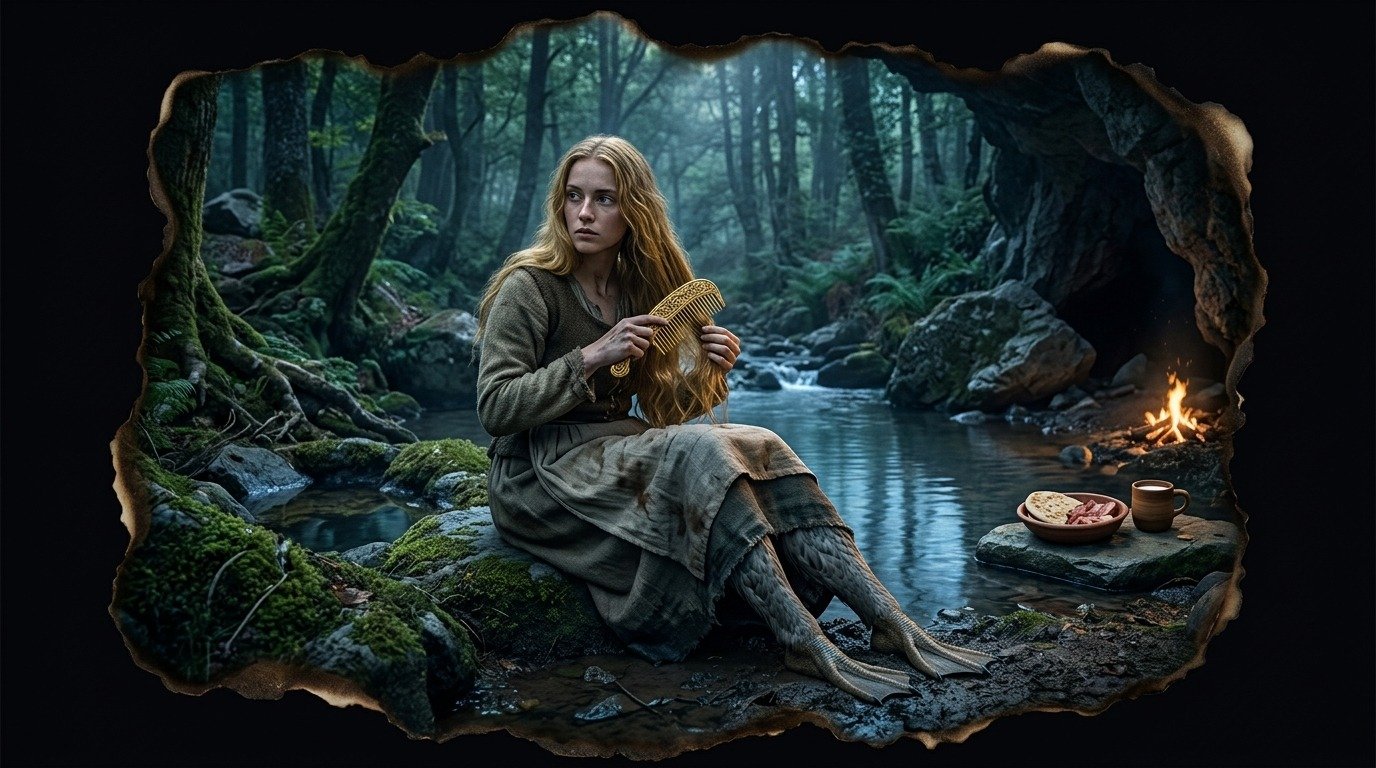
It is imperative to decouple the Lamia of the Basque Country (frequently referred to as *Lamiak* or *Lamiñak*) from the homonymous figure of Greco-Roman mythology. While the classical Lamia is a child-devouring monster and a seducer of men due to a curse from Hera, the Basque Lamia is a numen of a fluvial nature, a builder, and closely linked to the cult of Mari, the supreme goddess of Basque cosmology. The *Lamiak* commonly manifest as beautiful, golden-haired women who inhabit caves, river pools, springs, and deep wells. Their physical anomaly lies in their lower extremities: instead of human feet, they possess the feet of a duck, goose, or chicken, and in coastal areas (where they are called *Itsaslamiak*), fish tails. They spend the warm hours of twilight combing their long hair by the water's edge with solid gold combs (*urre-orrazia*), an object that concentrates much of their power and ritual symbolism.
The Gold Comb and the Relationship with Mortals
The interaction of the *Lamiak* with human communities is of a magnetic ambivalence. They are capable of immense generosity, but also of relentless vengeance if their laws are violated. They are prodigious architects: legends attribute to them the construction in a single night of bridges, castles, churches, and dolmens (such as the bridge of Licq-Athérey in Soule). To complete these works, they only demanded that the name of God or the Virgin Mary not be uttered during the construction process, and that they be provided with food (talo, bacon, and milk) at the entrance of their caves. The theft of their gold comb is a recurring motif in Basque folklore. Any mortal who dared to steal the comb of a sleeping Lamia gained temporary wealth, but unleashed a curse upon their lineage. The Lamia would pursue the thief to their own farmhouse (*baserri*), reclaiming her possession with laments that dried up crops and sickened livestock, demonstrating that excessive greed catastrophically alters the order of nature.
Transition from Life to Death
A deeply melancholic and ritual aspect of the *Lamiak* is their inability to die without human intervention. Being creatures belonging to the pre-Christian and telluric plane, when a Lamia lies dying in her cave, she cannot cross the threshold of death unless a mortal comes to pray an Our Father by her side or she receives the blessing of a priest. If a compassionate shepherd agreed to assist a dying Lamia, she would reward him by revealing treasures hidden in the roots of the mountain or ensuring the fertility of his lands for generations. This trait reveals an esoteric codependency between the ancient world (the pagan numen) and the new order (the Christian human), where human compassion is the key that allows the spirit of the earth to rest in peace.
Esoteric Significance and Matriarchal Identity
On the symbolic plane and that of archetypal psychology, the *Lamiak* represent the current of life, the flow of the unconscious (water), and the sovereignty of women in traditional Basque social structure. The gold comb is not a mere cosmetic accessory; it is a tool for ordering chaos, an instrument with which they comb the threads of destiny and the memory of the earth. Their waterfowl feet connect them to the primordial mud, the plane where earth and water merge. The *Lamiak* personify the memory of purifying water and the resistance of matriarchal chthonic cults that survived under the mantle of rural Christianity, reminding us that beneath the stone floors of churches, the rivers of ancient deities still run.
Comments
Share information, an experience, or a source to help enrich this entry. They are automatically reviewed before being published.
Loading comments...