Boggart
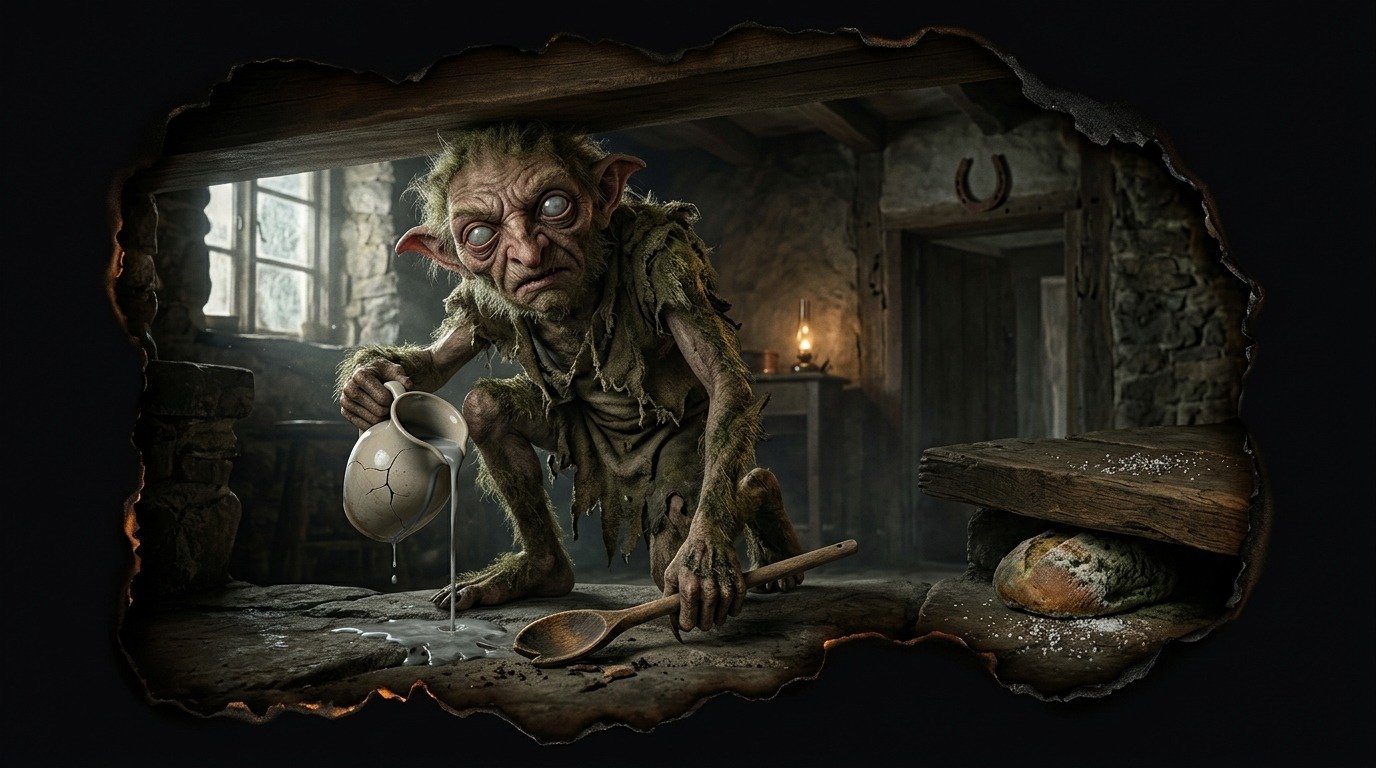
Boggart: The Scourge of the Domestic Threshold
The Corrupted Household Spirit
The Boggart is an earth and household spirit belonging to the folklore of Northern England (with an especially dense presence in the counties of Lancashire and Yorkshire). In the taxonomy of invisible beings, the Boggart represents the absolute degeneration of a *Brownie* (the benevolent household spirit that performs agricultural chores in exchange for a bowl of cream). When a Brownie is offended by the inhabitants of the house—whether by the gift of new clothes (which they consider an insult to their dignity), by the poor quality of food offerings, or simply by chronic household clutter—its spiritual energy sours and transmutes into a boggart.
Once this transformation has occurred, the entity dedicates itself to systematically sabotaging the lives of the residents. Milk sours in the cows' udders, household utensils disappear only to turn up broken in inaccessible corners, blankets are pulled off sleepers on the coldest winter nights, and children are pinched or frightened with shrill noises coming from the walls and the space under the beds.
Typologies: The Household Intruder and the Marsh Monster
English folklore clearly distinguishes two variants of Boggart depending on their habitat and degree of malevolence:
1. **The Household Boggart:** Although annoying and destructive, it rarely causes lethal physical harm to the adults of the house. Its activity resembles that of a *poltergeist* phenomenon: noises of dragging chains, thumping on ceiling beams, and the mysterious disappearance of everyday objects. It is a constant nuisance that wears down the family's mental resilience. 2. **The Wild or Outdoor Boggart:** It inhabits peat bogs, marshes, stone bridges, and sharp bends in rural roads (such as the famous *Boggart Hole Clough* in Manchester). This variant is significantly more dangerous and predatory. It attacks solitary travelers in the dark, frightens livestock to cause deadly stampedes, and kidnaps unattended children playing near stagnant waters, dragging them down into the muddy depths.
Psychology of Chaos and Archetypes
From a psychological perspective, the Boggart is the externalized projection of family dysfunction and repressed domestic conflict. Its activity increases in homes where discord, abuse, or emotional neglect prevail, feeding on the psychic energy of fear and the tension accumulated among family members.
On an esoteric level, it represents the "shadow double" of the house: the dirt and chaos that accumulate behind the walls and under the floorboards when the spiritual and physical hygiene of a dwelling is neglected. The Boggart is a reminder that the comfort of the home is a fragile balance that requires respect, order, and constant offerings of attention and cleanliness.
Methods of Containment and Mitigation
Getting rid of a household Boggart is one of the most difficult tasks in English magical folklore. The famous folk tale *"Ay, George, we're flitting!"* illustrates the futility of trying to move houses to escape it: when a family loaded their belongings onto a cart to move to another village, a neighbor asked if they were moving, to which the boggart replied from inside a wash tub: *"Ay, we're flitting today"*. The entity travels hidden among the household goods, as its bond is not with the physical structure of the house, but with the energy of the family lineage.
To neutralize or repel the entity, the following traditional methods must be employed:
- **Nailing a horseshoe:** It must be placed with the prongs pointing upward on the door of the main room or the kitchen to prevent the spirit's free passage through the living areas. - **Salt bread:** Placing a piece of stale bread rubbed with plenty of coarse salt under furniture or on ceiling beams absorbs the boggart's chaotic energy, forcing it to temporarily retreat. - **Changing the name of the dwelling:** Since the boggart binds itself to the spiritual name of the property, officially changing the name of the farm or the land confuses its geomantic anchor, forcing it to abandon the place in search of its former identity.
Comments
Share information, an experience, or a source to help enrich this entry. They are automatically reviewed before being published.
Loading comments...