Huldra
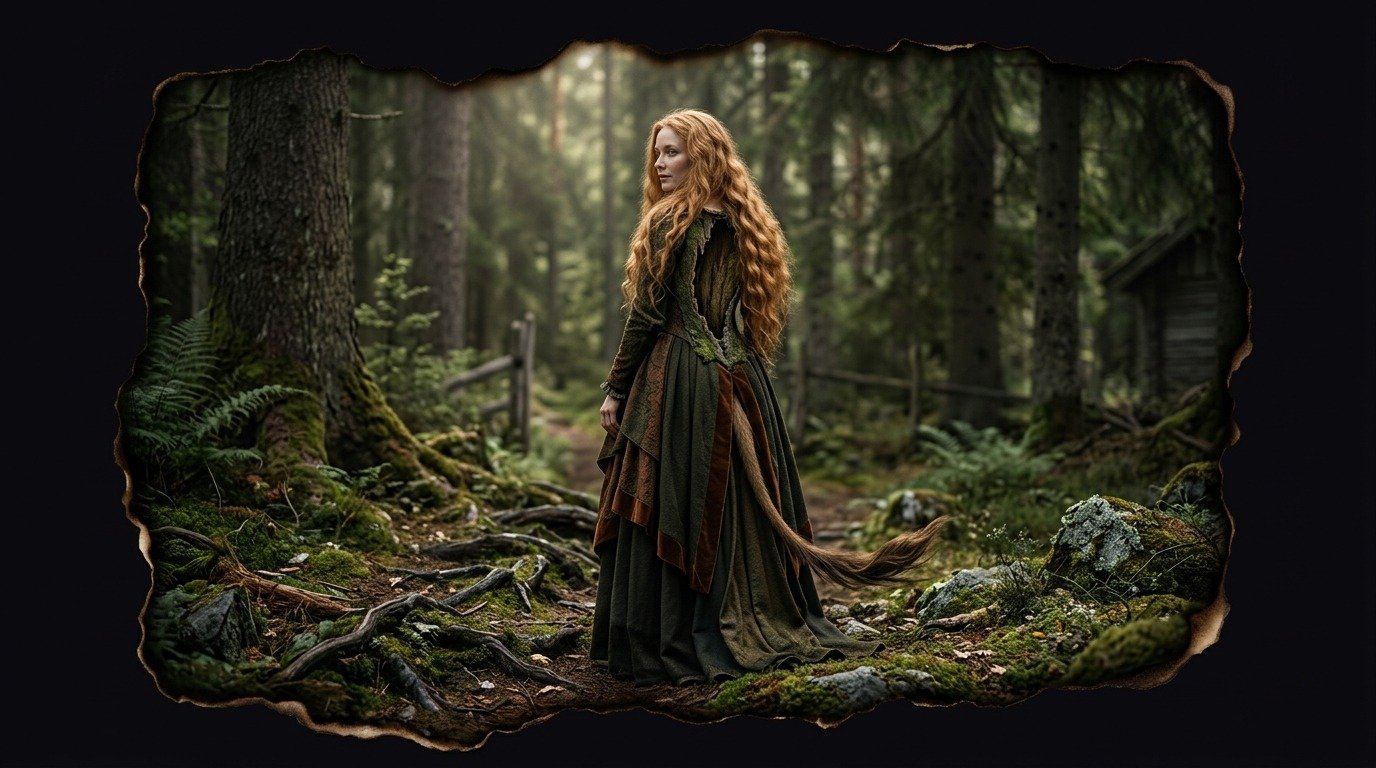
Huldra: The Hidden Seduction of the Northern Forests
Origin and the Hidden Lineage
The term *Huldra* (in Norwegian) or *Skogsrå* / *Tallemaja* (in Swedish) comes from the Old Norse root *hylja*, meaning "to cover" or "to hide." It belongs to the category of the *huldufólk* (the hidden people), those nature spirits that inhabit a subtle dimension parallel to our own, closely linked to the forest and mountainous geography of the Scandinavian peninsula.
Norwegian popular mythology assimilates their origin into an adapted Judeo-Christian narrative: it is said that Eve was washing her children in a river when God called her. Ashamed that some of them were not completely clean, Eve hid them. God, who sees all, declared that those children who had been hidden from His sight would remain hidden from all humanity. From these hidden children descended the *huldras*, the elves, and the rest of the subterranean spirits.
Anatomy of Illusion and Physical Signs
The Huldra manifests before solitary men—hunters, lumberjacks, and shepherds in the high mountain pastures (*seter*)—as a woman of dazzling beauty, with extremely long blonde or reddish hair and garments that mimic the elegance of high-society ladies. However, this appearance is an illusory projection designed to mask two anatomical imperfections that betray her wild nature:
1. **The Hollow Back:** Seen from behind, the Huldra lacks human flesh and a spine; her back is concave, resembling a decayed tree trunk or empty bark (*holback*). 2. **The Animal Appendage:** She possesses a cow's tail (*kurompe*) in Norwegian tradition, or a fox's tail in Swedish tradition (*skogsrå*).
The Huldra does everything possible to hide her tail under her skirts. Traditional tales warn that if a man notices the tail but warns her about it with courtesy and respect (for example, saying: *"Beautiful lady, your petticoat is falling"*), she will grant him fortune, health, and protection. If, on the contrary, he mocks her or exposes her cruelly, he will receive a curse that will wither his crops, cause him madness, or lead to fatal accidents in the forest.
The Conjugal Bond and the Loss of Magic
The Huldra frequently seeks marriage with human men in Christian temples. According to the folkloric laws compiled in the 19th century by Peter Christen Asbjørnsen and Jørgen Moe, if a Huldra is baptized and married in church, she loses her cow's tail and her wild nature, becoming an ordinary woman.
However, this transformation carries danger for the spouse. The huldra-wife retains immense physical strength, inherited from her chthonic origin. Folklore warns of the danger of mistreating her: there is a famous legend where a married huldra, upon seeing her enraged husband attempt to strike her, bends an iron horseshoe with her bare hands to show him what she could do to him if she decided to defend herself, earning the husband's respect and submissive fear for the rest of his days.
---
Comments
Share information, an experience, or a source to help enrich this entry. They are automatically reviewed before being published.
Loading comments...