Grendel
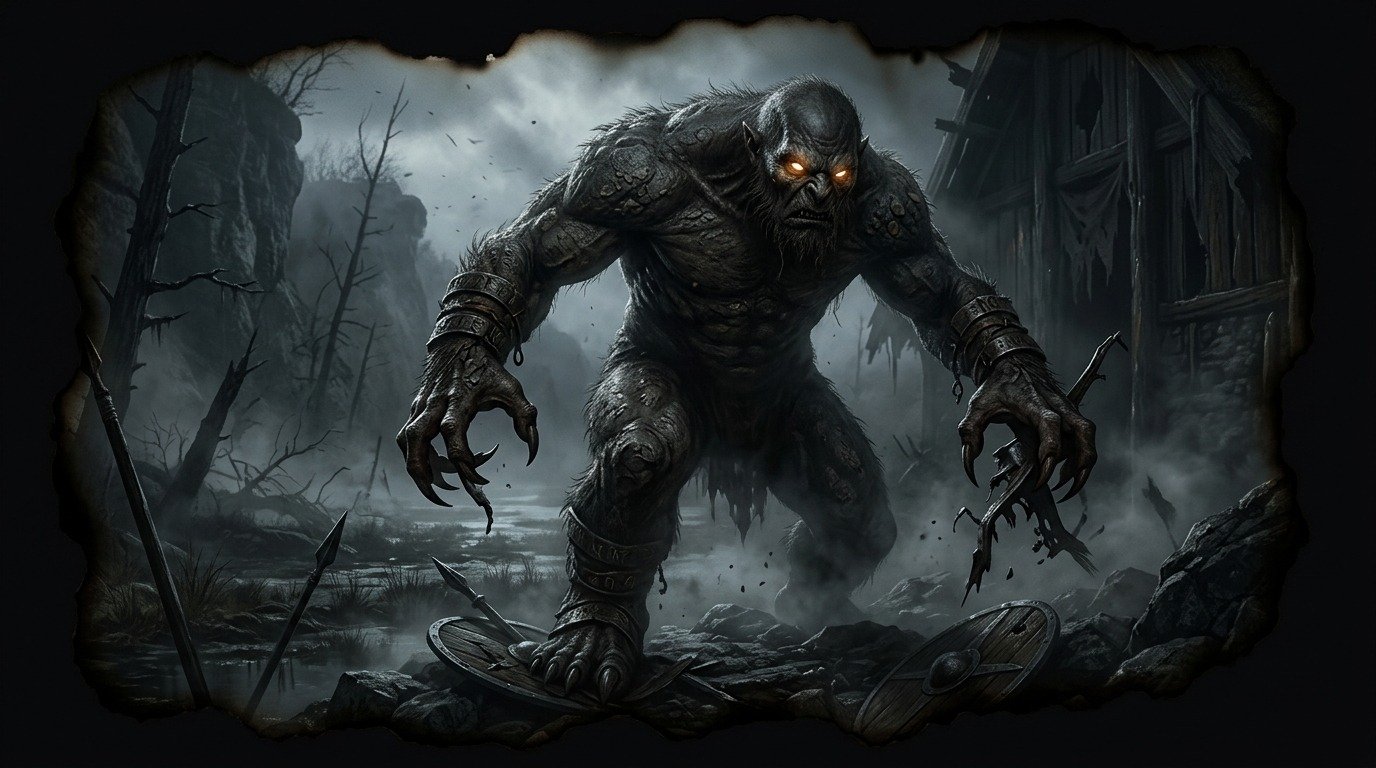
Grendel: The Outcast of the Lineage of Cain
Origin and Mythology
The figure of Grendel emerges from the mists of the Anglo-Saxon epic poem *Beowulf*, preserved in the unique codex *Cotton Vitellius A. XV* (dated around 1000 AD, although its oral composition is much earlier, situated between the 8th and 11th centuries). Grendel is not a mere physical monster of folkloric tradition; he represents the embodiment of otherness, the ultimate outcast within the Judeo-Christian cosmological scheme assimilated by the Germanic peoples.
The text of *Beowulf* explicitly defines him as a *mearcstapa* (one who wanders the borders, the dweller of the boundaries) and an *ellengæst* (a powerful spirit or demon of immense strength). The poem's cosmogony links his lineage directly to Cain, the first fratricide of the biblical narrative. After the murder of Abel, God cursed Cain and banished his descendants to the peripheries of Creation, where he fathered all kinds of abominations: *eotenas* (giants), *ylfe* (dark or fallen elves), and *orcneas* (monsters of the marine abysses). Grendel inhabits the marshy moors, the dark fens (*fen-hliðu*), and the wind-swept cliffs of 6th-century Scandinavia (where the historical action of the poem is set), remaining on the margins of the human community and divine grace.
Physiology and the Nature of the Outcast
The physical description of Grendel in the original sources is deliberately ambiguous, which intensifies the terror he evokes. He is not described with anatomical precision, but rather through his effects and metaphorical attributes. He is called a *þyrs* (giant or demon), and it is emphasized that his skin is impervious to weapons of tempered metal, which lose their edge upon touching him due to a spell or his unholy nature. His eyes emit a horrific light, comparable to an impure flame (*ligge gelicost*), and he possesses claws capable of tearing through the iron of the gates of the great hall of Heorot.
Unlike the dragons of Norse folklore, who covet gold out of greed, Grendel acts driven by an existential resentment. His pain and subsequent fury are unleashed by the sound of the harp, the poetry of the *scop* (the bard) singing of the creation of the world, and the social communion of the warriors in the hall of King Hrothgar. Grendel represents absolute exile (*wræcca*); he lacks a clan, cannot participate in the ring-giving (the Germanic bond of loyalty), nor pay the *wergild* (the blood price for the men he murders), which places him outside of all human and divine law.
Esoteric and Psychological Symbolism
From an esoteric and depth psychology perspective, Grendel is the collective Shadow of the Germanic clan. He represents the forces of primordial chaos that threaten to collapse the social order of the *comitatus* (the brotherhood of warriors). The hall of Heorot is the ordered, illuminated, and consecrated cosmos; Grendel's moors are the untamed unconscious, the void where the light of civilization is extinguished.
In the esoteric tradition of Norse-influenced grimoires, the lineage of Cain is associated with the "left-hand path" current, initiation through isolation, confrontation with the wilderness, and spiritual self-sufficiency taken to a monstrous extreme. Grendel is a reminder that the wild nature and the trauma of exile can dehumanize the spirit, transforming the pain of isolation into an insatiable appetite for destruction. ---
Comments
Share information, an experience, or a source to help enrich this entry. They are automatically reviewed before being published.
Loading comments...