Krampus
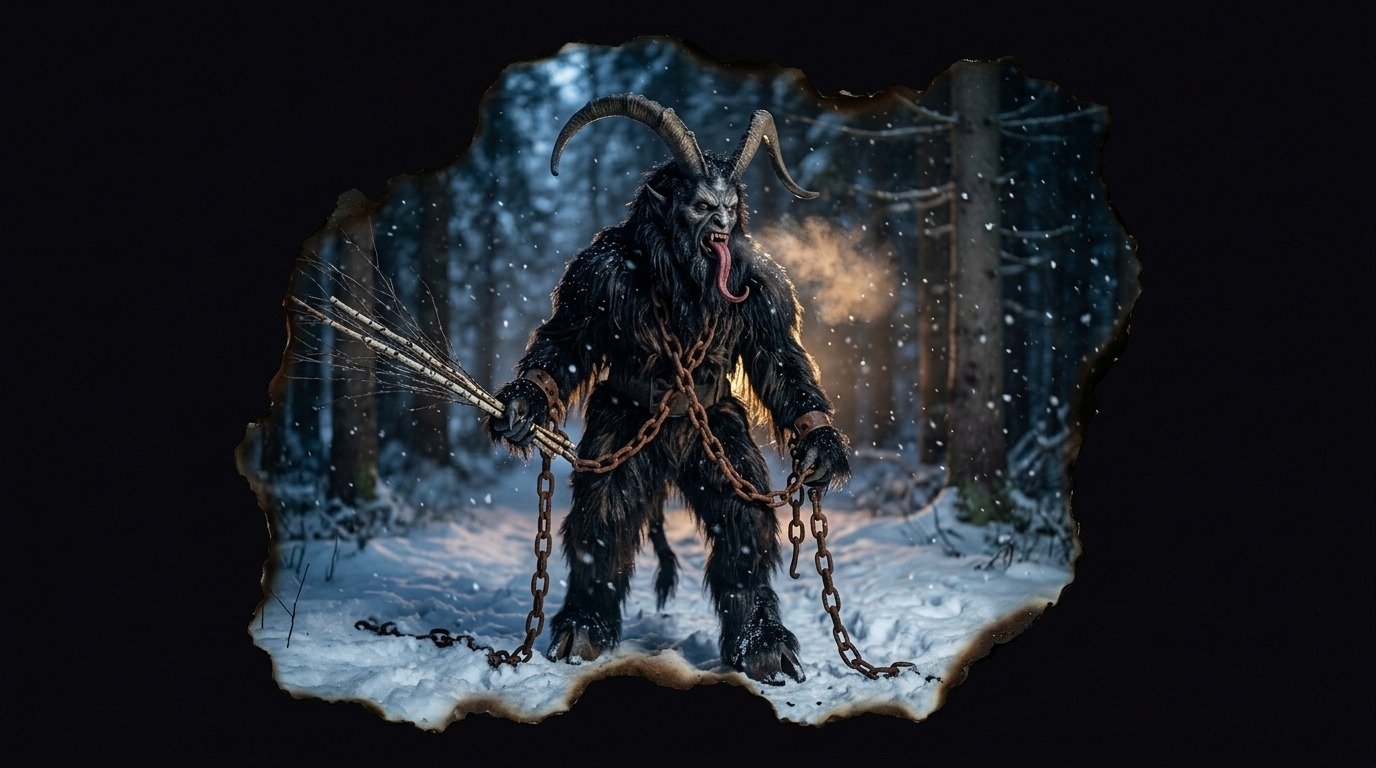
Krampus: The Horned Shadow of the Winter Solstice
Pagan Roots and Geographical Context
The *Krampus* is a liminal entity whose territory of origin is confined to the Alpine regions of Central Europe, spanning Austria, Bavaria (Germany), South Tyrol (Italy), Slovenia, and parts of Hungary. Its name derives from the Old High German word *Krampen*, meaning "claw," or from the Bavarian *Kramp*, which denotes something withered or rigid.
The origin of this creature dates back to the pre-Christian ritual practices of the Germanic and Celtic peoples associated with the winter solstice and the *Rauhnächte* (the twelve "harsh" or rough nights that take place between Christmas and Epiphany). During these nights, the veil between the world of the living and that of nature spirits was considered extremely thin. Krampus shares direct roots with the *Perchten*, masked figures that represented spirits of fertility and winter under the dominion of the ancestral goddess Perchta (or Holda), who was responsible for monitoring human behavior and punishing the lazy during the cold season.
Physiology and Sacred Attributes
The appearance of the Krampus is a compendium of chthonic and caprine iconography: * **Physiognomy:** It is covered in thick black or brown fur, possesses cloven hooves (one goat hoof and, often, one human foot, denoting its hybrid status), and large ibex horns. Its tongue is unusually long, forked, and bright red. * **The Chains:** Krampus carries heavy, rusted iron chains, which he drags and rattles to announce his arrival. In esoteric and syncretic interpretation, these chains represent the subjugation of the devil by the Church, but in the context of ancient ritual, the sound of metal serves to ward off hostile winter spirits. * **The Birch Switch (*Ruten*):** A bundle of thin birch branches with which he lashes sinners. In traditional Germanic and Celtic medicine, birch is a symbol of purification, regeneration, and fertility; Krampus's lashings were not originally interpreted as sadistic torture, but rather as a rite of passage to purge the physical and spiritual impurities accumulated throughout the year. * **The Wicker Basket (*Kraxe*):** A basket or leather sack carried on his back, used to kidnap disobedient children and transport them directly to the underworld or throw them into icy waters.
The Syncretism with Saint Nicholas and the Psychosocial Function
With the consolidation of the Catholic Church in the Alpine regions, ecclesiastical authorities attempted to eradicate the cult of Krampus. Faced with the impossibility of extinguishing such a deeply rooted tradition, they opted for syncretism: Krampus was subjugated and turned into the "shadow double" or servant of Saint Nicholas (*Heiliger Nikolaus*).
In this context, the night of December 5th (*Krampusnacht*) precedes Saint Nicholas Day (December 6th). Saint Nicholas and Krampus travel together in a perfect duality that embodies cosmic justice: the bishop rewards virtue, generosity, and learning, while the demon punishes laziness, lying, and disobedience. This dynamic served as an extremely effective pedagogical tool for social control in the isolated agricultural communities of the Alps, where winter survival depended on strict discipline and community cohesion.
Comments
Share information, an experience, or a source to help enrich this entry. They are automatically reviewed before being published.
Loading comments...