Basajaun
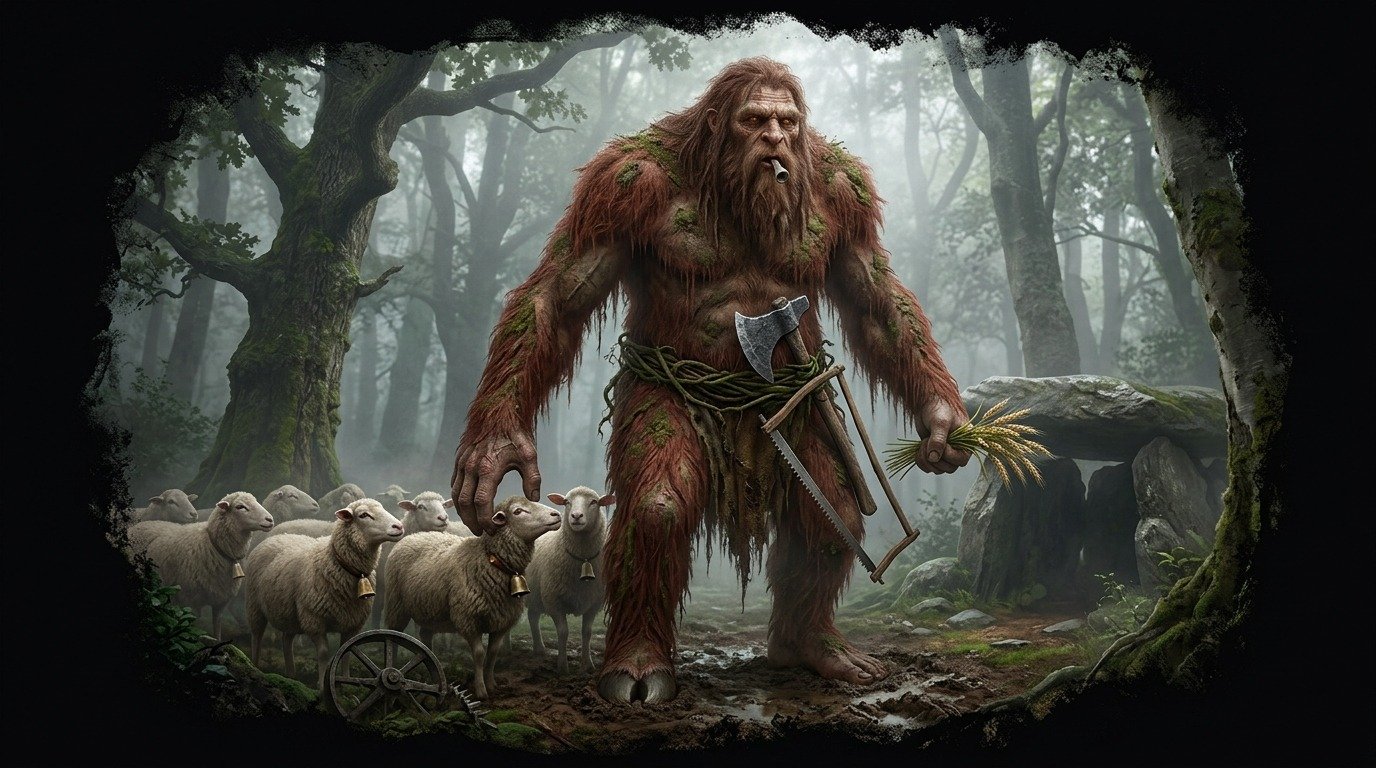
Basajaun: The Lord of the Thicket and Guardian of Telluric Knowledge
Origin and the Geography of Silence
The Basajaun (whose plural is *Basajaunak*, and whose name translates literally from Basque as "Lord of the Forest" or "Wild Lord") is one of the oldest numina of Basque mythology. He dwells in the depths of the forest masses of the Pyrenees, Gorbea, and the Irati Forest. Described as a hominid of colossal proportions, with superhuman strength and covered in a dense coat of reddish hair that reaches down to his knees, the Basajaun is the protective genius of nature, wildlife, and the secrets of the earth. On a physical level, he possesses a fundamental distinctive trait that links him to the folklore of liminal beings in the rest of Europe: while one of his feet is human-shaped, the other is circular, resembling the hoof of a horse or a cow. This asymmetrical footprint in the mud of forest paths was interpreted by shepherds as a ritual warning that they were crossing into the territory of the protective beast.
The Pastoral Pact and the Alliance with Livestock
Unlike the destructive giants of other mythologies, the Basajaun does not seek the annihilation of human beings, but rather the preservation of the natural order. He is the absolute protector of sheep flocks. When a sudden storm approaches or when wolves prowl the high pastures, the Basajaun emits a shrill, distinctive whistle that reverberates through the gorges. Upon hearing it, the sheep shake their bells in unison, alerting the shepherds to gather the livestock. This behavior transformed the Basajaun into a respected and revered figure. Shepherds left him offerings of bread, cheese, or milk at specific dolmens, caves, or crags. In return, the giant guaranteed the livestock's immunity against predators and inclement weather, acting as a mystical intermediary between the wild space (*baso*) and the domesticated space (*herri*).
San Martin Txiki and the Theft of Technological Fire
The Basque mythological corpus details that the *Basajaunak* held a monopoly on civilizing technologies: agriculture (wheat cultivation), metallurgy (iron forging), the manufacture of the saw, and the design of the millstone. Humans of antiquity lived in a state of technical helplessness until the appearance of San Martin Txiki (Saint Martin the Little), a cunning hero of Promethean character. Legends tell how San Martin Txiki visited the Basajaun's cave under the pretext of a wager to see who could jump over piles of stored wheat. San Martin, wearing deliberately large *abarcas* (traditional footwear), fell into the middle of the grain, which slipped into his footwear. As he left, the Basajaun realized the deception and threw his heavy double-edged axe at him, but failed to hit him. From those stolen wheat seeds and San Martin's subsequent espionage to discover the secrets of iron welding and saw manufacturing (imitating the edge of a chestnut leaf), humanity was able to emerge from barbarism.
Anthropological and Archetypal Significance
The Basajaun represents the collective memory of the Neolithic period and the transition from hunter-gatherer societies to agricultural and metallurgical ones. He is the custodian of the lost wisdom of the Stone Age, a symbol of nature that possesses the blueprints of civilization but chooses to remain on its margins. From an esoteric perspective, the Basajaun is the *Anima Mundi* of the Basque forest, a reminder that every technological advancement carries a debt to the original telluric forces. His figure teaches that human sovereignty over the earth is not absolute, but is subject to ecological and invisible laws that, if broken, would awaken the destructive wrath of the Lord of the Thicket.
Comments
Share information, an experience, or a source to help enrich this entry. They are automatically reviewed before being published.
Loading comments...