Tarasca
Tarasca: The Heretical Beast and the Taming of the Shadow
Origin and History of the Beast of the Rhône
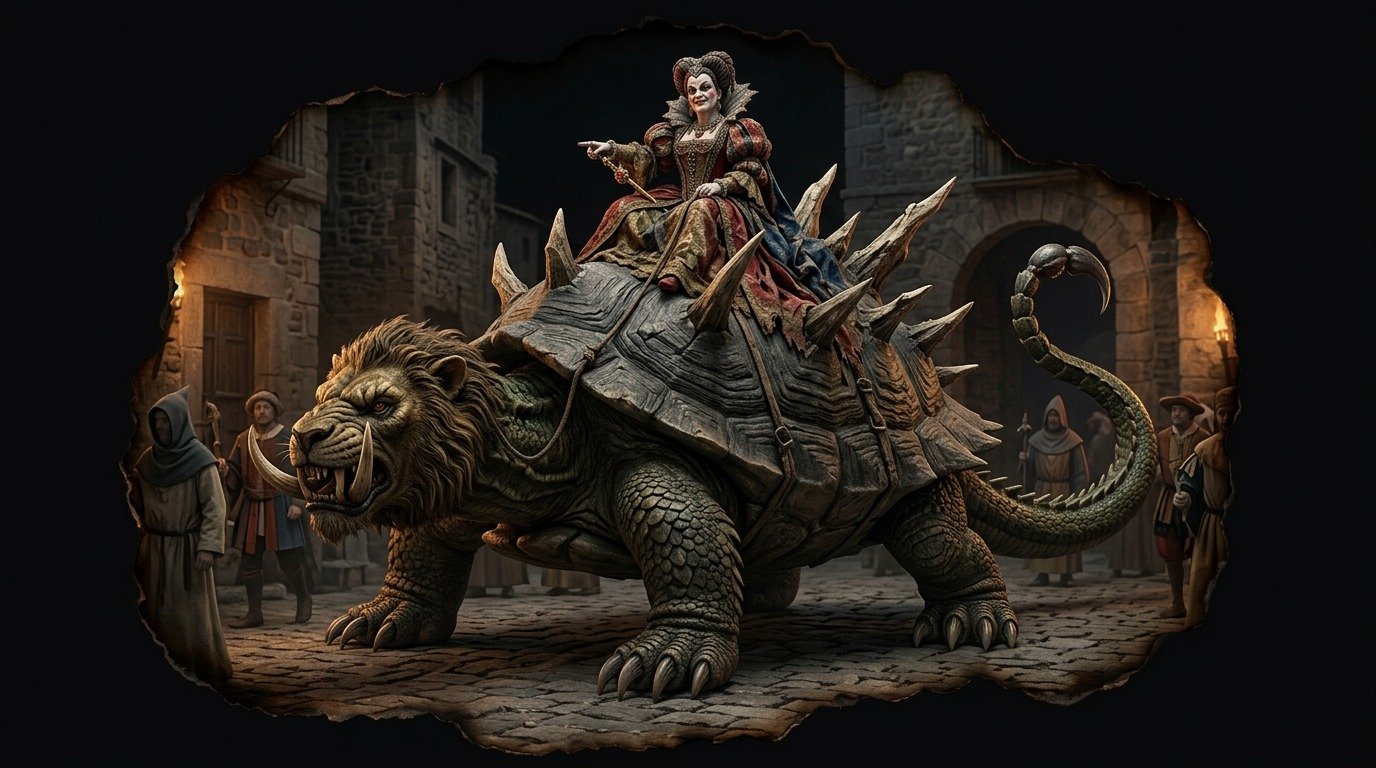
The Tarasca (from Provençal *Taraska*) is a legendary dragon whose historical cradle lies in the marshes and thickets along the banks of the Rhône River, near the present-day town of Tarascon, in French Provence. The canonical source that codified its myth is the *Golden Legend* (*Legenda Aurea*) by Jacobus de Voragine, written in the 13th century, although the creature's roots run deep into earlier Gallo-Roman cults dedicated to man-eating aquatic monsters. According to the medieval chronicle, the Tarasca was a monstrous and unnatural hybrid, sired by the biblical Leviathan and the Onachus (a beast of Galatia that burned everything it touched). Its physiognomy was a compendium of anatomical terrors: the head of a lion with the tusks of a wild boar, six short, robust legs equipped with bear claws, the shell of a giant turtle bristling with bony spikes, and a scaly serpent's tail ending in a scorpion's stinger. This beast ravaged the Rhône region, sinking ships, devouring livestock, and slaughtering anyone who attempted to cross the river.
The Intervention of Saint Martha and the Alchemy of Submission
The defeat of the Tarasca was not achieved through the force of arms of the King of Tarascon's armies, but through the spiritual strength of Saint Martha of Bethany, who arrived in Provence to evangelize the region. Martha ventured barefoot into the forest where the beast dwelt, armed only with holy water, a wooden cross, and her sacred chants. Upon encountering the monster, instead of attacking it, she sprinkled it with holy water and showed it the cross. The Tarasca, subjugated by the saint's spiritual purity, instantly lost all its ferocity. Martha tied her own belt around the creature's neck and led it, meek as a lamb, to the town square. However, the inhabitants of Tarascon, driven by accumulated panic and a desire for vengeance, fell upon the defenseless beast and tore it apart with spears and stones—an act they later regretted, adopting the monster's name for their town and establishing annual processions in its honor.
Expansion of the Tradition: The Processional Tarascas of Spain
Starting in the 15th century, the figure of the Tarasca crossed the Pyrenees and became deeply integrated into the Corpus Christi celebrations in Spain, especially in Toledo, Madrid, Granada, and Valencia. In the context of the Catholic Counter-Reformation, the Tarasca was reconfigured as a pedagogical and allegorical device. In Spanish processions, the Tarasca became a large mechanical dragon, carried by men hidden inside, which moved its head and spewed water or fire from its jaws to frighten children and the crowd. Atop its shell sat a female figure dressed in bizarre and theatrical clothing, known as the *Tarásquela* or the *Fiera Cupidia*, which represented pride, lust, heresy, or the weakness of the flesh in the face of the Sacrament of the Eucharist. This figure's attire was a source of great anticipation and popular gossip, setting the fashion trends of the era.
Esoteric Meaning and Integration of the Shadow
From a hermetic and analytical (Jungian) perspective, the Tarasca embodies the Collective Shadow, the irrational and destructive chthonic forces that dwell in the community's unconscious. Saint Martha's taming of the dragon does not represent the destruction of the monster, but rather its reintegration and submission to spiritual consciousness. The saint's belt holding the monster is the cord of the higher will over the inner beast. The subsequent slaughter of the dragon by the frightened crowd illustrates the inability of the profane masses to coexist with the integrated Shadow, preferring the physical destruction of the symbol instead of its internal transmutation. In the Corpus processions, as it parades defeated under the custody of sacred banners, the Tarasca acts as a reminder that the lowest animal passions must be channeled and put at the service of the process of spiritual individuation.
Comments
Share information, an experience, or a source to help enrich this entry. They are automatically reviewed before being published.
Loading comments...