Strix
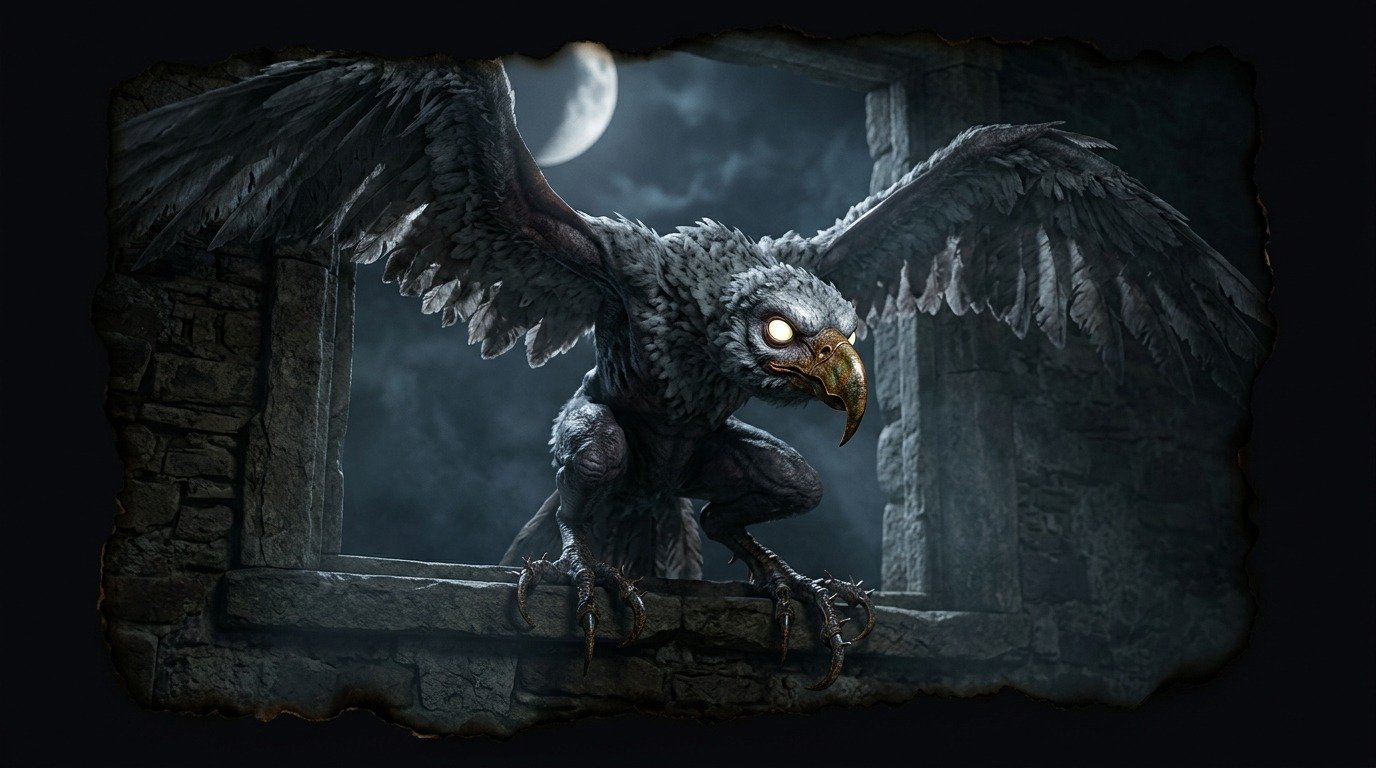
Strix: The Roman Strix and the Horror of the Devouring Night
Ancient Origin and Etymology of the Night Terror
The Strix (from the Latin *Strix*, and this from the Greek *strix* or *strigx*, whose original meaning is "screech owl" or "shrieking bird") is one of the most terrifying parasitic and predatory entities of Greco-Roman antiquity. It should not be confused with a simple nocturnal bird of prey, but rather with a monstrous mutation, a demon in the form of a bird of ill omen that dwells on the borders of the physical world and the spiritual plane of shadows.
The earliest literary mentions of the Strix date back to the 4th century BCE, but its most detailed and spine-chilling description appears in Ovid's *Fasti* and in the works of Pliny the Elder. They are described as gigantic birds with grayish or whitish plumage, fixed and bulging eyes that glow in the dark, a sharp and hooked beak of bronze or iron, and talons made of hooked thorns with which they tear flesh. However, their most repulsive feature is that they possess pendulous breasts filled with a poisonous milk that they use to nurse or poison infants.
Spiritual Infanticide and the Feast of Blood
The Strix is the embodiment of the primordial fear of infant mortality and the vulnerability of the home during the night. Its *modus operandi* consisted of slipping silently through the cracks of the windows of bedrooms where unprotected newborns slept.
Once inside, the creature would emit a sharp, paralyzing screech that plunged the parents into a hypnotic lethargy from which they could not wake. Immediately afterward, the Strix would drive its beak into the baby's chest or throat to suck its blood until it was drained, or it would tear open the child's abdomen with its metallic talons to devour its entrails alive, replacing the internal organs with straw or leaving it empty inside. In some accounts, if the child survived the attack, they were cursed for life, slowly wasting away from an incurable consumption caused by the creature's poisoned milk.
From Strix to Strega: The Birth of the Medieval Witch
In ancient Roman law, the existence of the Strix was treated with such seriousness that the Law of the Twelve Tables (5th century BCE) contained provisions prohibiting the use of incantations to summon or transmute into these creatures to harm crops or the health of citizens. Here we observe the crucial linguistic and conceptual transition: the Latin word *strix* evolved directly into the Italian term *strega*, meaning "witch," and the Romanian *strigoi*, which designates psychic vampires and the undead.
During the transition to the Middle Ages, the myth was refined. It was believed that striges were not solely winged monsters by nature, but human women versed in the arts of black magic and necrophagy who, through ointments made from the fat of children and cemetery fluids, managed to transform themselves into these nocturnal birds of prey to hold their covens and quench their thirst for innocent blood.
Esoteric Significance and Apotropaic Remedies
Symbolically, the Strix represents the devouring and destructive aspect of the Great Mother archetype: the night that consumes newborn life, the womb that becomes a tomb. It is the embodiment of sudden infant death syndrome, projected onto a creature that inverts the nurturing function of motherhood by feeding with poison and extracting life through the sucking of blood.
To defend against the incursion of a Strix, the ancient Romans used complex apotropaic rituals described by Ovid. Whitethorn (or strawberry tree) branches were placed on windows and doors to wound the creature if it attempted to enter. Likewise, wet nurses touched the doorframes with arbutus leaves dipped in lustral water and uttered incantations dedicated to the goddess Cardea (the deity of thresholds and hinges) and to Carna (protector of vital organs), offering the entrails of a young pig as a substitute sacrifice to divert the beast's appetite away from the household child.
Comments
Share information, an experience, or a source to help enrich this entry. They are automatically reviewed before being published.
Loading comments...