Succubus
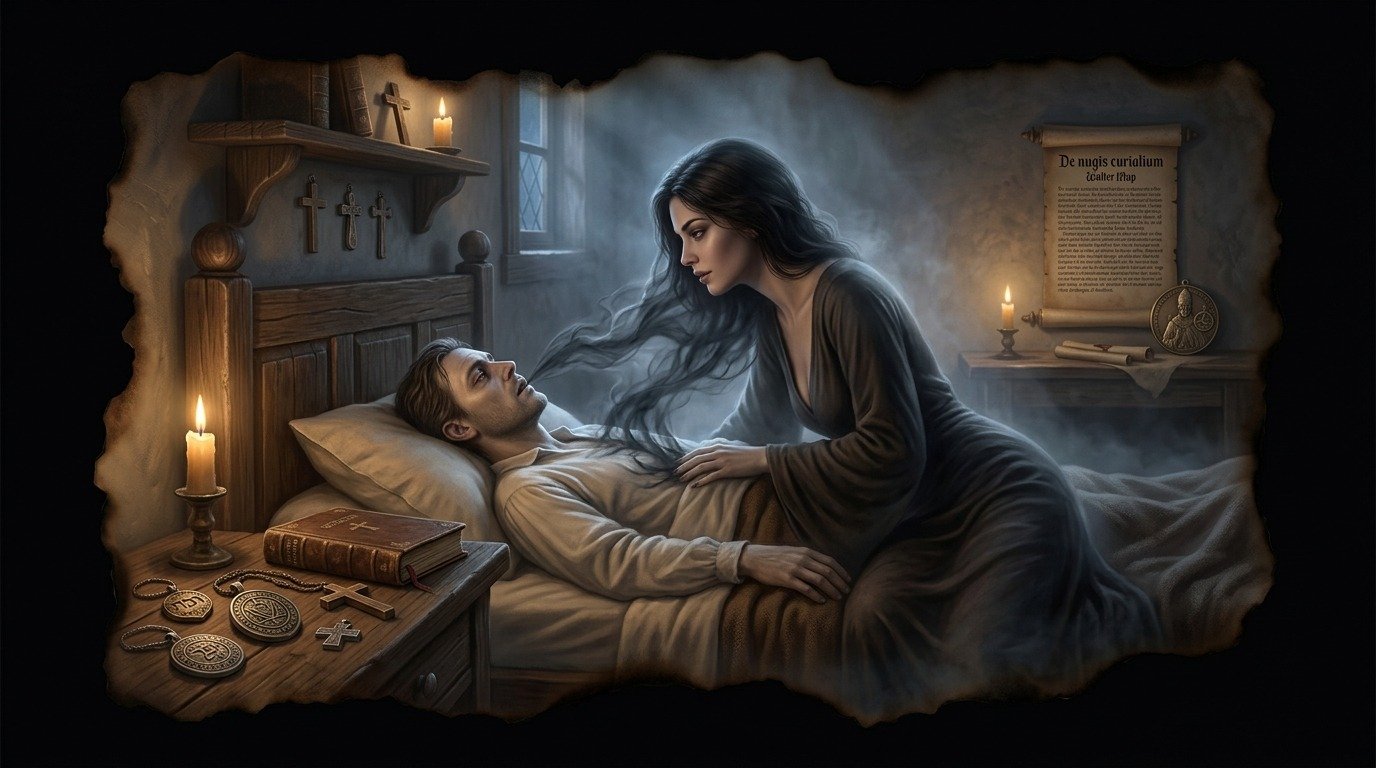
Succubus: the demon in the form of a woman who seduces men at night
What is a succubus
The succubus is a demon that takes the form of a woman to seduce men, almost always while they sleep. She appears in dreams or in that boundary between sleep and wakefulness, unites with her victim, and leaves him exhausted, as if she had stolen his life force. Her male counterpart, the one who visits women, is the incubus. The name comes from the Latin *succubare*, "to lie under."
Lilith and her daughters
Before the Church spoke of succubi, Jewish tradition already feared a woman of the night: Lilith. The Talmud warns that a man must not sleep alone in a house, because Lilith may take possession of him. In later Jewish mysticism, Lilith and her daughters, the *lilin*, visit sleeping men, and from those nocturnal unions, bodiless spirits are born. Nocturnal emissions were interpreted as her work, and for this reason, prayers were said and amulets were hung to keep them far from the bedroom.
The medieval figure of the succubus inherited a good part of that fear: a beautiful woman who arrives at night, who is not what she seems, and who takes something from the one who receives her.
The temptations of the saints
The hermits and monks of early Christianity recounted that the devil tempted them by taking the form of a woman. In the *Life of Saint Anthony*, written by Saint Athanasius in the 4th century, the devil presents himself before the saint in the desert, adopting the figure and gestures of a woman to make him fall. The image of female temptation in the solitude of the cell was repeated for centuries in monastery tales.
Thomas Aquinas gave the succubus a role in his theory on how demons could procreate: acting as a succubus, the demon collected the seed of a man, and acting as an incubus, deposited it in a woman.
The pope and the woman of the forest
The most famous legend is that of Gerbert of Aurillac, the scholar who became pope under the name Sylvester II and died in the year 1003. Almost two centuries later, the writer Walter Map recounted in *De nugis curialium* that, as a poor young man, Gerbert met a woman of impossible beauty named Meridiana in a forest. She offered him riches and knowledge in exchange for his company, and from then on his career was unstoppable: archbishop of Reims, then of Ravenna, and finally pope. According to the legend, Gerbert confessed everything before dying and repented publicly.
The story served to explain something that seemed suspicious to many: a man of humble origin, an expert in mathematics and astronomy, who reached the very top of the Church.
How it manifests
Tales about succubi share very specific traits:
- **Intense and repeated dreams** with an unknown woman or with someone known who does not act as they do in real life. - **A physical presence** in bed: a weight, a touch, the sensation of a body next to you. - **Paralysis** upon waking, with the certainty that someone was there. - **Exhaustion**: waking up without energy, day after day, while the visits continue. - **Obsession**: in some accounts, the victim begins to look forward to the visits and loses interest in his real life.
As in the case of the incubus, sleep paralysis explains a good part of these experiences from a medical standpoint. Tradition, on the other hand, sees the key in the exhaustion: the succubus does not seek pleasure, she seeks energy.
Protection in tradition
Historical defenses vary by culture. In Jewish tradition, amulets and prayers were used before sleeping, and sleeping alone was avoided. In the Christian tradition, confession, prayer, the sign of the cross, and, in persistent cases, exorcism. In all of them, the same idea appears: the bedroom is the most vulnerable place, and what is let in at night is harder to cast out by day.
Comments
Share information, an experience, or a source to help enrich this entry. They are automatically reviewed before being published.
Loading comments...