Sleep paralysis
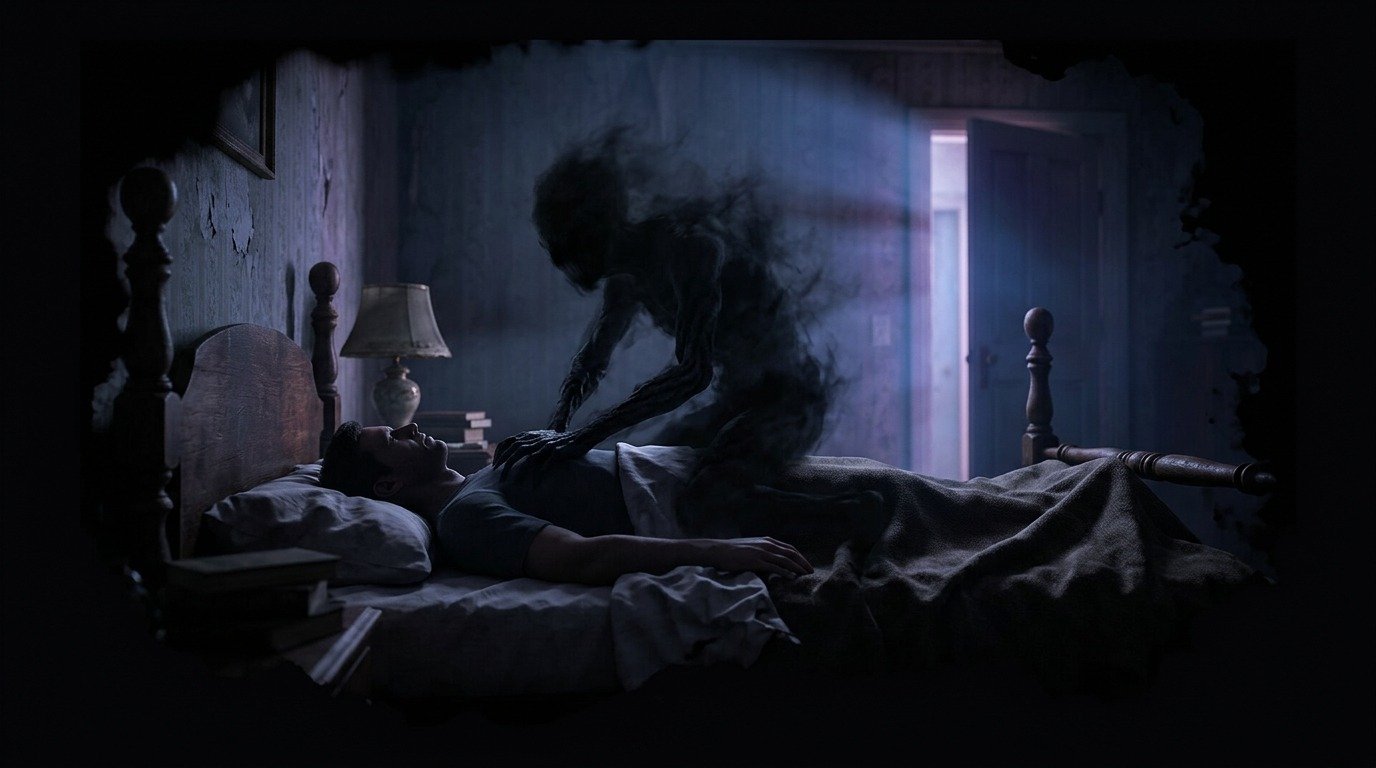
Sleep paralysis: the oppression of the night visitor
What it is
Sleep paralysis is a transitional state between wakefulness and sleep in which a person is aware of their surroundings but experiences a total inability to perform voluntary movements. This phenomenon is accompanied by vivid hypnagogic or hypnopompic hallucinations, an intense feeling of terror, and the perception of a hostile presence in the room oppressing the sleeper's chest.
How it manifests
The episode occurs abruptly immediately before falling asleep or at the moment of waking up. The person opens their eyes and discovers they cannot move their arms, legs, or speak. Breathing becomes forced. The most characteristic symptom is the illusion of an extreme physical weight on the chest, as if someone were sitting on their chest preventing lung expansion. Added to this are sensory hallucinations: - **Visual**: anthropomorphic shadows approaching from the doorway or the corners of the room. - **Auditory**: high-frequency metallic buzzing, approaching footsteps, unintelligible whispers, or mocking laughter near the ear. - **Tactile**: the sensation of being touched, dragged by the sheets, or suffocated. The episode lasts from a few seconds to several minutes and ends suddenly, leaving the individual in a state of hypervigilance and tachycardia.
History and traditions
Before the development of modern medicine, every culture attributed this phenomenon to underworld entities that fed on vital energy or caused nightmares: In Norse and Germanic mythology, the phenomenon was attributed to the *Mara*, a female demon who sits on the chests of sleepers to suffocate them (the origin of the word *nightmare* in English and *alptraum* in German). In Anglo-Saxon folklore, it is known as the *Old Hag* (the Old Witch), a spirit that performs a "mystical flight" over the victim to paralyze them through witchcraft. In Japan, it is called *Kanashibari* (bound by metal chains), a state that Buddhist tradition attributed to the action of spirits summoned by warrior monks or vengeful ghosts (*onryō*). In Yoruba culture, it is described as the attack of *Ogun Oru*, a demon who assaults the person during the night. In medieval Europe, this phenomenon defined the activity of *incubi* (male demons seeking sexual acts with sleeping women) and *succubi* (their female counterparts).
Famous cases
The painting *The Night Figure* or *The Nightmare* (1781) by the painter Henry Fuseli is the most famous iconographic representation of sleep paralysis: it shows a woman sleeping on her back with a grotesque-looking demon and incubus sitting on her belly, while a horse with spectral eyes watches from the background. The writer Guy de Maupassant depicted his own chronic experiences of sleep paralysis and hallucinations in his horror story *The Horla* (1887), where he describes an invisible being that drains his life while he sleeps.
What explains it
The esoteric explanation holds that during the process of falling asleep, the subtle or astral body begins to detach from the physical body. If consciousness is activated prematurely at this threshold, the individual perceives the lower astral plane. The shadows and entities perceived are low-vibration parasitic entities that take advantage of the vulnerability of the incomplete projection to feed on the energy of fear generated by the paralysis. The neurobiology and sleep medicine explain the phenomenon as an intrusion of the REM (rapid eye movement) phase into the waking state. During REM sleep, the brain disconnects the skeletal muscles to prevent the body from physically acting out dreams (muscle atonia). If the person wakes up consciously before this phase ends, the brain remains awake but the body continues to be paralyzed. The hallucinations are the result of the brain trying to interpret the state of paralysis in a situation of extreme alertness, activating the amygdala and projecting images of internal threat into the real environment.
Connections
It is related to astral projection, bedroom visitors, incubi and succubi, familial sleep paralysis, and the "shadow people" phenomenon. ---
Comments
Share information, an experience, or a source to help enrich this entry. They are automatically reviewed before being published.
Loading comments...