Anneliese Michel
Anneliese Michel: The Klingenberg Exorcism
What happened
Anneliese Michel was a young German university student who died in 1976 at the age of twenty-three, after undergoing 67 Catholic exorcism sessions over a ten-month period. Her death from severe malnutrition and dehydration led to a criminal trial of enormous public impact. The judicial process ended with the conviction of her parents and the two exorcist priests for negligent homicide, setting a definitive precedent in the relationship between psychiatry and religious rites in the contemporary world.
The protagonists and the location
The events took place mainly in the town of Klingenberg am Main, in the state of Bavaria, West Germany, between 1968 and 1976. The protagonist of the case was Anneliese Michel, a young woman born into a family of deep and strict Catholic convictions. The other key players were her parents, Josef and Anna Michel; the local parish priest Ernst Alt, who detected the signs of possession; the Salvatorian priest Arnold Renz, appointed to perform the rite; and the bishop of the Diocese of Würzburg, Josef Stangl, who granted formal authorization to perform the exorcism.
The facts
In 1968, when she was sixteen years old, Anneliese suffered a severe seizure that caused body rigidity and loss of speech. Specialists at the psychiatric clinic in Würzburg diagnosed her with temporal lobe epilepsy and prescribed anticonvulsant and antipsychotic medications, including Tegretol and Zentropil. Despite regular medical treatment, Anneliese's health did not improve. Around 1973, the young woman began to experience visions of demonic faces during her prayers and to exhibit a violent physical rejection of religious objects, such as crucifixes, rosaries, and images of saints.
In 1975, faced with the ineffectiveness of conventional medicine and convinced that her ailment was of strictly demonic origin, the Michel family discontinued psychiatric consultations and medical treatment. The priest Ernst Alt requested formal intervention from the Church. Bishop Josef Stangl analyzed the report and authorized the rite of exorcism according to the *Rituale Romanum* of 1614, ordering absolute secrecy.
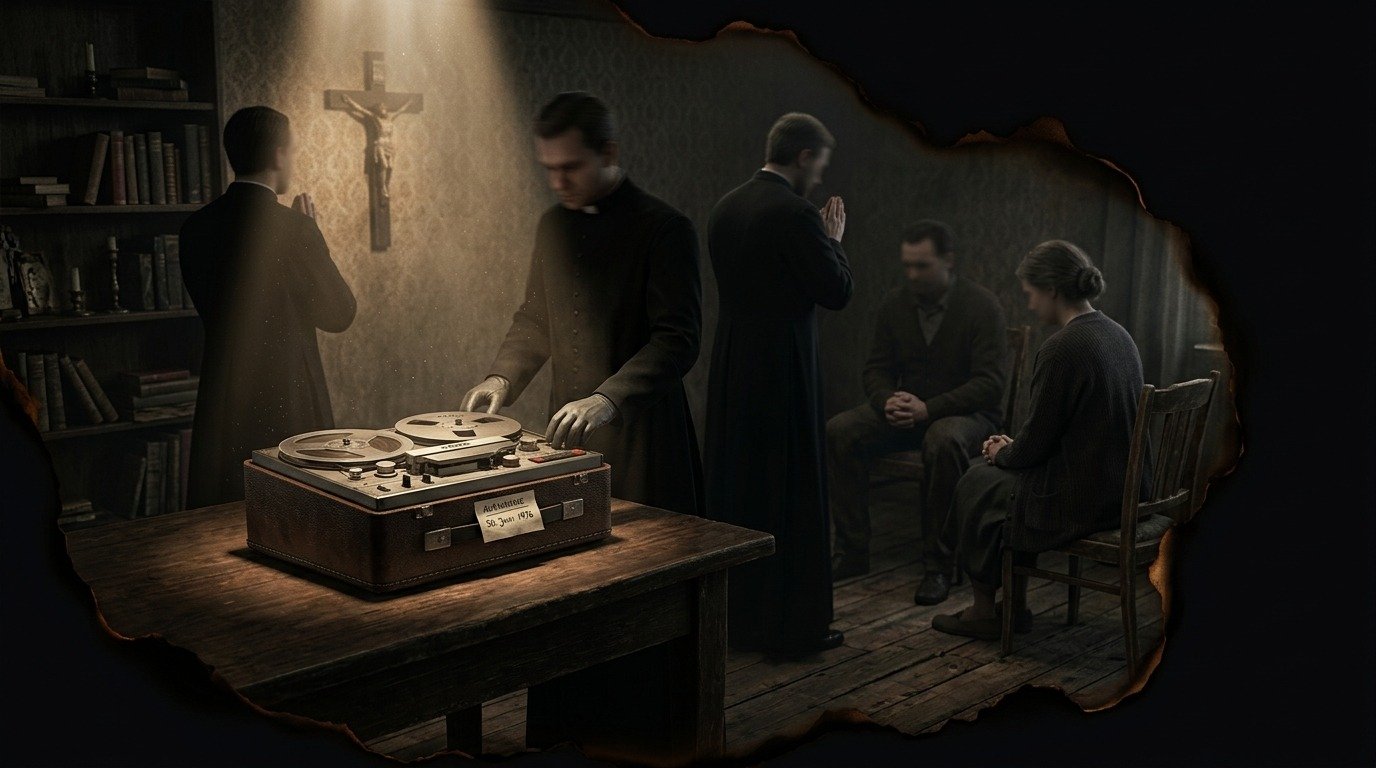
The first exorcism took place on September 24, 1975. The sessions were conducted twice a week and were recorded on magnetic tapes accumulating more than forty hours of recordings. In the recordings, Anneliese can be heard speaking with a drastic and deep voice alteration. The entities that manifested through her identified themselves by the names of Lucifer, Cain, Judas Iscariot, Nero, Hitler, and Fleischmann, an excommunicated priest from the 16th century.
During the first months of 1976, Anneliese began to systematically refuse to eat and drink. She claimed that her voluntary starvation was an act of atonement demanded by the Virgin Mary to save the souls of modern youth and reform the Church. The physical exertion of the exorcisms, combined with the hundreds of daily genuflections she performed compulsively, caused her knee tendons to rupture. The last exorcism session took place on June 30, 1976. Anneliese Michel passed away at her home on July 1, 1976. The forensic report determined that the cause of death was starvation and extreme dehydration, weighing barely thirty kilograms (66 pounds) at the time of her death.
The investigation
The German state prosecutor's office intervened immediately after the young woman's death and formally charged Anneliese's parents and the priests Ernst Alt and Arnold Renz with the crime of negligent homicide, for failing to seek mandatory medical assistance when the young woman's life was in obvious danger.
The trial began in 1978. During the proceedings, fragments of the exorcism recordings were played to demonstrate the young woman's mental state. Medical experts for the prosecution testified that Anneliese suffered from psychosis induced by temporal lobe epilepsy, aggravated by schizophrenia that distorted her perception of reality. They asserted that her death was preventable if intravenous force-feeding had been used, even a week before her passing. The defense argued that the rite was a practice protected by freedom of worship and that the priests acted in accordance with the victim's own beliefs.
The court ruled to find all four defendants guilty of negligent homicide. The sentence handed down was six months in prison, which was suspended and replaced with three years of probation for all involved, after it was considered that they had already suffered sufficient emotional punishment.
The legacy
The case of Anneliese Michel irreversibly transformed the protocol for exorcisms in the Catholic Church. The German Bishops' Conference ruled that, from then on, no exorcism would be authorized without the prior intervention and binding diagnosis of a team of qualified doctors, neurologists, and psychiatrists. The original audio tapes of the case remain the subject of theological and scientific analysis. In the cultural sphere, the case served as the direct basis for the film *The Exorcism of Emily Rose* (2005) and the German production *Requiem* (2006), remaining the ultimate point of reference in the debate over the boundaries between mental health and demonic possession.
Comments
Share information, an experience, or a source to help enrich this entry. They are automatically reviewed before being published.
Loading comments...