Demons Caught on Camera
Demons Caught on Camera: The Four Records That No One Could Explain
Almost all of the "demon caught on camera" videos circulating on social networks are setups. But there are four cases in which someone turned on a recorder or a camera in front of something that had no explanation, and those records still exist. One served as evidence in a homicide trial. Another was filmed by the director of *The Exorcist* with his own hands. Another was left in an official report from the United States government. These are their stories, with the records so you can see and hear them yourself.
1. The Anneliese Michel Tapes (Germany, 1975-1976)
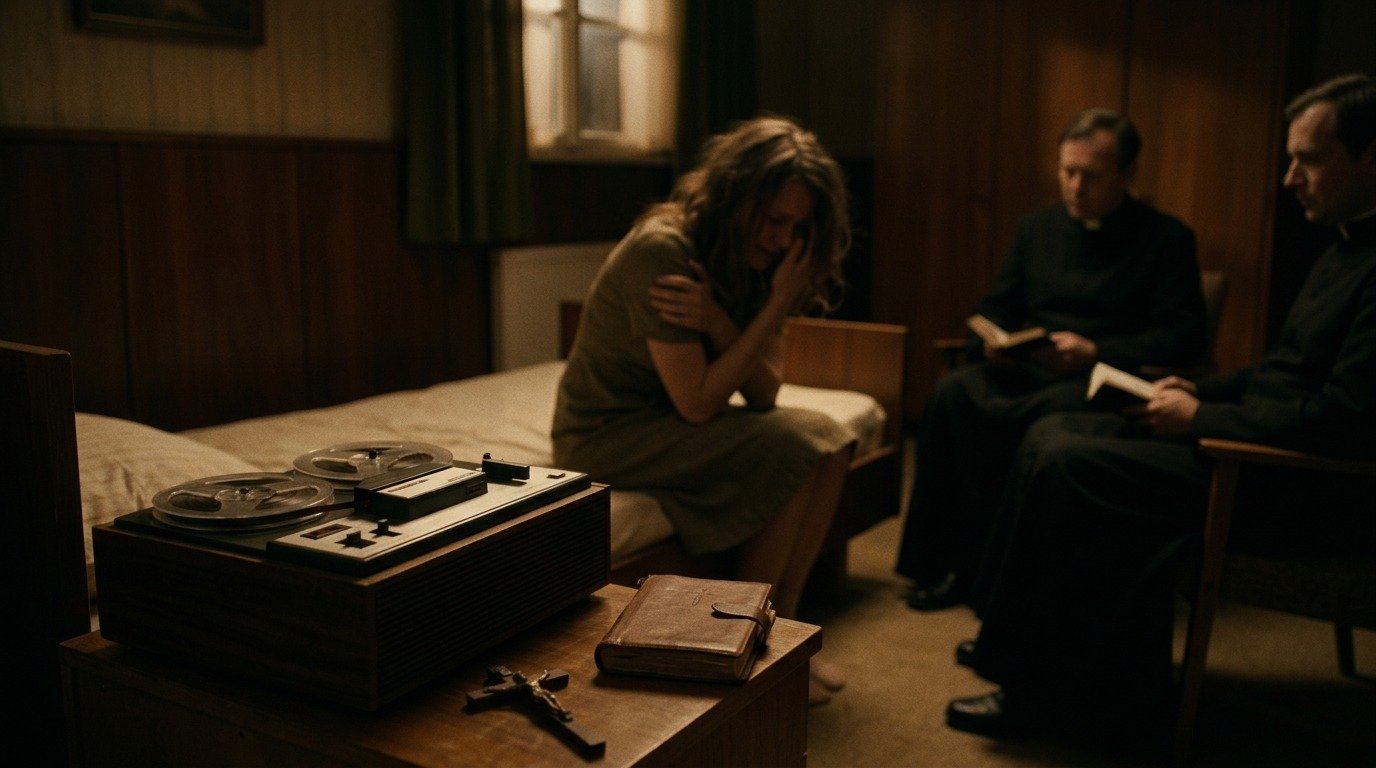
In September 1975, in a house in Klingenberg, a town in Bavaria, two priests placed a tape recorder on the table and began to pray the ritual of exorcism over a 23-year-old student. Her name was Anneliese Michel, she had been diagnosed with epilepsy for years, and the treatment had been of no use. The priests decided to record every session. There would be 67 in ten months, and more than forty hours of tape.
What was recorded is difficult to listen to. Anneliese's voice drops until it sounds like that of an adult man, she growls, insults, barks. Between the prayers in Latin, the priests ask her who is there, and the voices answer with names: Lucifer, Judas, Cain, Nero, Hitler, and a certain Fleischmann, a priest fallen from grace centuries ago. In some fragments, the voices argue among themselves about who has to speak.
In the spring of 1976, Anneliese stopped eating. She said that her suffering was an atonement for the souls of others. She did hundreds of genuflections a day, until the ligaments in her knees broke. On July 1, 1976, she was found dead in her bed: she weighed about thirty kilos (66 lbs). According to the family's account, her last words, the night before, were to her mother: "Mother, I'm afraid."
The prosecution accused the parents and the two priests of negligent homicide. In the trial, in 1978, the tapes were played in front of the court. The defense used them as proof of possession, and the prosecution as proof of an illness that no one treated. All four were convicted. The tapes survived the case and today are the most listened-to record of a possession in the world. The complete story is in the file of Anneliese Michel.
2. The Exorcism Filmed by the Director of *The Exorcist* (Italy, 2016)
William Friedkin spent more than forty years answering the same question: whether he believed in what he had filmed in *The Exorcist*. In 2016, at age 80, he decided to look for the answer. He wrote to Father Gabriele Amorth, the official exorcist of the diocese of Rome, a 91-year-old priest who claimed to have performed tens of thousands of exorcisms. Amorth admired the movie. And he agreed to something he had never allowed anyone else to do: for Friedkin to film a real exorcism.
The conditions were strict. No film crew, no lights. Only Friedkin, a small camera, and the permission of the woman and her family. She appears in the documentary under a false name, Cristina. It was her ninth exorcism with Amorth.
What Friedkin filmed in that room is what is seen in *The Devil and Father Amorth*. Cristina, sitting in a chair, held by several men, writhes, screams, and, at one point, begins to speak in a deep, raspy voice that sounds nothing like her own. Amorth continues praying in Latin as if nothing were happening.
Afterward, Friedkin took the footage to neurosurgeons and psychiatrists in the United States. He expected them to give him a diagnosis. They did not give him one: none of them could say with certainty what was wrong with that woman. Amorth died in September 2016, a few months after the filming. It was the last exorcism he left recorded.
3. The Voice of Bill (England, 1977-1979)
In August 1977, in a humble house in the Enfield neighborhood, north of London, a single mother named Peggy Hodgson heard knocks in her daughters' room and saw a chest of drawers slide across the floor on its own. She called the police. A female officer signed a statement saying she saw a chair move without anyone touching it.
During the following two years, two investigators from the Society for Psychical Research, Maurice Grosse and Guy Lyon Playfair, practically lived in that house with recorders turned on. They recorded hundreds of hours. And at one point, the thing started to talk.
The voice came from Janet, one of the daughters, aged 11. But it was not her voice: it was hoarse, masculine, like an old man's. He said his name was Bill. He told that he had lived in that house and that he had died there: that before dying he went blind, had a hemorrhage, fell asleep, and died in the armchair in the corner, downstairs. Years later, the son of a man named Bill Wilkins, who had indeed died in that house, confirmed that this was how his father had died.
Skeptics always maintained that Janet faked the voice, and she herself admitted as an adult that they had made up some things with her sister. But she maintained until the end that most of it was real. The recordings of Bill are still there, and the voice still makes your hair stand on end.
4. The House of 200 Demons (United States, 2011-2012)
In November 2011, Latoya Ammons moved with her mother and her three children to a rented house in Gary, Indiana. In the middle of December, with snow outside, the porch became full of black flies. Then came the footsteps in the basement, the doors that opened on their own, and the wet shoe prints on the floor. Then, the children.
According to the family's account, the 12-year-old daughter levitated over the bed, unconscious, in front of her grandmother and a friend. The children began to speak in voices that were not their own. One night, the youngest, aged 7, was thrown backward as if someone had flung him.
What makes this case unique is who recorded it. In April 2012, in a hospital, a social worker from the Department of Child Services and a nurse stated that they saw the 9-year-old son walk backward, climbing up the wall to the ceiling, with a strange smile, and flip over to land standing behind his grandmother. They put it in writing in an official report. Police Captain Charles Austin, who arrived at the house convinced it was a fraud, left saying he believed. He told that in photos he took inside, figures appeared that were not there when he shot, and that in a recording of the basement, a voice was heard.
A local priest, a police chaplain, performed three exorcisms with permission from the bishop. The story was uncovered by the *Indianapolis Star* newspaper in 2014. That same year, paranormal investigator Zak Bagans bought the house, filmed a documentary inside, and in 2016 had it demolished. In 2024, Netflix released a movie based on the case, *The Deliverance*.
How Not to Fall for Fake Videos
Faced with these four cases, there are thousands of viral videos that do not withstand a minute of analysis. Before you believe one, ask yourself five questions:
1. **Is it known who recorded it, where, and when?** The cases above have names, addresses, and dates that can be verified. 2. **Are there witnesses besides the camera?** Police, doctors, social workers, a court. A video with no one to back it up is worth little. 3. **Does the original exist?** If it only appears in compilations of "the 10 scariest videos," without a source, be suspicious. 4. **Is the scare perfectly framed?** Real life is messy. Setups have the "demon" right in the center, right on time. 5. **What else could it be?** A face in a stain (the brain sees faces everywhere), an insect near the lens of a security camera, dust with the flash, an effect from an app, or a video made with artificial intelligence.
That most are fake does not mean that nothing happens. It means that the real thing almost never arrives as a viral video: it arrives as a case file, an old tape, or a signed statement by someone who had no reason to lie.
Comments
Share information, an experience, or a source to help enrich this entry. They are automatically reviewed before being published.
Loading comments...