Roland Doe
Roland Doe: The Cottage City Exorcism
What Happened
Roland Doe (a pseudonym given by the Catholic Church to protect the real identity of Ronald Edwin Hunkeler) is the subject of the most documented case of possession and exorcism in the history of the United States. The events, which took place in 1949, served as the direct documentary basis for William Peter Blatty's novel *The Exorcist* and its subsequent film adaptation.
The Protagonists and the Location
Ronald Hunkeler was born in 1935 into a family of German origin of the Lutheran faith residing in Cottage City, Maryland. The formal exorcism process was carried out in several settings, primarily in the family home, at the Alexian Brothers Hospital in St. Louis, Missouri, and in the rectory of the St. Francis Xavier Church in the same city. The primary investigators and operators of the rite were Jesuit priests: Father Albert Hughes, Father William S. Bowdern, Father Raymond J. Bishop, and seminarian Walter Halloran.
The Events
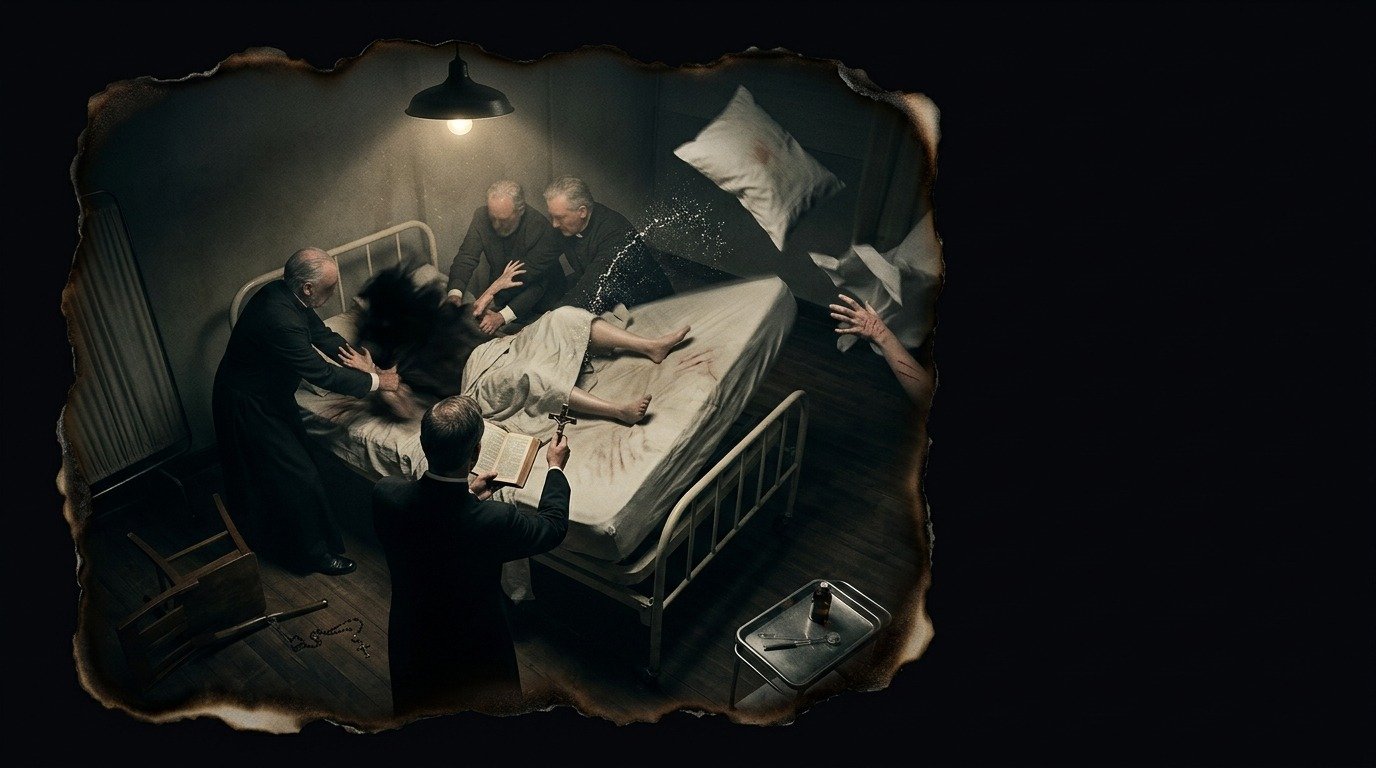
The phenomena began in January 1949, shortly after Ronald used a Ouija board under the guidance of his Aunt Harriet, a spiritualist who passed away shortly thereafter. The first signs were physical and acoustic in nature in the Maryland home: scratching noises beneath the floor and walls, constant dripping of water with no visible leaks, and objects flying or sliding in the young boy's presence. His bed mattress suffered violent vibrations and inexplicable rotations. The situation quickly escalated to physical aggression against the minor. Red marks, scratches, and deep gashes began to appear on his skin, forming legible words such as "St. Louis" or "3 weeks," pointing to the destination where the family needed to travel to seek help. Faced with the failure of local doctors and psychiatrists, the family turned to the Catholic Church in St. Louis. The archbishop authorized the formal exorcism under the *Rituale Romanum*. The process lasted more than two months and required over thirty individual exorcism sessions. During the rites, Ronald exhibited extreme physical strength that required several men to hold him down, spoke in Latin with a distorted, guttural voice, spat with precision at the priests' faces, and reacted violently to religious symbols and holy water. In one violent episode, the youth managed to free a hand and assault Father Hughes with a bedspring, causing a wound that required stitches. The final and successful exorcism occurred on April 18, 1949 (Easter Monday) at the Alexian Hospital. After an intense confrontation in which the youth claimed to be the Archangel Michael fighting the entities, Ronald uttered the word "go" directed at the presence, and the minor's body relaxed for good. The phenomena ceased completely from that moment on.
The Investigation
The primary historical source of this case is the detailed diary written by Father Raymond J. Bishop during the course of the exorcism, where he recorded day-by-day the physical phenomena, Ronald's reactions, and the prayers used. This document remained classified in the Archdiocese archives until it was retrieved and analyzed by journalists and historians. Subsequent rational analyses and skeptical investigations propose that Ronald Hunkeler suffered from a combination of severe psychological disorders, possibly childhood schizophrenia, obsessive-compulsive disorder, or a profound hysteria triggered by grief following the death of his Aunt Harriet. Researchers point out that the words on his skin could have been caused by dermatographia (skin writing caused by physical pressure from the minor himself) and that his knowledge of Latin was limited to mimicking the liturgical phrases repeated by the priests during the long sessions of the rite.
The Legacy
This case redefined the modern perception of exorcism and possession in Western culture. Ronald Hunkeler grew up, changed his identity, worked as an engineer for NASA, and passed away from natural causes in the year 2020. The Alexian Brothers Hospital in St. Louis, where the final exorcism was performed, demolished the specific room in 1969 to prevent mystery tourism. The case remains the standard of study for contemporary Catholic demonology and the definitive example of liturgical combat against possession.
Comments
Share information, an experience, or a source to help enrich this entry. They are automatically reviewed before being published.
Loading comments...