Ouija Board
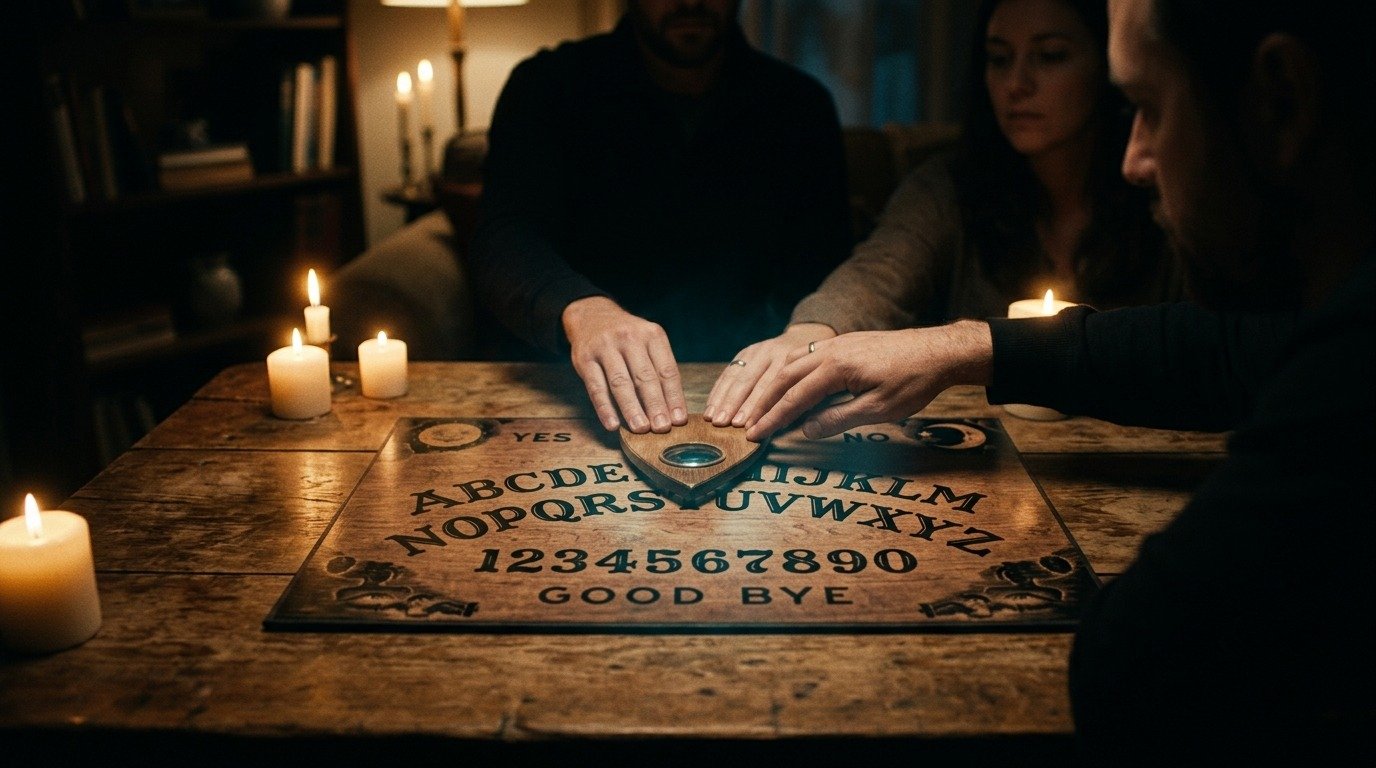
Ouija Board: The Alphabet Portal
What is the Ouija Board
The Ouija board is an instrument made of wood, cardboard, or plastic designed to establish direct contact with spirits, the deceased, or other entities of the astral plane. Its surface features the twenty-six characters of the Latin alphabet, the numbers from 0 to 9, the words "Yes", "No", "Hello", "Goodbye", and, in some designs, the symbols of the sun, the moon, and the circle of protection. For its operation, a planchette or mobile pointer with a central opening or viewfinder is required, which slides over the board to point to letters and spell out messages.
How it Manifests
The use of the Ouija begins when two or more participants lightly rest the tips of their index fingers on the planchette. After formulating a question directed at the unseen environment, the pointer begins to move across the surface of the board without any conscious motive force on the part of the operators.
The sessions show a recurring pattern: the movement begins slowly and erratically, then gains speed, fluidity, and precision. Through spelling, the entity manifests a defined personality, a particular tone of communication, and, at times, access to private information of the participants or future events. In complex sessions, the physical manifestation includes sudden drops in ambient temperature, vibration of the board, or the violent movement of the pointer beyond the limits of the wood.
History and Traditions
The Ouija does not come from mystical antiquity, but rather from the entertainment industry and the rise of nineteenth-century spiritualism in the United States. In the 1880s, families used homemade boards with letters to communicate with the deceased. Upon detecting the commercial potential of the object, businessman Elijah Bond patented the first formal design of the "talking board" on May 28, 1890.
In 1891, Charles Kennard's company began its mass sale. William Fuld, partner and subsequent owner of the firm, registered the name "Ouija" and expanded the business, claiming that the term was an Egyptian word meaning "good luck". In 1966, the toy company Parker Brothers bought the commercial rights and sold millions of units as a family board game.
Public perception changed radically after the release of the movie *The Exorcist* in 1973. From that moment on, the Ouija ceased to be considered a parlor pastime and came to be seen as a dangerous tool for contacting the lower astral plane. Western esoteric currents warn that the board acts as an energy accumulator that opens spiritual portals without safety filters, attracting low-vibration entities, trickster spirits, or obsessors who simulate false identities to manipulate the operators.
Famous Cases
* **Patience Worth and Pearl Curran (United States, 1913):** Pearl Curran, a woman without literary training from St. Louis, began using a Ouija board in her home. Through the pointer, she contacted Patience Worth, an English Puritan writer who claimed to have lived in the 17th century. For years, Worth dictated through the Ouija historical novels, complex poems, and aphorisms of such high aesthetic value that they were published by prestigious publishing houses and praised by *The New York Times* newspaper. * **The Vallecas Case (Spain, 1990):** The young Madrilenian Estefanía Gutiérrez Lázaro held a Ouija session at her high school to contact a friend's deceased boyfriend. The session was interrupted by a teacher, who broke the glass acting as a pointer. From that moment on, Estefanía began to suffer a severe physical decline, with convulsions, visual hallucinations, and fits of rage that doctors failed to diagnose. Months later, she passed away at the Gregorio Marañón Hospital in Madrid. The subsequent poltergeist activity in the family home was recorded in an official police report signed by Inspector José Negri.
What Explains the Phenomenon
The esoteric explanation holds that the Ouija operates through the contribution of vital energy or ectoplasmic fluid that the participants unconsciously project onto the pointer. Wandering or discarnate spirits use this accumulation of energy to magnetically couple with the operators' muscles and guide the movement of the planchette across the characters. Since it does not require a trained medium with protective guides, any nearby entity on the astral plane can access the session.
Science explains the functioning of the board through the ideomotor effect, a physiological phenomenon described by physician William Benjamin Carpenter in 1852. This effect consists of the execution of automatic, involuntary, and imperceptible muscular movements triggered by a conscious or unconscious expectation, desire, or mental suggestion of the subject. Participants physically move the pointer without realizing it, while the brain attributes the movement to an external force. The coherence of the answers is produced by the subconscious coordination of finger pressures from the different operators exposed to the same expectation of an answer.
Connections
The Ouija board is associated with automatic writing, poltergeist phenomena, the ideomotor effect, demonic possession, the infestation of places, and astral projection.
Comments
Share information, an experience, or a source to help enrich this entry. They are automatically reviewed before being published.
Loading comments...