Incubus
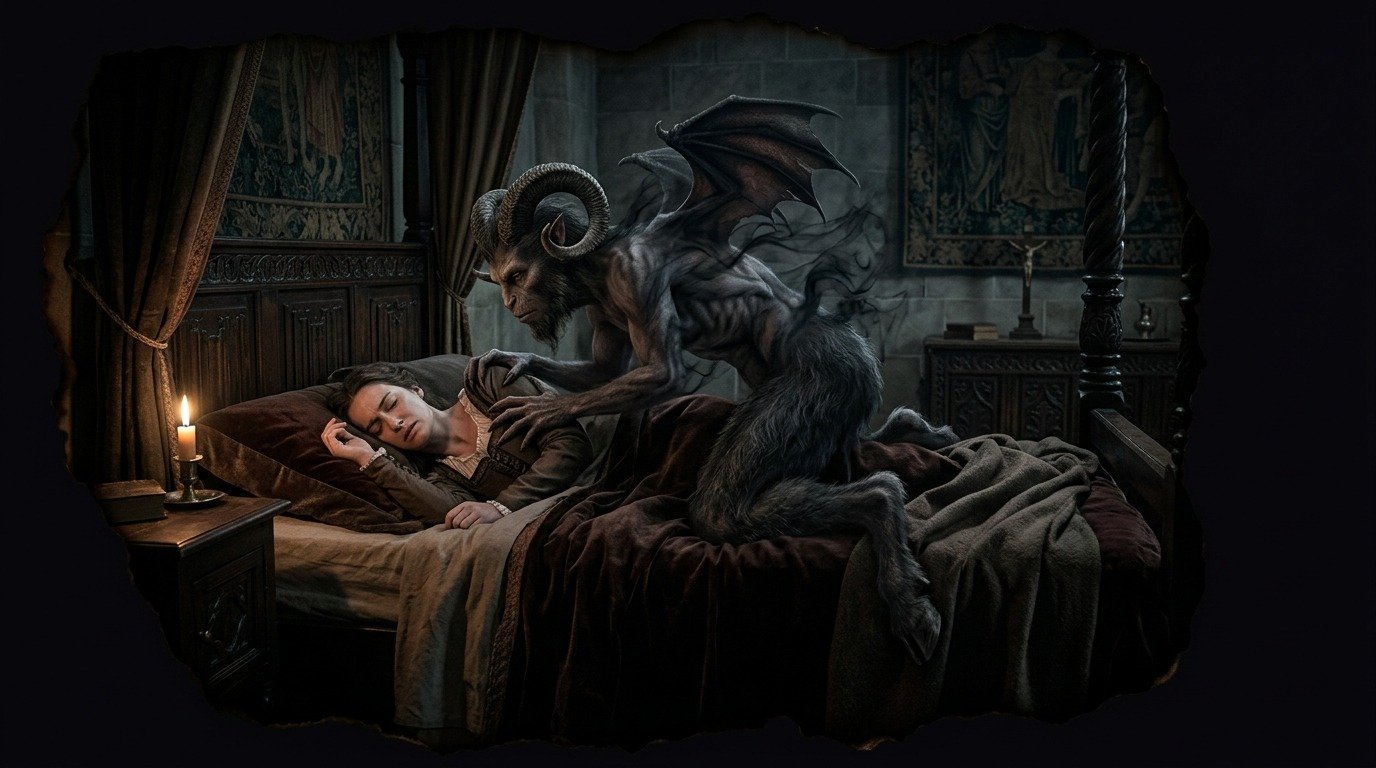
Incubus: the demon that visits women while they sleep
What is an incubus
The incubus is a male demon that, according to European tradition, lies upon sleeping women to unite with them. He arrives at night, felt as a weight upon the body, and the victim wakes up unable to move or scream, convinced that something was on top of her. His female counterpart, who visits men, is the succubus. The name comes from the Latin *incubare*, "to lie upon", and describes exactly what is attributed to him.
From the fauns of Rome to the Christian demon
The figure is older than Christianity. The Romans already spoke of forest beings, sylvans and fauns, who entered houses at night and oppressed those who slept. Saint Augustine, in *The City of God* (5th century), records that many highly credible people asserted that these sylvans and fauns, whom the common people called incubi, had united with women, and adds that to deny it seemed to him an imprudence.
The Middle Ages finished turning him into a demon. Thomas Aquinas, in the *Summa Theologiae*, explained how a bodiless being could engender: the demon took the seed of a man by acting as a succubus and deposited it in a woman by acting as an incubus. With this theory, the child was not the demon's but that of a real man, yet conceived through him.
The children of the incubus
The most famous legend is that of Merlin. Geoffrey of Monmouth, in his *History of the Kings of Britain* (around 1136), tells that Merlin's mother was a nun who received visits at night from a beautiful young man who appeared and disappeared without a trace. A wise man consulted by the king explained that it was one of those spirits that inhabit between the Moon and the Earth and that unite with women: an incubus. From this, Merlin derived his powers.
Over time, incubi were blamed for unexplained pregnancies, children born with deformities, and even entire families of "cursed blood."
The incubus and the witch hunts
The *Malleus Maleficarum* (1486), the inquisitors' manual, devotes entire chapters to incubi. For its authors, witches were not victims but accomplices: they voluntarily surrendered themselves to these demons as part of their pact. That idea fueled thousands of confessions obtained under torture in the witch trials of the 16th and 17th centuries.
The same book lists the remedies against the incubus for the woman who suffered it against her will: confession, the sign of the cross, the Hail Mary, exorcisms, and, if nothing worked, moving to another place.
A different opinion: Sinistrari
In the 17th century, the Franciscan Ludovico Maria Sinistrari wrote *De Daemonialitate*, a treatise that maintained something surprising: incubi were not demons, but rational creatures with a subtle body, born and mortal, neither angels nor men, resembling the fauns of the ancients. The book remained unpublished for nearly two centuries and was only published in 1875.
How it manifests
The accounts agree on a pattern that has been repeated for centuries:
- **The weight.** A pressure on the chest or over the entire body, as if someone were lying on top. - **The paralysis.** The victim is conscious but cannot move, speak, or call for help. - **The presence.** The certainty that someone is in the room, sometimes seen as a shadow or a figure next to the bed. - **The contact.** Physical sensations and, in many accounts, of a sexual nature. - **The fatigue.** Waking up exhausted, as if the night had stolen energy instead of giving it.
Modern medicine recognizes almost all of these elements in sleep paralysis, in which the mind wakes up before the body and the brain completes the scene with a presence. Many researchers believe that the incubus was the way the Middle Ages explained that experience. For the spiritual tradition, on the other hand, paralysis is precisely the state in which these entities can draw near.
In art
The most well-known image of the incubus is the painting *The Nightmare* (1781), by the Swiss painter Johann Heinrich Füssli: a sleeping woman, stretched out on her back, with a small demon sitting on her chest and the head of a horse peering through the curtains. The work caused a scandal in London and became the definitive portrait of nightly visits.
Comments
Share information, an experience, or a source to help enrich this entry. They are automatically reviewed before being published.
Loading comments...